
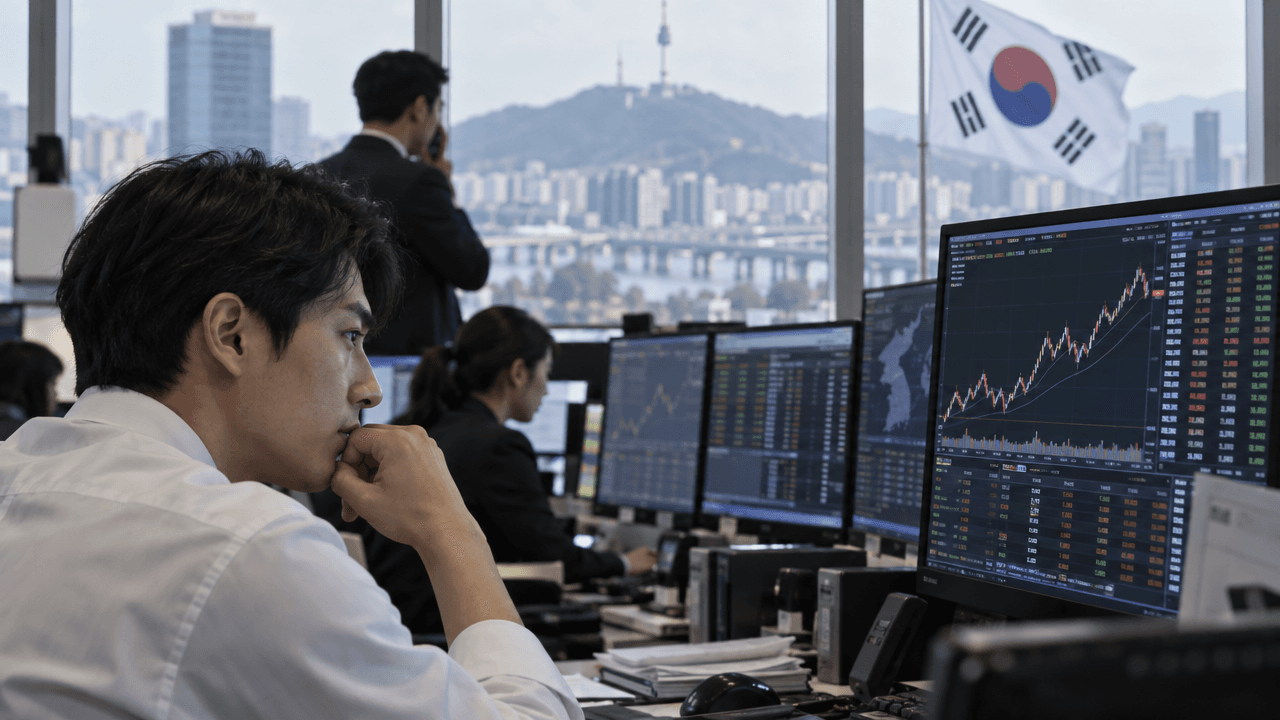
South Korean government bond futures started the day on a firmer footing, signaling cautious demand for duration even as yields remain near recent highs.[1][4] Three-year futures rose four ticks to 102.07 and 10-year contracts gained one tick to 103.36 in early trading, a modest rebound after a sharp selloff in cash bonds.[1][8]
Market Snapshot: Small Move, Big Signals
The uptick in futures comes after Korean government bond yields jumped more than 10 basis points the previous session as markets reopened following the Chuseok holiday.[1][8] Benchmark three-year and 10-year yields recently pushed above 4% and 4.5% respectively, levels not far from the highest since late 2022.[4][8]
At the same time, the entire Korean curve has shifted higher over recent months, reflecting expectations of continued policy tightness and persistent global rate volatility.[11][12] Ten-year yields are roughly 1.5 percentage points higher than a year ago, underscoring how dramatically the rate environment has reset.[4][11]
Against that backdrop, even a small rise in futures prices suggests that some market participants view the previous day’s selloff as excessive and are willing to add exposure to government debt at higher yield levels.[1][8] For traders, the key takeaway is that demand for duration has not disappeared; it is becoming more tactical and price-sensitive.
Why Bond Futures Are Edging Higher
Bond futures reflect expectations about the path of interest rates and the price of underlying government bonds, making them a convenient way to express macro views with leverage and relatively low capital outlay.[1][13] When futures prices rise, implied yields fall, signaling investors are slightly more optimistic on bonds or more cautious on future rate hikes.[4][13]
Today’s move in Korean futures is modest in size—just a few ticks—but meaningful in context.[1] After a day where cash yields spiked double digits, a higher futures open indicates that some investors see value at these elevated yield levels rather than expecting another immediate leg higher.[1][8]
Global factors are also at play. Korean yields have been tracking a broader global bond selloff, driven by resilient inflation and expectations that major central banks will keep rates restrictive for longer.[4][11] If global yields stabilize or retrace, local futures can become an attractive way to position for a normalization in volatility while limiting balance sheet usage.
Reading The Move: What It Signals About Risk Sentiment
The combination of high absolute yields and slightly stronger futures tells a nuanced story about risk sentiment. On one hand, the steep rise in yields over the past year reflects tighter financial conditions and higher term premia across the curve.[4][11] On the other, today’s futures bounce suggests investors are not indiscriminately selling duration.
In practice, this kind of price action often signals that macro traders and asset managers are reassessing their rate views, shifting from outright bearish positions to more balanced or range-trading strategies.[1][8] Short-covering in futures after a rapid selloff is common, especially when yields move into historically attractive territory for long-term buyers.[4][13]
For equity and FX traders, the move in bond futures matters because government yields anchor discount rates and risk premia across asset classes.[4][11] A stabilization in bond futures can reduce cross-asset volatility, supporting more orderly price action in stocks, credit, and currencies linked to the Korean economy.
Implications For Traders And Simulated Finance Users
For traders working within a SimFi environment like E8 Markets, Korean government bond futures offer a rich case study in how macro themes translate into price action.[1][4] The sequence—holiday closure, sharp yield spike, then a modest futures rebound—illustrates how liquidity, positioning, and news flow interact in real time.[8][11]
This is an ideal setting to practice
1) Interpreting tick moves in futures relative to basis-point shifts in cash yields.[1][4] 2) Building scenarios around central bank expectations, inflation trends, and global risk sentiment.[4][11] 3) Testing strategies that differentiate between trend moves and short-term overshoots, such as mean-reversion trades after large one-day yield jumps.[8][13]
Because simulated environments remove real capital risk, traders can experiment with position sizing, leverage, and risk management around events like holiday re-openings and sudden repricings in bond curves.[8][11] The Korean market’s recent volatility provides ample data to refine playbooks for both breakout and reversal conditions.
Practical Takeaways For Your Playbook
Several practical lessons emerge from the latest move in South Korean government bond futures:
First, context matters more than the absolute size of a move. A four-tick rally might seem small, but following a double-digit basis-point spike in yields, it can mark a turning point in sentiment or at least a pause in the selloff.[1][8]
Second, watch both futures and cash yields. Divergences between the two often reveal positioning shifts—such as futures buyers stepping in ahead of cash demand—or hint at flows from hedgers versus speculators.[4][13] Simulated trading is a powerful way to learn how these relationships behave under stress.
Third, elevated yields can attract value-oriented buyers, even in a higher-for-longer rate regime.[4][11] When term yields move to multi-year highs, the risk-reward for adding duration improves for some investors, and futures are often the first place that renewed demand shows up.
Finally, macro trades are rarely about a single headline. The Korean bond story is part of a wider narrative involving global inflation, central bank policy paths, and term premium repricing.[4][11] Building structured scenarios in a SimFi environment helps convert those narratives into coherent trading strategies rather than reactive, headline-driven decisions.
Conclusion: Small Ticks, Big Learning Opportunity
South Korean government bond futures opening higher may not be a blockbuster headline, but it is a revealing signal in a market grappling with elevated yields and shifting expectations.[1][4] The price action underscores that even after sharp selloffs, demand for high-quality government debt can re-emerge quickly as investors reassess value and risk.[1][8]
For traders—especially those honing their skills in simulated markets—the move offers a timely reminder to focus on context, cross-market relationships, and scenario planning rather than raw price changes alone.[4][11] Using events like this as a live case study can significantly improve macro awareness, risk discipline, and the ability to turn complex bond market dynamics into structured, testable strategies.