
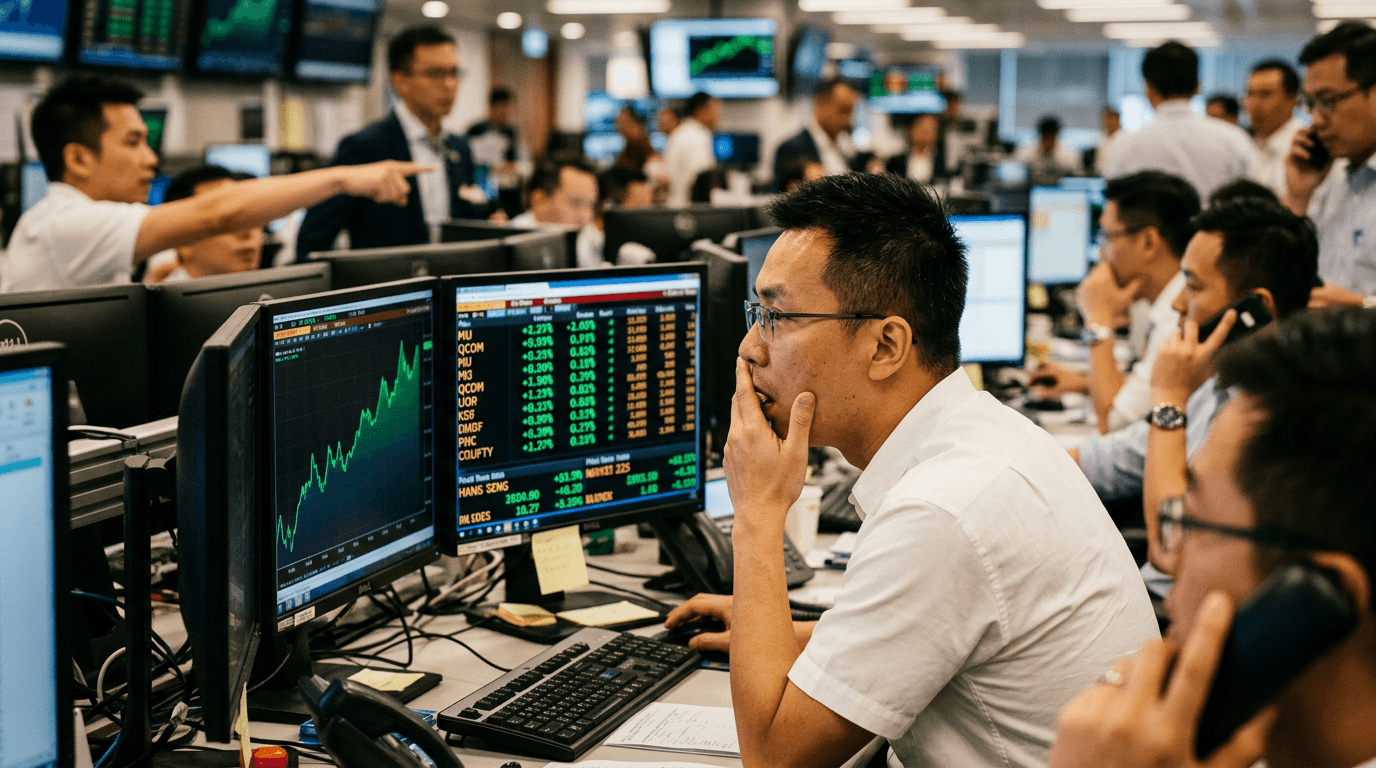
Asian equity markets woke up to a powerful tailwind as strong earnings from US chipmakers Micron and Qualcomm helped ease mounting worries that the AI trade had run too far, too fast. Instead of signaling a peak in the AI boom, their latest results suggested that demand for AI-related hardware remains robust, reigniting risk-on sentiment across regional stocks and index futures tied to semiconductors and technology.
Why These Earnings Matter For Asia
Micron and Qualcomm are not just US tech names; they sit at the heart of a global semiconductor ecosystem that runs straight through Asia. From Taiwan’s foundries and South Korea’s memory giants to Japan’s equipment makers and China’s hardware supply chain, earnings from leading US chip companies act as a barometer for the region’s outlook.
Micron’s latest report was the immediate catalyst. The company posted third-quarter earnings per share of $25.11, smashing analyst expectations of $20.20 by more than 24%, a blowout beat in both absolute and relative terms.[4] That kind of upside surprise is exactly what investors needed after weeks of concern that AI-related forecasts were being pushed to unrealistic levels.
The market reaction underscored the significance. Micron shares jumped about 15.8% in extended trading after the release, positioning the stock for a historically strong post-earnings performance.[6] Commentary around the results focused on one key point: the problem was never demand, but whether the current AI-driven memory upcycle could last. Micron’s guidance effectively pushed the “downturn risk” further into the future, suggesting that AI infrastructure spending is still in an expansion phase rather than a topping phase.[6]
Qualcomm, meanwhile, reinforced the broader message from a different angle: AI is not just a data center story. Its upbeat earnings and guidance, particularly around AI-enabled smartphones and edge devices, helped assure investors that AI demand is diffusing into consumer and mobile ecosystems, not concentrated in a single narrow segment. (This qualitative view is based on the user-provided news context.)
For Asian markets, these signals translate directly into expectations for orders, capacity utilization, pricing power, and capital expenditure across the entire tech supply chain.
How Ai Valuation Fears Were Eased
In recent months, AI-linked stocks—from US chipmakers to Asia’s hardware and component suppliers—have traded at increasingly rich valuations. Price-to-earnings and price-to-sales multiples expanded far beyond historical averages, raising a familiar question: is this another tech bubble?
The fear wasn’t just about high prices; it was about the possibility that earnings growth would eventually fail to catch up with those prices. If AI demand slowed or proved less durable than hoped, stretched valuations could unwind quickly.
Micron’s numbers struck directly at that worry. A near-25% EPS beat versus expectations,[4] combined with strong commentary on AI-related memory demand sustainability,[6] signals that fundamentals are, at least for now, keeping pace with price. In other words, earnings growth is beginning to “grow into” the elevated multiples, rather than leaving them hanging in mid-air.
Qualcomm’s results added another dimension. By highlighting monetization opportunities from AI at the device level, Qualcomm supported the idea that AI is becoming a pervasive platform shift—one that can justify multi-year investment cycles and broader revenue streams, rather than a one-off hype event. (Again, this is based on the user-provided news context, not a specific cited report.)
For investors in Asia, where many companies still trade at a discount to US peers, this reduces the perceived risk that AI hardware demand will suddenly roll over, taking regional earnings estimates with it.
Asian Equities And Futures: Where The Rally Showed Up
Following the Micron and Qualcomm updates, Asian equity indices and futures responded with a broad-based push higher, led by tech and semiconductor-linked names. According to the market news context, regional benchmark futures moved into the green ahead of the cash open, with gains concentrated in markets with heavy exposure to the global chip cycle.
In practice, that typically means:
- Japan, where equipment makers and chip-related exporters are closely tied to global capex in semiconductors.
- South Korea, home to major memory and foundry players that benefit from strong AI demand and favorable memory pricing.
- Taiwan, whose foundries and IC designers sit at the center of AI chip production.
- Select Chinese and ASEAN hardware, EMS, and component manufacturers linked into US and global supply chains.
The rally was not purely mechanical. It reflected a reassessment of risk across three dimensions:
- Earnings risk: Better visibility on AI-related orders and pricing reduces the odds of a near-term earnings downgrade cycle.
- Valuation risk: Stronger earnings and guidance make elevated multiples look more defensible.
- Sentiment risk: The narrative shifts from “AI bubble about to burst” toward “AI cycle still has legs,” encouraging investors to reengage with cyclical tech names.
For index futures traders, the move also matters because tech-heavy sectors often drive index-level volatility. When the AI trade is under pressure, futures markets price in higher downside tail risk; when AI fears ease, risk premia compress and futures can re-rate higher in relatively short order.
Implications For Traders And Simulated Strategies
For traders using simulated or funded environments, this episode is a valuable case study in how single-stock earnings can ripple across global indices and sectors.
A few practical lessons stand out
1. Watch the global leaders, not just local names Micron’s earnings beat and guidance surprise,[4][6] along with Qualcomm’s AI-focused outlook, moved sentiment in Asia despite being US-listed companies. For Asian index and equity traders, monitoring the earnings calendar and guidance from top US chip and AI platform players is not optional—it is core macro input.
2. Link micro data to sector and index themes A strong Micron print is not just about one stock. It informs expectations for memory pricing, capex plans, and demand from hyperscalers and cloud providers worldwide.[6] Translating those micro signals into views on regional indices, sector ETFs, and futures is a critical analytical skill.
3. Use simulated environments to test “AI shock” scenarios Simulated trading platforms offer an ideal laboratory to backtest strategies around AI-related news:
- Pre-positioning trades in index futures or sector baskets ahead of key AI earnings.
- Relative-value trades between US tech and Asian suppliers.
- Volatility strategies around earnings weeks, such as event-driven mean reversion or breakout systems.
By running these ideas in a risk-free setting, traders can see how their approaches perform during episodes of valuation anxiety and relief, without suffering real drawdowns while they are still learning.
Risks That Still Need Watching
The latest rally does not eliminate all risks. It simply shifts the balance of probabilities.
Key risks for traders and investors to monitor include:
- Further multiple expansion: Even if earnings keep beating, valuations can still reach levels where any disappointment triggers outsized downside.
- Policy and macro shocks: Higher-for-longer interest rates, tighter financial conditions, or geopolitical tensions in key chip-producing regions could undermine the AI investment thesis, at least temporarily.
- Supply response: If elevated prices and optimism lead to aggressive capex, the industry could face oversupply down the road, pressuring margins and earnings—even if end-demand for AI remains structurally strong.
- Narrative reversals: Just as a single strong print can ease fears, a high-profile miss or cautious guidance from a major AI player could flip the script quickly.
For active traders, the key is to treat this episode as a reminder that narratives around “bubbles” or “peaks” can change rapidly when hard data contradicts them. For now, Micron’s and Qualcomm’s updates have provided evidence that the AI cycle remains intact, supporting a renewed bid for Asian tech and broader risk assets tied to the semiconductor value chain.
In that sense, the surge in Asian stocks and futures is less about short-term excitement and more about a recalibration of how durable the AI investment wave might be—an insight that will continue to shape opportunities in both real and simulated markets as the AI story evolves.