
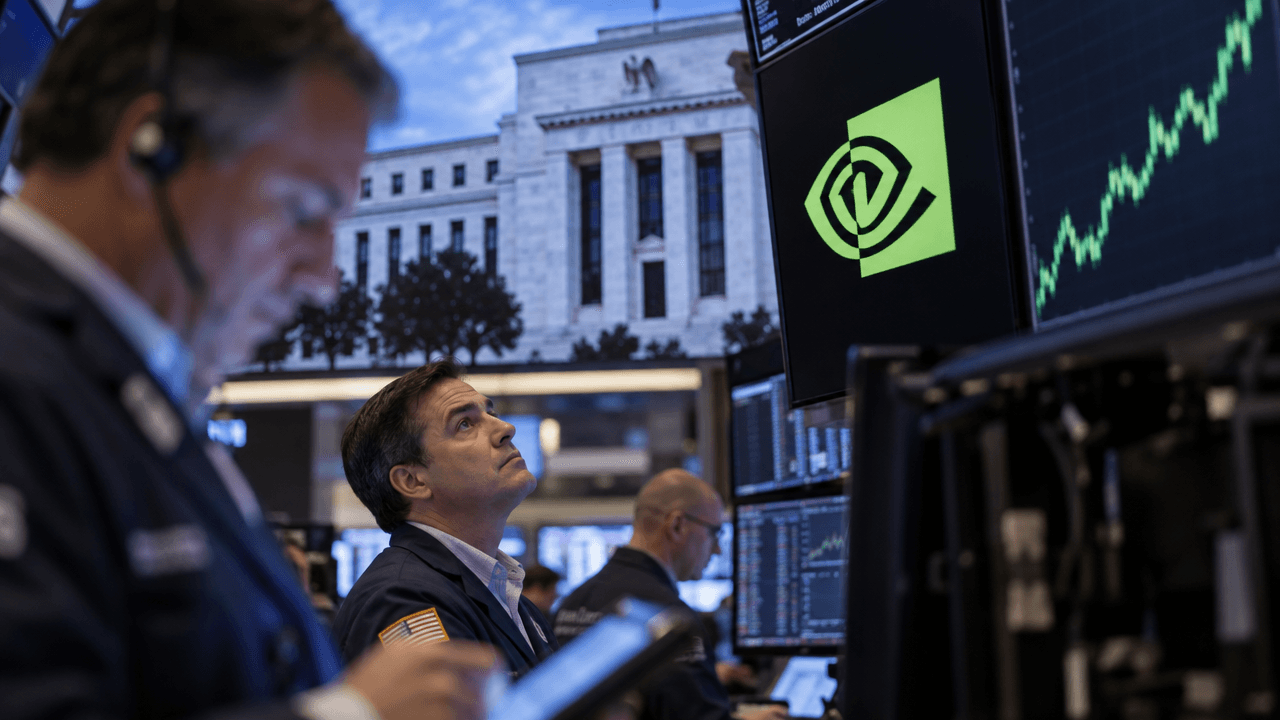
US index futures rebounded in early Asian trading as investors looked beyond recent volatility and turned their attention to two major catalysts: Nvidia’s upcoming earnings report and the Federal Reserve’s latest meeting minutes. Nasdaq 100 futures rose 0.5%, while S&P 500 futures gained 0.2%, signaling a cautious improvement in risk appetite after pressure on growth stocks.
The rebound does not necessarily mean markets have regained confidence. Instead, it reflects a pause as traders assess whether the artificial intelligence investment boom can continue supporting elevated technology valuations and whether the Federal Reserve is moving closer to a more accommodative interest-rate stance.
For traders, the week presents a useful reminder: futures markets often react first to expectations, while the larger price move comes when actual results either confirm or challenge those expectations.
The Two Events Driving Market Attention
Nvidia is scheduled to release its third-quarter fiscal 2027 results on Tuesday, November 17, after the US market closes. The company’s investor-relations calendar confirms the earnings event for 5:00 p.m. Eastern Time. [3]
Nvidia has become one of the most important companies in the global equity market because its chips and related systems are central to the expansion of artificial intelligence infrastructure. Its earnings can influence not only the Nasdaq 100 but also semiconductor stocks, cloud-computing companies and the broader S&P 500.
The key question is no longer simply whether Nvidia can beat analyst estimates. Investors will also examine the quality and durability of demand. Important areas include data-center revenue, the pace of new product shipments, customer spending plans and management’s outlook for future growth.
Even a strong earnings report could produce a muted or negative reaction if expectations are already extremely high. Conversely, a result that appears merely solid may support stocks if it reduces fears that AI-related spending is slowing.
The second major event is the release of the minutes from the Federal Reserve’s October 27-28 meeting, scheduled for November 18. [1] The minutes provide more detail than the official policy statement, including how policymakers viewed inflation, employment, economic growth and the risks surrounding future rate decisions.
What The Fed Minutes Could Signal
Interest rates remain a central variable for equity valuations. When bond yields rise, future corporate earnings become less valuable when discounted back to the present. High-growth technology stocks are particularly sensitive because much of their expected value may come from earnings projected years into the future.
Traders will therefore examine the minutes for evidence of disagreement among policymakers. A discussion emphasizing persistent inflation could push Treasury yields higher and pressure growth stocks. On the other hand, concern about slowing economic activity or a weakening labor market could strengthen expectations for future rate reductions.
The wording will matter. References to “restrictive” policy, financial conditions or downside risks may influence rate-sensitive assets even if the minutes contain no new decision. Markets will also compare the minutes with recent economic data and Federal Reserve speeches to determine whether the central bank’s stance is shifting.
Importantly, the minutes describe the discussion at a previous meeting. They are not a guarantee of future policy. Traders should avoid treating a single sentence as a definitive signal and instead evaluate the document alongside inflation readings, employment data and Treasury-market pricing.
Why The Futures Rebound Matters
The early gains in Nasdaq 100 and S&P 500 futures suggest investors are willing to add exposure before the two catalysts arrive. However, futures movement is not the same as a confirmed trend reversal.
Overnight markets can be affected by thinner liquidity, positioning and headline-driven trading. A 0.5% rise in Nasdaq 100 futures may indicate improved sentiment, but it does not reveal whether buyers will remain active when the cash market opens or when Nvidia reports.
The rebound may also reflect short covering. Traders who had bet on further declines may close those positions before a major earnings event, creating upward pressure without representing broad, long-term buying.
Market participants should watch whether the advance is accompanied by stronger breadth. If only a small group of mega-cap technology stocks rises, the move may be fragile. A broader rally involving industrials, financials, small-cap shares and economically sensitive sectors would provide stronger evidence that risk appetite is improving across the market.
Practical Takeaways For Simfi Traders
First, define the event risk before entering a position. Nvidia’s report could produce sharp moves in technology indexes, particularly outside regular trading hours. Traders should know in advance where a position will be reduced, closed or protected if volatility expands.
Second, separate direction from volatility. A market can rise while implied or realized volatility remains elevated. A bullish bias does not eliminate the risk of rapid reversals, especially when expectations are concentrated around one company.
Third, monitor confirmation rather than chasing the first move. After the earnings release, compare Nvidia’s headline results with its forward guidance and price reaction. A gap higher that quickly fades may signal profit-taking or disappointment beneath the surface.
Fourth, use the Fed minutes as a framework rather than a standalone trading signal. Look for changes in the market’s expectations for interest rates, then compare those changes with Treasury yields and equity-sector performance.
SimFi traders can use this environment to practice event-driven discipline without exposing real capital. A useful exercise is to record the expected market reaction before each event, define a maximum acceptable loss and review whether the actual response followed the forecast.
The Bigger Market Picture
The futures rebound shows that investors remain willing to buy equities, but it also highlights how dependent sentiment has become on a narrow group of high-impact events. Nvidia represents the earnings side of the equation, while the Fed minutes represent the monetary-policy side.
Together, they may determine whether the recent improvement develops into a broader recovery or fades into another volatile trading session. The most effective approach is not to predict every short-term move. It is to identify the information that can change the market narrative, plan for multiple outcomes and manage risk when uncertainty is highest.
For now, traders are watching two questions: Can Nvidia provide fresh evidence that AI demand remains powerful, and will the Federal Reserve minutes support or challenge expectations for interest rates? The answers could set the tone for technology stocks and the broader US market through the rest of the week.