
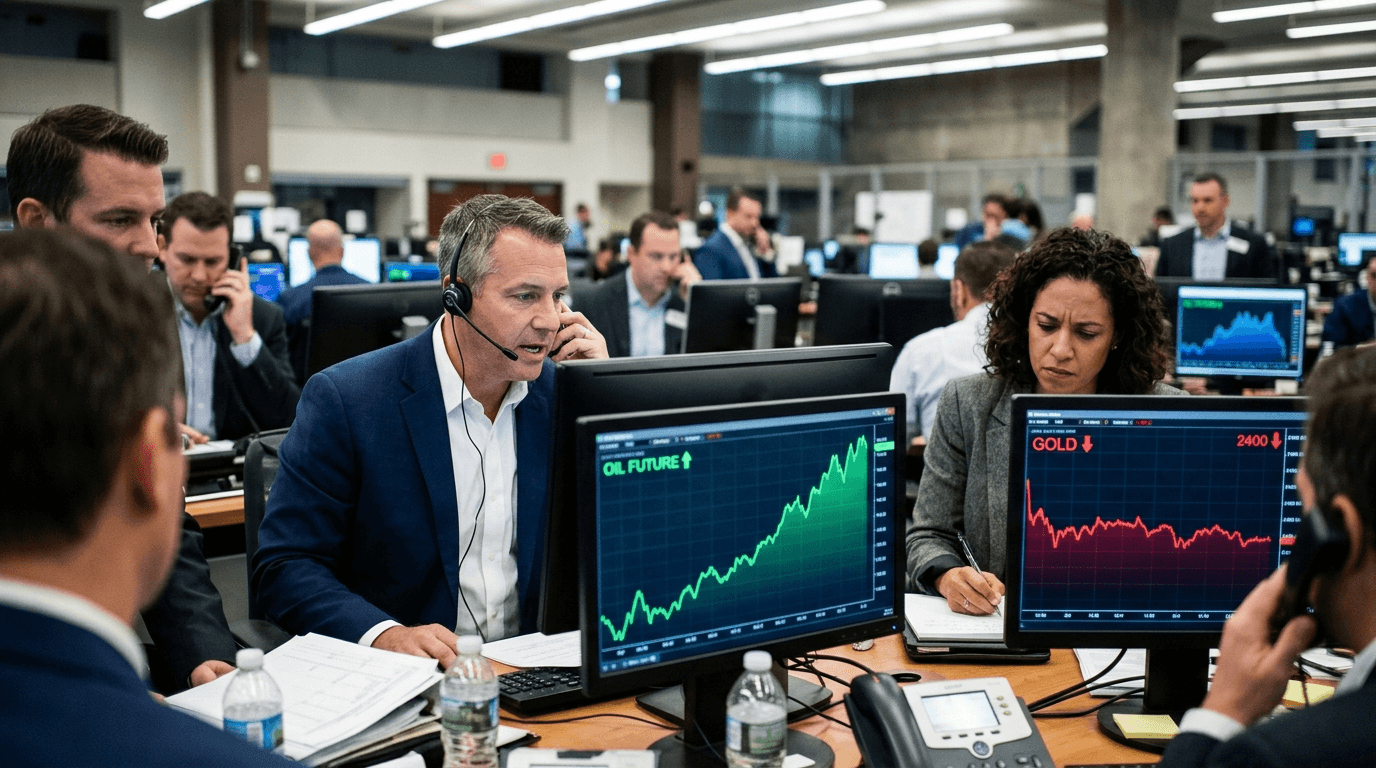
Oil and gold are sending mixed signals, with crude prices grinding higher on renewed Middle East tensions while bullion struggles to hold firm near the $4,400 mark. This divergence is reshaping risk dynamics across commodities and futures, forcing traders to reassess how they hedge inflation, geopolitical risk, and portfolio volatility in the months ahead.
Market Snapshot: Oil Up, Gold Soft
West Texas Intermediate (WTI) crude has pushed to multi‑day highs in the mid‑$80s per barrel, extending a recent upswing as markets price in persistent supply risks tied to the Middle East conflict[1][3][11]. Brent, the global benchmark, has been trading near or above $90 on average this year, compared with roughly $70 last year, underlining a structurally tighter energy market backdrop[6]. Against that, gold has come under pressure near $4,400 per ounce, briefly dipping below that level before staging a modest rebound as investors weigh profit‑taking against lingering macro uncertainty.
For traders, this combination—rising energy prices and a consolidating gold market—signals a shift in how capital is allocated across the commodity complex. Oil is once again behaving like a classic geopolitical risk proxy, while gold is trading more in line with real rates, currency moves, and positioning dynamics than with headline anxiety alone.
Why Middle East Tensions Keep Oil Bid
The key driver behind oil’s resilience is the intersection of war risk and physical supply disruption. Regional hostilities have slowed or threatened traffic through the Strait of Hormuz, a critical chokepoint for global oil shipments, producing what major energy bodies describe as the largest oil supply disruption in history[5][8][15]. Episodes of US‑Iran flare‑ups, missile attacks, and direct threats against tankers have repeatedly triggered 2–3% daily gains in crude futures as traders scramble to price in potential export losses[7][11][12].
This is not just about temporary price spikes. A prolonged reduction in Middle Eastern output and transit can tighten balances by several million barrels per day, forcing refiners to seek alternative cargoes at higher cost[5][8]. As a result, front‑month futures stay elevated, calendar spreads can widen in backwardation, and energy‑sensitive sectors—from airlines to petrochemicals—face a higher and more volatile input cost base[10]. For macro traders, sustained high oil prices feed into inflation expectations and central bank reaction functions, raising the importance of energy futures as a hedge or speculative instrument.
Gold Under Pressure Despite Elevated Levels
Gold’s struggle near $4,400, despite ongoing geopolitical stress, highlights how the metal’s price action increasingly reflects macro mechanics rather than headlines alone. When real yields rise, or when the US dollar strengthens, the opportunity cost of holding non‑yielding assets like gold increases, often triggering de‑risking or rotation into income‑producing securities. At elevated price levels, even modest shifts in rates or FX can unleash profit‑taking from leveraged positions and systematic strategies.
In addition, some investors appear to be using gold rallies to rebalance toward other “risk‑off” instruments such as short‑duration government bonds or volatility products, dampening follow‑through on upside moves. For futures traders, this environment rewards tactical rather than purely directional approaches: fading overextensions, trading around support and resistance zones near the $4,400 area, and watching how positioning data and options skews evolve around key macro releases.
Implications For Commodity And Futures Traders
The divergence between oil strength and gold softness creates a different set of opportunities depending on a trader’s horizon and risk appetite. Short‑term, crude futures may remain sensitive to headlines about shipping lanes, ceasefire talks, and sanctions, with intraday ranges expanding on new developments[7][11]. Longer‑term, the prospect of structurally tighter supplies keeps the bull case alive, especially if demand holds up and alternative production fails to fully offset Middle East losses[5][8][15].
For gold, the key is context. Near $4,400, every move in real yields, inflation data, and central bank guidance can shift expectations about the metal’s role in portfolios. Traders who treat gold purely as a crisis hedge risk being whipsawed if macro fundamentals point in the opposite direction. Instead, blending geopolitical analysis with rate and FX tracking is essential—using gold futures not only as a hedge but as a relative‑value instrument against other safe assets.
Practical takeaways for active traders include
1) Monitor energy headlines as potential triggers for oil volatility, especially around Hormuz transit, sanctions updates, and military escalations[7][11][12]. 2) Track real yields and the dollar index alongside gold levels to better anticipate when rallies are likely to stall or extend. 3) Use spread trades—such as long oil/short gold or vice versa—to express views on relative performance, rather than only outright direction. 4) Integrate scenario analysis into risk management, asking how portfolios behave if oil spikes another 10–15% or if gold breaks decisively below $4,400.
How Simulated Finance Can Help Navigate Volatility
In an environment where a headline can move oil several dollars and push gold through key psychological levels, practicing in a simulated setting becomes especially valuable. On a SimFi platform like E8 Markets, traders can build and test strategies in real market conditions—tracking live futures prices, margin requirements, and P&L swings—without putting capital at risk.
This allows newer participants to learn how crude and gold futures respond to macro catalysts, while experienced traders can stress‑test complex portfolios, options structures, and cross‑commodity spreads. For example, a trader might simulate:
- A strategy that buys dips in WTI during temporary de‑escalations, with tight risk controls when conflict headlines return.
- A range‑trading approach in gold around $4,400, using clear stop‑losses and profit targets based on historical volatility.
- A macro hedge that combines long energy exposure with tactical gold shorts when real yields are rising and inflation data is cooling.
By iterating in a simulated environment, traders refine execution discipline, sizing, and scenario planning—skills that matter just as much as directional calls when markets are driven by geopolitics and macro cross‑currents.
Conclusion
Oil’s grind higher on Middle East tensions and gold’s hesitation near $4,400 capture a broader message: not all “risk assets” react the same way to the same shock. Crude is pricing in physical disruption and supply scarcity, while bullion is negotiating a tug‑of‑war between fear, rates, and profit‑taking. For commodity and futures traders, the opportunity lies in understanding those distinct drivers, aligning strategies with the underlying mechanics, and rehearsing responses before the next volatility spike.
In a world where energy flows and safe‑haven demand can shift overnight, combining informed analysis with simulated practice offers a powerful edge. It helps traders move beyond reacting to headlines and toward systematically navigating the complex relationship between oil, gold, and the global macro landscape.