
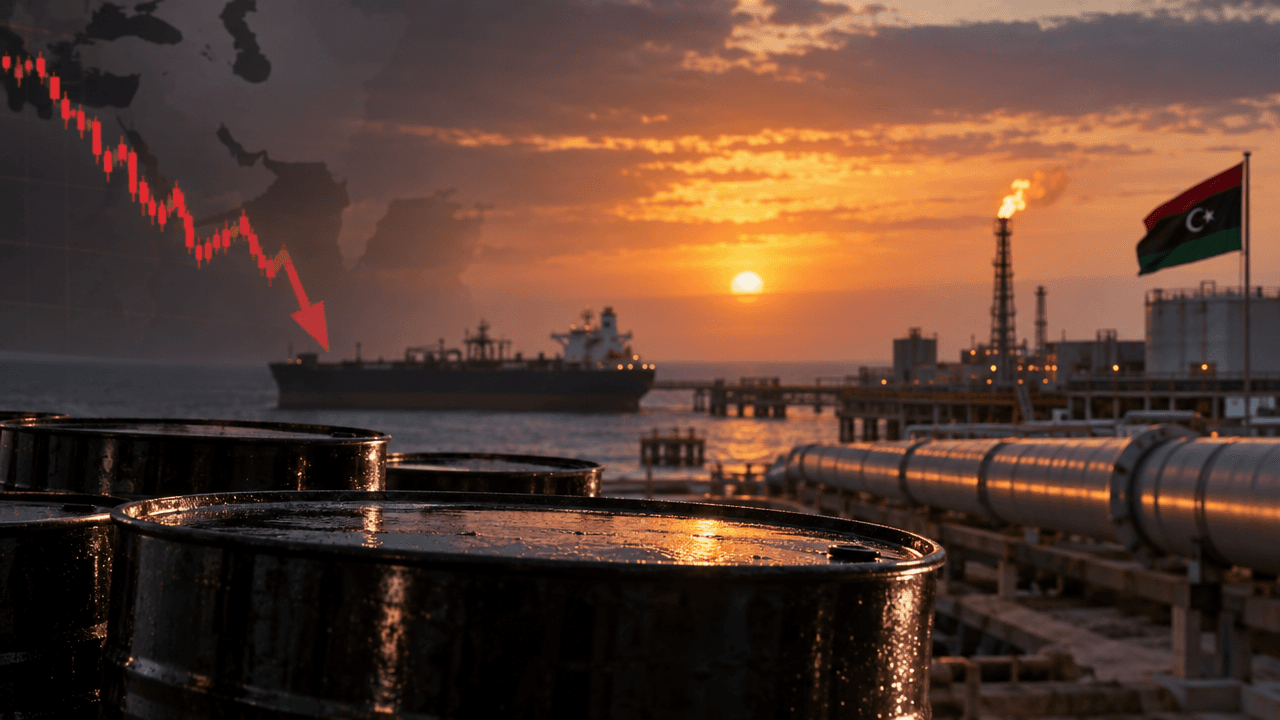
Oil futures dropped more than 3% as traders shifted their attention from geopolitical risks to a more immediate concern: rising supply. Brent crude settled down $3.20, or 3.46%, at $89.37 a barrel, while U.S. West Texas Intermediate fell $3.24, or 3.88%, to $80.17. Both benchmarks reached three-month lows as additional Middle East production and the restart of Libya’s Sharara pipeline outweighed concerns about attacks on regional shipping and refineries. [1]
Supply Pressure Takes Center Stage
The decline reflects a change in the market’s priorities. Oil prices had been supported by fears that conflict in the Middle East could disrupt production, exports, or transportation through critical routes. However, increased flows from the region have reassured traders that available barrels may be sufficient to meet near-term demand.
Libya added to that supply pressure when its Sharara oil pipeline reopened. The pipeline carries crude toward storage facilities at Zawiya, and Libya’s National Oil Corporation said oil had begun flowing again. The closure had threatened to remove approximately 350,000 barrels per day from production, making the restart a meaningful development for supply expectations. [3]
In futures markets, prices respond not only to barrels already available but also to expectations about future availability. The return of Libyan flows reduces the likelihood of a prolonged supply interruption and encourages sellers to reassess the risk premium previously built into crude prices.
Geopolitical Risk Has Not Disappeared
The sell-off does not mean geopolitical risk is irrelevant. Reports of attacks involving regional shipping and refineries continue to create uncertainty, particularly around the safety of energy infrastructure and transport through the Strait of Hormuz.
That uncertainty has helped prevent an even sharper collapse in prices. Traders are balancing two opposing forces: the possibility of further disruptions against evidence that supply outside the most affected areas is increasing. When fresh supply data becomes more convincing, the risk premium can unwind quickly, even while security concerns remain.
This is an important lesson for traders. A market can fall during a conflict if production and export flows remain resilient. Headlines about military activity may be dramatic, but crude prices ultimately depend on whether those events materially change the balance between supply and demand.
What The Price Move Signals
Brent’s close at its lowest level since August 31 and WTI’s lowest close since August 10 show that the market is developing a bearish technical tone. Oil also recorded a third consecutive weekly decline, with supply-side pressure becoming the dominant theme. [1][4]
For traders, a move of roughly 3.5% to 4% in major crude benchmarks is large enough to affect risk management across energy markets. Producers may face pressure on expected revenue, while airlines, transport companies, and other fuel consumers could benefit if lower prices persist.
The move also highlights the difference between headline risk and market pricing. Even though shipping and refinery attacks could support crude, traders may be more focused on whether global inventories are building and whether additional production is returning. If supply continues to exceed consumption, rallies may attract sellers rather than trigger sustained momentum.
Longer-term forecasts reinforce that concern. JPMorgan expects persistent oversupply to push Brent prices into the high-$70s during the first half of 2027, citing higher Middle East production and growing supply from the Americas, led by the United States. [6]
Why Other Assets Matter
Oil’s decline stood out because it occurred alongside strength in equities and gold. That combination suggests the session was not simply a broad-based liquidation of risk assets. Instead, investors appeared to be distinguishing between asset-specific fundamentals.
Equities can rise when investors expect economic resilience or improved corporate earnings. Gold can gain when traders seek protection from geopolitical or macroeconomic uncertainty. Oil, meanwhile, can fall when those same geopolitical concerns fail to reduce actual supply and demand expectations.
This divergence is useful when analyzing markets. Correlations that seem reliable during one phase can break down quickly. A geopolitical event may lift gold because of safe-haven demand, while simultaneously weighing on oil if the market believes production and transportation will remain intact.
Practical Takeaways For Traders
First, watch physical supply indicators rather than relying only on political headlines. Pipeline restarts, export volumes, inventory reports, and refinery operations can provide a clearer picture of crude’s underlying direction.
Second, treat sharp percentage moves as a risk-management signal. A 3% to 4% daily move can rapidly increase volatility in energy-linked currencies, equities, and commodities. Traders should review position size, stop placement, and exposure to overnight gaps.
Third, monitor whether WTI holds the $80 area and whether Brent can stabilize near $90. These levels are not guarantees of support, but they are psychologically important reference points. A sustained break lower could encourage further selling, while a rebound would suggest that traders are rebuilding a geopolitical risk premium.
Finally, avoid assuming that one pipeline restart settles the broader outlook. Libya’s production has historically been vulnerable to operational and political disruptions. The immediate bearish impact may fade if supply is interrupted again or if regional attacks begin to affect exports more directly.
Conclusion
The latest oil sell-off shows how quickly crude markets can shift from fear of disruption to concern about oversupply. Rising Middle East flows and the reopening of Libya’s Sharara pipeline gave traders tangible evidence that additional barrels may reach the market, outweighing unresolved geopolitical risks.
For SimFi traders, the key takeaway is to follow the balance between actual supply conditions and anticipated demand. Oil prices are shaped by both headlines and physical market data, but durable trends usually emerge when expectations about production, inventories, and consumption begin moving in the same direction.