
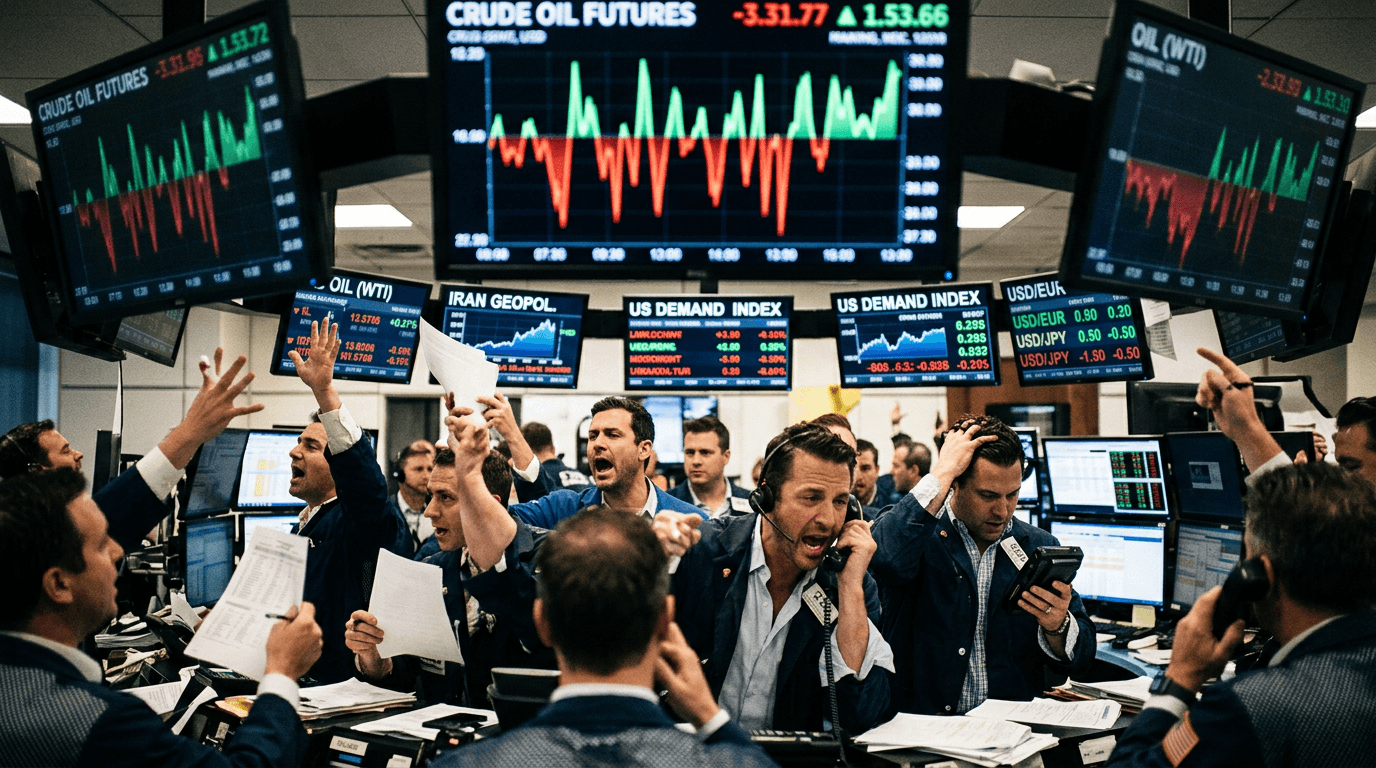
Oil futures have been thrown into a classic “risk-on, risk-off” tug of war, lurching higher on conflict headlines and then giving back gains on signs of diplomatic progress and softer demand expectations.[1][2] That push-and-pull has left intraday charts looking like seismographs, with wide ranges, rapid reversals, and sharp moves spilling over into energy-linked currencies and equity indices.[2][4] For traders, the message is clear: this is a headline-driven market where timing, risk management, and scenario planning matter as much as directional views.
WHAT’S DRIVING THE WHIPSAW IN OIL FUTURES?
At the heart of the recent volatility is the evolving U.S.–Iran dynamic, which directly affects both perceived supply risk and the potential for additional barrels to hit the market.[1][2] In past episodes, news around the nuclear deal and broader conflict has sparked rapid two-way moves as traders tried to price in the odds of Iranian supply returning or being constrained.[1][2] ING, for example, has described how uncertainty around a possible U.S.–Iran deal created a “whipsaw” effect, with markets repeatedly repricing that probability.[1]
When tensions flare—especially around the Strait of Hormuz, one of the world’s most critical oil shipping chokepoints—futures often spike as participants add a geopolitical risk premium to prices.[2][5] During one of the most volatile weeks in 2026, June WTI futures swung between roughly $107 and $89 per barrel as the market reacted to conflict, export disruptions, and shifting diplomatic negotiations.[2] That kind of range tells you the market is struggling to anchor expectations around a stable baseline.
On the flip side, headlines suggesting ceasefires, extended truces, or progress toward reopening key shipping lanes have prompted swift selloffs, as traders discount the risk premium and factor in the potential return of Iranian barrels.[5][6] Analysts have noted that a durable peace agreement could shave roughly $8–9 off crude prices by easing supply fears.[7]
Key takeaway: oil is currently being priced less like a slow-moving fundamental market and more like a macro asset where geopolitics can redraw the intraday chart in minutes.
Geopolitics Vs Fundamentals: How Headlines Reprice Risk
Geopolitical risk is only one side of the equation; the other is demand, which has increasingly crept into the narrative as traders reassess global growth prospects. While conflict can tighten perceived supply, weaker manufacturing data, slower trade, or cautious corporate guidance can pull in the opposite direction, tempering bullish bets. When demand concerns resurface, they can quickly offset geopolitical risk premiums, especially if the market was already long.
U.S.–Iran developments act as a lever on the risk premium embedded in oil prices—essentially, the extra dollars traders are willing to pay to compensate for the probability of disruption.[1][2] Missile launches, attacks on infrastructure, or shipping threats increase that premium; ceasefire announcements, talks about reopening the Strait of Hormuz, or signals of a revived nuclear framework reduce it.[2][5][6] That is why you often see sharp reversals: price is toggling between “worst case” and “base case” scenarios as each new headline hits the tape.
At the same time, the possibility of additional Iranian exports coming back to market if diplomacy succeeds is a clear bearish input, especially if global demand is not robust enough to absorb them easily.[1][7] The prospect of those barrels encourages traders to fade rallies built solely on conflict fears, particularly when macro indicators hint at softer consumption.
Key takeaway: watch both sides of the ledger—geopolitical risk adjusts the premium, while demand data tells you whether the underlying floor is rising or falling.
Ripple Effects Across Currencies And Equities
Oil is not trading in isolation. The same headlines that yank crude futures around are reverberating through energy-linked currencies like the Canadian dollar, Norwegian krone, and Mexican peso, as well as through equity sectors tied to energy costs and revenues. When crude rallies on supply risk, oil exporters’ currencies and energy stocks often catch a bid, while fuel-intensive sectors such as airlines, transportation, and some manufacturers come under pressure. When prices fall on peace or demand worries, those relationships can invert just as quickly.
Equity indices with heavy energy weightings or high exposure to global trade have been particularly sensitive, showing increased intraday volatility when oil futures swing sharply on U.S.–Iran updates.[2][4] For macro and cross-asset traders, this means oil is both a driver and a barometer of risk sentiment—an information-rich asset that can signal shifts in the broader market mood.
Volatility itself becomes a tradeable theme. Options markets tend to reprice implied volatility higher after episodes like the wide WTI range in early May, reflecting expectations of continued choppiness.[2] For systematic and discretionary strategies alike, this changes the calculus around position sizing, stop placement, and the choice between directional and volatility-focused trades.
Key takeaway: treat oil as a central node in the macro network—its swings can both influence and reflect moves in FX and equities, offering opportunities but also compounding risk.
Navigating Headline-driven Energy Markets
In a market dominated by fast-changing headlines, process often matters more than prediction. Traders who thrive in this environment typically do three things well: they define scenarios in advance, they manage risk aggressively, and they separate signal from noise.
Scenario planning starts with mapping out plausible paths for U.S.–Iran relations: escalation and wider regional disruption, a messy status quo with periodic flare-ups, or a gradual thaw that brings more Iranian barrels back.[1][2][5][6] For each scenario, you can outline expected impacts on oil prices, curve shape (contango vs backwardation), and related assets like energy equities and exporters’ currencies. This framework helps you react quickly when news breaks—if a ceasefire headline aligns with your “partial de-escalation” scenario, you already have an idea of how you expect the market to respond.
Risk management means acknowledging that whipsaws are not a bug; they are a feature of this tape. Wider intraday ranges argue for smaller position sizes, looser but well-defined stops, and, in some cases, using options to express views with limited downside. The large swings seen when oil traded between the high $80s and above $100 in a single week illustrate how quickly P&L can move if leverage is excessive.[2]
Signal versus noise is about recognizing that not every headline is equal. Official statements, confirmed changes in export flows, or clear shifts in diplomatic posture carry more weight than unsourced rumors. Building a disciplined news and data workflow—prioritizing reliable sources and cross-checking reports—can help protect you from whipsawing your own positioning every time a headline scrolls by.
Key takeaway: in headline-heavy environments, your edge comes less from guessing the next news and more from having a robust, pre-planned response when it lands.
Practical Takeaways For Simulated And Live Traders
For traders using simulated finance environments, this kind of market is a valuable training ground. You can practice running playbooks around major geopolitical events, test different stop-loss and take-profit strategies, and explore how cross-asset hedges behave when oil volatility spikes. Because the U.S.–Iran narrative can flip the tape from risk-on to risk-off in minutes, it is ideal for stress-testing intraday decision-making and emotional discipline.[1][2][4]
On the strategy side, some traders may prefer short-term mean-reversion approaches, fading sharp spikes or drops that are not backed by follow-through in fundamentals or positioning data. Others might focus on breakout strategies, looking to catch sustained moves when headlines indicate a genuine regime shift—such as a durable ceasefire or a confirmed hit to exports.[2][5][6] Volatility strategies, including long gamma or calendar spreads, can be attractive when options underprice the likelihood of large swings relative to realized ranges.
Regardless of style, integrating macro context with technical levels can improve decision quality. Key support and resistance zones are more likely to break when news meaningfully shifts the probability of a major outcome—like a comprehensive agreement that brings significant Iranian supply back online, which some analysts estimate could knock nearly $10 off crude.[7] In contrast, minor statements that do not change the underlying path may produce moves that revert once the initial emotional reaction fades.
Key takeaway: treat this period as a live-fire exercise in managing macro risk—use it to refine your playbooks, position sizing, and ability to respond rationally rather than react impulsively.