
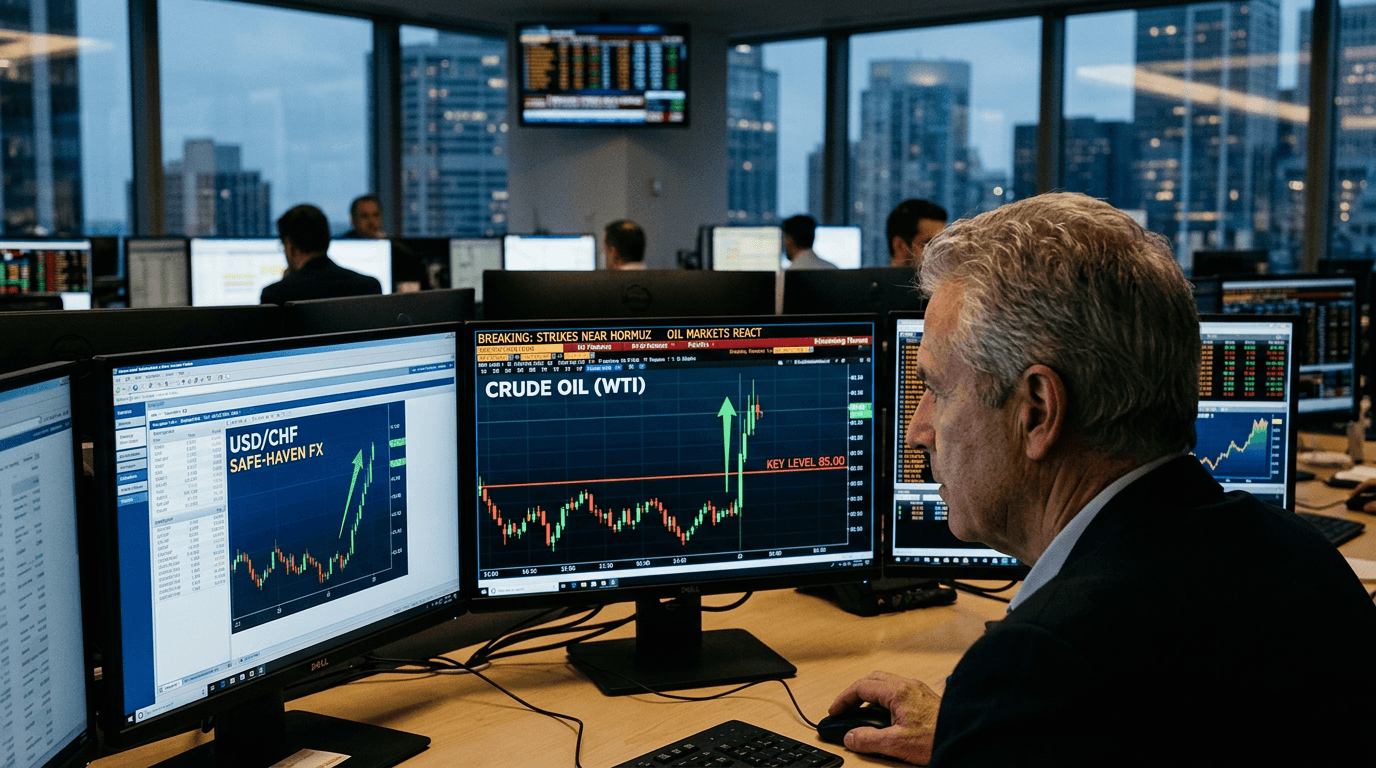
Renewed military tensions near the Strait of Hormuz have quickly spilled over into markets, lifting oil futures and driving a classic flight to safety in foreign exchange. Reports that U.S. forces struck Iranian rocket launchers close to the waterway, alongside signs of possible retaliation, have reignited supply concerns and pushed Brent crude above $90 and WTI above $85, reversing last week’s pullback in energy prices. As traders reprice geopolitical risk, commodity‑linked currencies are finding support while demand for the U.S. dollar and other safe‑haven assets has intensified, making crude and energy futures a central market driver today.
Market Snapshot: Crude, Fx And Safe-havens
Today’s move in oil is not occurring in isolation; it sits on top of months of elevated tension around Hormuz that have already disrupted shipping and energy flows. Previous clashes between U.S. and Iranian forces, including strikes on military positions and attacks on merchant vessels, have periodically throttled traffic through the strait and unsettled global supply chains[1][4][11]. Against that backdrop, traders are highly sensitive to any sign that hostilities could escalate, particularly when they involve direct strikes on launchers or assets capable of threatening commercial shipping[1][6][9]. The result is a rapid rebuilding of the geopolitical risk premium in crude, buoyed by algorithmic and discretionary flows that key off headline risk and key price levels such as $90 in Brent.
On the currency side, the pattern is familiar but nuanced. Higher oil prices generally support producers’ currencies, such as those of key energy exporters, by improving terms of trade and revenue expectations. At the same time, heightened geopolitical risk tends to favor the U.S. dollar, which benefits from its reserve status and deep liquidity, as well as traditional safe‑haven currencies like the Japanese yen and Swiss franc during sharp risk‑off episodes. When the underlying tension relates directly to energy supply and global trade bottlenecks, the dollar’s role as both a safe asset and an invoicing currency for commodities is amplified, drawing in hedging and speculative flows from across the futures and FX complex.
Why The Strait Of Hormuz Matters
The Strait of Hormuz is one of the world’s most important maritime choke points, carrying roughly one‑fifth of global oil supply and a significant share of key inputs such as fertilizers[11]. Bounded by Iran to the north and Oman and the United Arab Emirates to the south, the corridor narrows to roughly 30–50 kilometers, leaving tankers and commercial ships highly exposed to any attempt to assert control or disrupt transit[13][14]. Over the past year, a sequence of attacks on commercial vessels, missile and drone strikes, and temporary closures has repeatedly highlighted how quickly tensions in this narrow waterway can ripple through global energy markets and broader trade[4][8][10].
In 2026, conflict episodes and shifting ceasefire arrangements between the U.S., Iran and regional actors have led to periods of near‑total blockage, naval blockades, and sharp slowdowns in shipping through Hormuz[4][8]. Shipping giants have suspended operations at times, while threat levels for maritime traffic have been raised to “substantial” or “severe” amid strikes on merchant vessels and military targets[1][10][15]. Each flare‑up reinforces a core lesson for traders: when a major energy artery is at risk, even temporary disruptions can generate outsized moves in crude, refined product spreads and related assets, as markets price not just current outages but the probability of longer‑lasting damage to infrastructure and supply chains.
Oil Futures: How Geopolitics Translates Into Prices
Geopolitical shocks in key producing regions generally manifest in futures markets through changes in risk premia, curve shape and volatility. When traders fear disruption at Hormuz, the immediate response is often a jump in front‑month contracts as participants hedge near‑term supply risk and physical buyers seek coverage, pushing benchmarks like Brent and WTI higher and widening spreads versus longer‑dated contracts. During recent phases of the Hormuz crisis, attacks on tankers and warnings from Iranian forces have coincided with spikes in energy prices and sharp moves in calendar spreads as shipping through the strait slowed or stopped[4][8][10].
Options markets also tend to reprice quickly. Implied volatility on crude and energy names rises as investors seek protection against tail risks, and skew can shift as demand for upside calls or downside puts changes with sentiment. When hostilities appear contained or ceasefires are announced, some of that premium can bleed out, leading to a partial retracement. However, as seen in previous cycles where truces broke down and strikes resumed, the market often retains a “memory” of recent disruptions and is quicker to rebuild premia when new attacks or military actions are reported[6][7][12]. For active traders, understanding that futures are not just discounting fundamentals but also probabilities around political decisions is critical when sizing positions and setting stops.
Safe-haven Flows And Cross-asset Behavior
Safe‑haven FX flows typically reflect a combination of risk aversion, funding dynamics and positioning rather than a simple binary pattern. In episodes where tension in Hormuz spills into broader regional conflict, investors often rotate into the U.S. dollar, high‑grade sovereign bonds and select currencies perceived as stable stores of value, even as commodity exporters benefit from higher energy prices[6][9]. The coexistence of stronger oil and stronger dollar can be explained by the fact that oil is largely priced in dollars, so higher crude prices can increase dollar demand from purchasers, while risk‑off sentiment drives additional defensive flows into U.S. assets.
Equity and credit markets add another layer. Energy producers and service companies may rally on higher price expectations, but global indices and risk assets can struggle if investors focus on the downside risk to global growth from sustained supply disruptions and higher input costs[11][15]. In previous shipping slowdowns and closures at Hormuz, logistics, manufacturing and emerging‑market credits linked to trade routes in the Gulf felt the pressure from delayed cargoes and higher insurance costs, even as some energy names benefited[8][11]. Cross‑asset traders need to track these divergences, recognizing that safe‑haven FX strength, higher oil and mixed equity performance can coexist during complex geopolitical shocks.
Practical Takeaways For Simulated And Live Traders
First, treat key price levels such as Brent $90 and WTI $85 as more than just numbers; they often act as psychological and technical triggers that attract order flow. When headlines push prices through these thresholds, be prepared for momentum strategies and systematic flows to amplify the move, increasing intraday volatility and slippage risk.
Second, separate short‑term volatility from longer‑term trend. Geopolitical headlines can produce violent but brief spikes, followed by consolidation once additional information clarifies the extent of damage or disruption. Building scenario plans in advance—how to respond if shipping slows, if a ceasefire holds, or if strikes escalate—helps avoid reactive decision‑making under stress and is well suited to simulated environments where strategies can be tested without real capital at risk.
Third, watch correlations rather than assuming they are fixed. Commodity currencies may rally on higher oil, but could underperform if risk aversion dominates and investors prioritize liquidity and safety. Likewise, safe‑haven flows can strengthen the dollar even as higher energy prices support producer currencies, creating opportunities in relative value and cross‑pairs rather than just outright positions.
Finally, risk management should adapt to event risk. Wider spreads, faster moves and potential gaps around key news updates argue for careful use of leverage, disciplined stop placement and a clear plan for position sizing. Using simulated finance platforms to rehearse responses to geopolitical shocks, test hedging strategies and understand how portfolio risk behaves under stress can build confidence and discipline before deploying capital in live markets.
Conclusion: Trading Around A Critical Geopolitical Fault Line
Tensions near the Strait of Hormuz are a reminder that geopolitical risk remains a powerful driver of energy and currency markets, especially when they threaten a maritime corridor that carries a large share of global oil and vital trade[11][13][14]. As U.S. and Iranian forces continue to exchange strikes and negotiations prove fragile, markets are likely to remain sensitive to any development that affects shipping, infrastructure or the perceived durability of ceasefires[1][4][6][7]. For traders, the challenge is to navigate these events with a structured approach: understand the strategic importance of Hormuz, monitor how futures curves and FX flows are repricing risk, and integrate robust scenario and risk management frameworks. Simulated trading can play a valuable role in that process, providing a controlled environment to learn from these episodes and refine strategies before facing the next headline.