
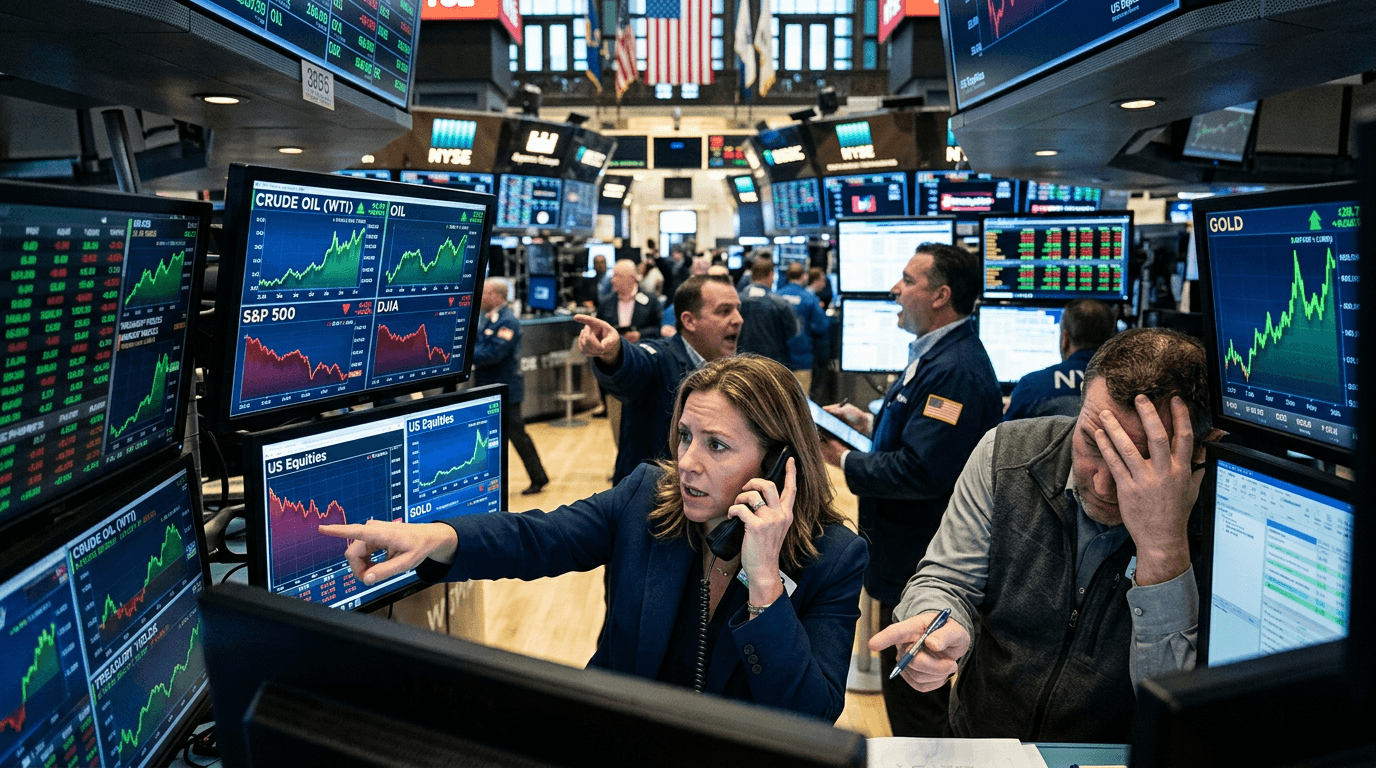
Oil’s latest surge has turned a geopolitical headline into a broad market shock. As West Texas Intermediate (WTI) crude jumps roughly 9%, touching its highest level since mid‑2024, and Brent pushes into the mid‑$80s, US equities and index futures are moving sharply lower, while capital rotates into traditional safe havens.[2] This is not just an energy story; it is a macro shock that ripples through inflation expectations, central bank policy, corporate earnings, and risk sentiment.
Market Shock: Oil Spikes, Equities Slide
The trigger for the move is the escalating war involving Iran, with disruption around the Strait of Hormuz—one of the world’s most critical energy chokepoints.[2][3] Recent price action has already delivered the biggest weekly surge in US oil prices since at least 1985, with WTI up more than 38% in a matter of days and briefly trading above $92 per barrel, while Brent has climbed around 30% to trade in the $90s.[2] That kind of move compresses months of typical volatility into a single news cycle.
Equity index futures, from the S&P 500 to the Nasdaq 100, have reacted in textbook “risk‑off” fashion: higher expected input costs and geopolitical uncertainty are being priced in as lower forward earnings and higher risk premia.[2] Cyclical sectors that are sensitive to consumer spending and margins—such as retail, travel, and parts of industrials—typically underperform in these scenarios, while energy producers and some commodity‑linked names may initially benefit.
In simulated trading environments, this type of sudden repricing is crucial for learning: index futures can gap lower on the open, correlations can spike, and strategies that worked in low‑volatility regimes may suddenly behave very differently. Understanding why is the first step to adapting.
Inflation, The Fed, And Why Energy Matters
Oil is a foundational input for the global economy. A sustained rise in crude prices feeds into gasoline, diesel, jet fuel, and freight costs, and ultimately into the prices consumers pay for goods and services. When WTI and Brent move 30–40% higher in a week, markets naturally revisit their assumptions about inflation’s path.[2]
Central banks, particularly the Federal Reserve, watch these dynamics closely. Higher energy prices can keep headline inflation “sticky,” even if core components are moderating. That complicates the Fed’s easing plans: a shock that lifts inflation expectations can delay rate cuts or even revive discussion of further tightening, especially if wage growth remains firm.
Analysts are already modeling more extreme scenarios. Some research suggests that a prolonged closure of the Strait of Hormuz could push crude prices towards $150 per barrel or beyond, given that nearly 20% of global oil and LNG shipments transit the region.[2][3] While that is a tail risk rather than a base case, markets must price the possibility, and that alone can tighten financial conditions.
For traders—real or simulated—this linkage between oil, inflation, and rates is a core macro lesson. A move in one commodity can reprice the entire curve of interest rate expectations, which then flows through to stock valuations, credit spreads, and foreign exchange.
SAFE‑HAVEN FLOWS AND CROSS‑ASSET REACTION
As oil spikes and equity futures fall, investors tend to seek refuge in assets perceived as safer or more stable. Historically, US Treasuries, high‑quality government bonds, gold, the US dollar, and “safe‑haven” currencies like the Swiss franc and Japanese yen see increased demand in such episodes.
That pattern appears again in this Iran‑linked shock: bond yields may initially rise on inflation fears but can fall back as growth concerns and risk aversion dominate, supporting longer‑duration government debt. Gold often benefits from both inflation anxiety and geopolitical uncertainty, while the dollar can strengthen on safe‑haven flows and repatriation of capital.
Cross‑asset correlations typically rise in stress events. Equity indices may move more in sync, credit spreads widen, and volatility indicators such as the VIX spike as hedging demand surges. For options traders, implied volatility can jump across indices and sectors, altering the risk‑reward of strategies like covered calls, spreads, and volatility selling.
For SimFi participants, this environment is ideal for studying how one headline propagates across markets: oil, equities, bonds, FX, and volatility are not independent—they form a network of cause and effect.
Trading And Risk Management In An Oil Shock
Geopolitical energy shocks test every aspect of a trading approach: time horizon, position sizing, diversification, and emotional discipline.
Short‑term traders might focus on intraday trends and breakouts in oil futures, energy equities, and index futures, using tight risk controls to navigate rapid swings. News‑based volatility can produce sharp reversals, so having a pre‑defined plan for entries, exits, and maximum loss is crucial.
Swing and position traders may instead look at bigger picture themes: whether energy sector strength is sustainable, how much downside remains in vulnerable industries, and how interest‑rate‑sensitive assets reprice as the Fed’s path shifts. They may reduce leverage, raise cash, or use options to hedge downside risk.
Risk management becomes non‑negotiable. High‑volatility environments magnify both gains and losses. Position sizing relative to account equity, using stop‑losses, and avoiding concentration in a single theme (for example, being heavily short equities while long only oil) can help avoid large drawdowns. Simulated trading platforms provide a sandbox to practice these decisions without capital at risk, but the lessons translate directly to real markets.
Practical Takeaways For Simulated And Live Markets
Several practical lessons stand out from this oil‑driven market shock:
First, follow the chain: geopolitical risk → oil supply disruption → price spike → inflation expectations → central bank policy → broad asset repricing. Understanding this sequence helps traders anticipate rather than simply react.
Second, watch the level and the speed of moves. A moderate, gradual rise in oil has very different macro implications than a sudden 30–40% surge, the kind seen recently as WTI and Brent jumped on war‑driven supply fears.[2] Speed increases the likelihood of policy responses, such as discussions about strategic reserve releases or diplomatic pressure to de‑escalate.[1][2]
Third, respect correlation and contagion. What begins as an energy story can become a full‑fledged risk‑off event, with equities down, safe havens up, and volatility elevated. Strategies should be tested under these conditions; if a portfolio relies on low correlations that disappear in stress, its risk is higher than it appears.
Finally, treat simulated trading as a rehearsal for real decision‑making. Platforms like E8 Markets allow traders to experience oil shocks, equity sell‑offs, and flight‑to‑safety dynamics in real time, building a playbook for when similar events occur in live portfolios. Practicing how to adjust exposures, hedge, and manage emotion in a fast‑moving geopolitical crisis is an investment in future resilience.
Oil’s spike on the back of the Iran war is a reminder that markets are not insulated from global events. When a single shipping lane or regional conflict can move crude by double digits and send cross‑asset volatility surging, traders need both a macro framework and a disciplined process. Whether in simulated or live markets, the goal is the same: navigate uncertainty with informed, well‑risk‑managed decisions.