
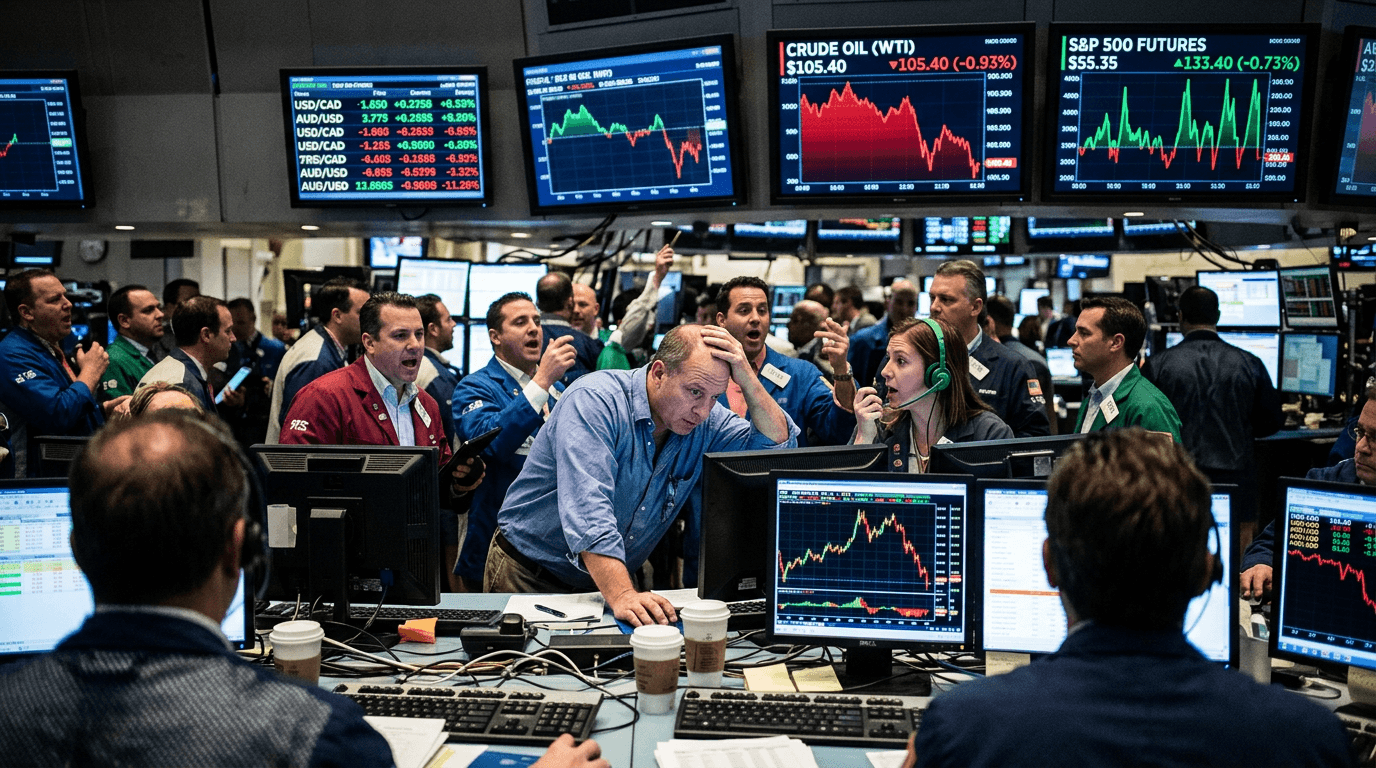
Oil markets and global risk assets have just delivered a textbook example of how quickly sentiment can flip when geopolitics collide with supply fears. A sudden spike in crude on escalating conflict with Iran jolted index futures and commodity-linked currencies, only for a ceasefire framework and an end to a key naval blockade to trigger an equally sharp reversal. For traders, this is not just eye‑catching price action—it is a live lesson in how risk premia are built and destroyed in real time.
Markets Whipsawed By Oil Shock And Ceasefire Hopes
The sequence began with a surge in US crude as tensions with Iran intensified and tanker traffic through the strategically vital Strait of Hormuz came under threat. West Texas Intermediate (WTI) jumped as much as 9%, pushing above $81 per barrel, while Brent climbed toward $86 as traders priced in the risk of meaningful disruptions to global supply. Higher oil prices spilled quickly into currencies: oil‑linked FX such as the Canadian dollar (CAD) and Norwegian krone (NOK) caught a bid, while global equity futures sagged as markets braced for a “tax” on global growth via higher energy costs.
Then the narrative flipped. Headlines hit that Iran had confirmed a ceasefire memorandum with the US and agreed to allow safe passage for tanker traffic, effectively ending a key naval blockade that had choked off flows through Hormuz.[1] That easing of supply fears fed directly into risk sentiment. Oil prices retreated as the geopolitical risk premium compressed, while Dow futures rebounded sharply, mirroring a broader bounce in S&P 500 and Nasdaq futures.[1] The same commodity FX pairs that had surged on the way up began to give back gains as traders reassessed the durability of elevated crude.
From a distance, the moves may look chaotic. Under the surface, they reflect a rational repricing of risk as the probability distribution of future outcomes shifts with every headline.
How Oil Shocks Flow Through Index Futures
Oil is not just another commodity; it is a core input into transportation, manufacturing, and logistics. When crude spikes, equity markets immediately start recalculating margin pressure, growth expectations, and sector winners and losers.
For index futures, the chain of reasoning often runs like this:
Higher oil prices raise costs for energy‑intensive sectors—airlines, shipping, industrials, and some consumer discretionary names. That squeezes profit margins unless companies can pass through costs.
Higher fuel and utility bills act as a drag on consumers and businesses, effectively operating as a tax on the global economy. That can lower expected GDP and earnings growth.
Central banks facing an oil‑driven inflation spike may feel less room to cut rates, or may even sound more hawkish, which is typically a headwind for equity valuations.
The result is that when crude jumps almost 10% in a short window, equity index futures often trade lower as traders incorporate these negative macro and micro effects into their models.
The opposite happens when a ceasefire or de‑escalation removes the worst‑case scenarios. Reports that the US and Iran agreed to a temporary ceasefire and safe passage through Hormuz, easing immediate supply concerns, saw Dow futures jump more than 2% as traders unwound some of the defensive positioning built up during the escalation.[1] Short‑term volatility can be intense: systematic and algorithmic traders react to keywords in headlines, macro funds adjust exposure to global growth, and market‑makers hedge options books as implied volatility pops and then fades.
For active traders, index futures become a primary tool to express a view on the net balance of these forces—hedging equity portfolios, speculating on relief rallies, or fading what they see as overdone fear.
Commodity Fx: Why Cad And Nok Spiked, Then Stalled
Commodity‑linked currencies sit at the crossroads of these moves. The Canadian dollar and Norwegian krone are often dubbed “petro‑currencies” because oil and gas exports make up a significant share of their economies and trade balances.
When oil prices surge
Export revenues rise, improving the terms of trade for oil‑exporting nations.
Government and corporate energy income increases, potentially supporting fiscal balances and investment.
Markets may anticipate relatively stronger growth or tighter policy from the Bank of Canada or Norges Bank if higher energy prices boost domestic activity or inflation.
All else equal, that tends to support currencies like CAD and NOK, which is exactly what we saw as WTI and Brent spiked—both gained ground as markets rewarded their improved external positions.
However, once headlines signaled a ceasefire framework and an end to the naval blockade, the logic reversed. As the oil risk premium started to deflate and crude pulled back, the relative advantage for oil exporters diminished. Traders who had piled into CAD and NOK on the way up began to take profits, and some positions were unwound as the prospect of persistently elevated oil became less certain.
For traders, this underscores two key points about commodity FX:
Moves are often driven by expectations of future oil prices, not just today’s spot level. If traders think a ceasefire will cap further gains, the currency reaction can fade quickly.
Geopolitically driven moves can be sharp but temporary. Unless higher prices translate into a sustained shift in fundamentals, commodity FX can “round‑trip” as the news cycle evolves.
Trading Lessons From Rapidly Changing Headlines
Episodes like this are challenging but rich in lessons for both discretionary and systematic traders.
First, they highlight the importance of understanding cross‑asset linkages. Oil, index futures, FX, and even rates markets are connected via growth, inflation, and risk‑sentiment channels. A spike in one market rarely stays contained.
Second, they emphasize position sizing and risk controls. When geopolitics are in play—especially around critical chokepoints like the Strait of Hormuz—headline risk can trigger gaps that stop out tightly‑levered positions. Keeping risk per trade disciplined and using protective stops or options structures can prevent a single shock from derailing a trading plan.
Third, they show why traders need scenarios, not single forecasts. Before major risk events, it can be helpful to map:
Bull case: rapid de‑escalation, oil risk premium collapses, equities rally, USD softens, commodity FX normalizes.
Bear case: conflict escalates, shipping disruptions worsen, oil surges again, risk assets sell off, haven FX and bonds catch a bid.
Base case: choppy headlines, partial de‑escalation, oil trades in a wide range, correlations stay unstable.
Simulated environments are ideal places to practice these “if‑then” responses. Instead of reacting emotionally to each headline, traders can rehearse how they would adjust exposure across indices, FX, and commodities as new information arrives.
Practical Takeaways For Active And Simulated Traders
For traders following this episode—whether with real capital or in a SimFi environment—several practical takeaways stand out:
Watch the risk premium, not just the price. Ask how much of the current oil price reflects geopolitical risk rather than fundamentals. As the probability of worst‑case outcomes shrinks, that premium can evaporate quickly.
Track correlations in real time. During stress, usual relationships can strengthen or break down. Monitoring how oil is moving relative to index futures, CAD, NOK, and haven assets helps identify when a move is broad‑based risk aversion versus a more contained adjustment.
Use futures and options strategically. Index futures can be efficient tools to hedge or express a macro view around geopolitical events, while options can help define downside risk when volatility is elevated.
Separate narrative from positioning. By the time a story dominates headlines, a lot of the move may already be in the price. Looking at positioning indicators and market depth can help you judge whether the risk is crowded or under‑owned.
Ultimately, the recent swings in oil, index futures, and commodity FX are a reminder that markets are constantly repricing probabilities as new information arrives. For prepared traders, volatility is not just noise—it is opportunity. The key is to understand the transmission channels, respect the risks, and use a structured approach to turn rapid market swings into informed trading decisions rather than emotional reactions.