
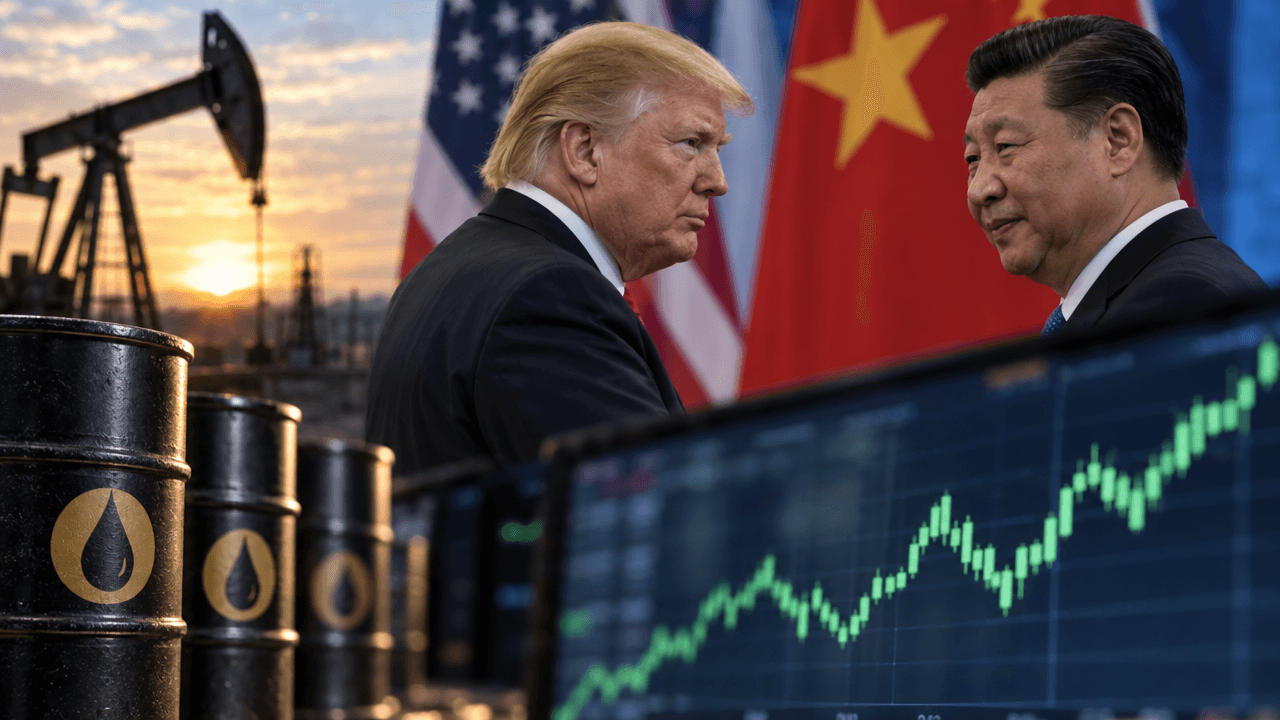
U.S. stock futures started the week on a firmer footing, with Dow, S&P 500, and Nasdaq-100 contracts all trading higher in early Monday action as investors leaned back into risk assets.[5][15] The move is being helped by a simultaneous drop in crude oil, where benchmark U.S. prices have slipped roughly 2–3% toward the high-$90s per barrel, relieving some pressure from inflation and corporate input costs.[5][10][15] Together with anticipation around the upcoming Trump-Xi summit in Washington, this mix of lower energy prices and potential policy signals is shaping a more optimistic tone across global markets.[9][15]
Markets Kick Off The Week In Risk-on Mode
Futures linked to the Dow Jones Industrial Average have jumped around 0.8%, while S&P 500 and Nasdaq-100 futures are up roughly 0.7% and 1.1%, respectively, as traders position for a rebound after a choppy prior week.[5] Gains are being led by growth and technology names, with AI-related stocks helping to power Wall Street futures higher even as investors stay attentive to geopolitical headlines.[15] The combination of rising equity futures and falling oil prices has also pushed U.S. Treasury yields slightly lower, reinforcing the sense that immediate macro fears are easing—at least for now.[15]
Under the surface, this pattern reflects a familiar dynamic: when energy and rate pressures cool, investors tend to rotate back into higher-beta sectors and speculative growth themes. Lower expected input costs can support profit margins, while modest yield declines can make future earnings streams from tech and AI companies more attractive relative to safer assets.[14][15] Key takeaway: For traders, the current backdrop favors carefully constructed risk-on exposure, but with an eye on how quickly sentiment can change around energy or policy news.
Why Falling Oil Prices Matter For Equities
Oil has been trading near or above the $100-per-barrel mark in recent sessions, supported by earlier concerns about Middle East supply disruptions and geopolitical risk premia.[8][10][11] In the last few days, however, crude benchmarks such as Brent and West Texas Intermediate (WTI) have pulled back to the low-$100s and high-$90s, as signs of diplomatic engagement and requests to limit attacks on key infrastructure have softened worst-case fears.[8][10][11] This retreat has snapped a strong two-week winning streak for oil and reminded markets that high prices can themselves sow the seeds of demand destruction and eventual corrections.[10][14]
Beyond the immediate price move, the strategic impact is significant. Lower oil reduces fuel and transportation costs, supports disposable income for consumers, and can temper headline inflation readings that central banks watch closely.[2][14] If energy-driven inflation pressures ease, the probability of additional aggressive rate hikes diminishes, which tends to benefit equities, credit, and higher-risk assets broadly.[14][15] Key takeaway: When crude rolls over after a strong run, it often opens a window for equities and other risk assets to outperform—though traders should watch whether the move is driven by improved supply-demand balance or by fears of slowing growth.
Trump-xi Summit: What Markets Are Pricing In
Layered on top of the energy narrative is rising anticipation around the upcoming summit between U.S. President Donald Trump and Chinese President Xi Jinping in Washington.[9] The meeting comes against the backdrop of an expiring trade truce, tens of billions of dollars in potential tariff relief, and sensitive discussions around advanced technologies such as artificial intelligence.[9] Both economies have strong incentives to stabilize the relationship, with manufacturing, export competitiveness, and global supply chains heavily exposed to any renewed tariff escalation.[9]
Markets are not necessarily pricing in a sweeping breakthrough, but they are assigning some probability to headline-friendly outcomes such as temporary tariff reductions, clearer rules for AI cooperation, or frameworks to manage future disputes.[9][15] Even modest progress could reduce uncertainty premia embedded in global equities and emerging-market assets, while a breakdown could quickly reverse the current risk-on posture and push investors back toward defensive sectors and safe-haven currencies.[9][15] Key takeaway: The summit is a binary event for sentiment—traders should prepare scenarios for both constructive dialogue and renewed tension, rather than assuming one outcome.
Cross-asset Sentiment: Equities, Fx, And Crypto
The combination of higher U.S. equity futures, lower oil prices, and a potentially market-moving diplomatic event is shaping cross-asset flows beyond stocks alone.[5][9][15] Historically, periods of easing energy and rate pressures tend to support cyclical currencies, emerging-market FX, and higher-volatility assets such as cryptocurrencies, as investors seek carry, growth, and diversification opportunities. At the same time, any disappointment on the policy front or a renewed spike in crude could quickly push capital back into the U.S. dollar, defensive equities, and short-duration bonds.
For traders, the message is clear: think in terms of correlations and regimes, not isolated instruments. In the current environment, equity indices, oil benchmarks, and key FX pairs are tightly interlinked, with shifts in one often triggering cascades across the others.[2][10][15] Key takeaway: Building multi-asset strategies that account for energy, rates, and policy risk together can provide more robust positioning than trading any single market in isolation.
How Simulated Finance Traders Can Respond
On a simulated finance platform like E8 Markets, traders can turn this complex backdrop into structured learning and strategy development without risking real capital. By running parallel scenarios—such as a “constructive summit plus stable oil” case, a “summit breakdown and crude spike” case, and a “diplomatic progress with continued oil softening” case—participants can see how equity indices, FX, and crypto might behave under different combinations of shocks and surprises. This kind of scenario testing helps traders understand position sizing, hedging, and diversification before applying similar frameworks in live markets.
Practical actions include stress-testing current strategies against sudden changes in oil, experimenting with hedges using index futures or options, and exploring how correlation structures shift when policy headlines hit the tape. Traders can also use simulated environments to practice reacting to fast-moving news—such as real-time updates from the Trump-Xi summit—without succumbing to emotional decision-making. Key takeaway: Using SimFi tools to rehearse multi-asset responses to energy and policy shocks can make traders more prepared and disciplined when similar conditions arise in the real world.
Conclusion
U.S. stock futures are signaling a more optimistic start to the week, supported by a pullback in oil prices and cautious hope that the Trump-Xi summit will reduce some of the uncertainty hanging over trade and technology policy.[5][9][15] Whether this risk-on tone persists will depend on how energy markets evolve and what concrete outcomes emerge from Washington, but the current setup offers a valuable case study in how macro drivers, geopolitics, and cross-asset correlations intersect.[9][10][15] For both new and experienced traders, especially those practicing on SimFi platforms like E8 Markets, this is an ideal moment to refine multi-asset playbooks, test scenarios, and deepen understanding of how global events ripple through portfolios.