
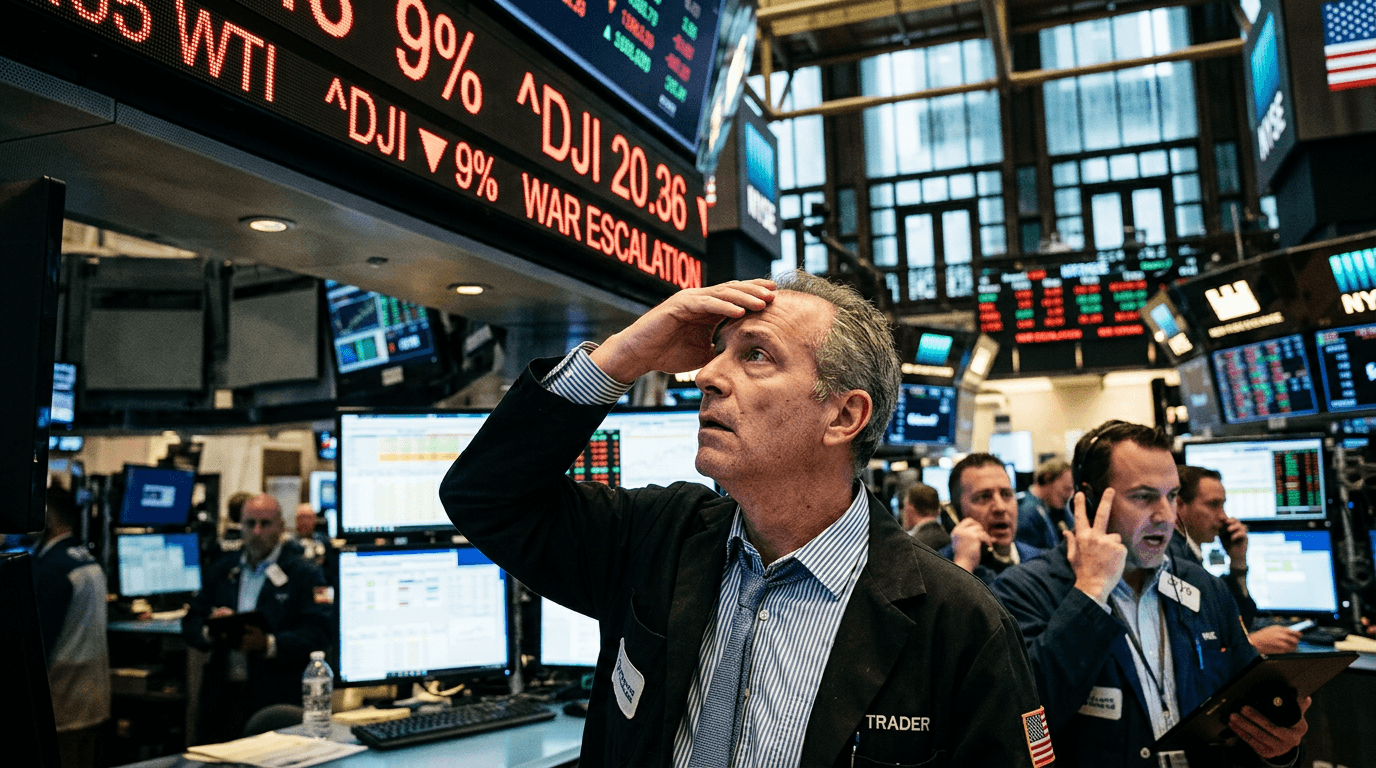
U.S. stock indices and equity futures were jolted as crude oil prices spiked as much as 9% amid a sharp escalation in the Middle East conflict involving Iran. The surge sent West Texas Intermediate (WTI) above $81 and Brent crude above $85, reigniting inflation worries, souring risk sentiment, and pushing traders to reassess the path of central bank rate cuts. For both active and simulated traders, this is a textbook example of how geopolitics, commodities, and macro expectations collide in real time.
Markets Rocked By An Oil Price Shock
The immediate reaction was classic “risk-off.” U.S. benchmarks pulled back from record or near-record levels as investors priced in the prospect of higher energy costs and greater geopolitical uncertainty, while equity futures signaled further weakness ahead.[2][4]
According to recent coverage, U.S. stocks retreated from their highs on a day when oil jumped sharply after renewed fighting in the Middle East threatened a fragile ceasefire involving Iran, knocking the S&P 500, Dow Jones Industrial Average, and Nasdaq into the red.[2] European indices sold off even more, underscoring the global nature of the shock and the market’s sensitivity to any disruption in energy supply routes.[2]
Behind the moves is not just the price of crude itself, but the narrative: a conflict that could disrupt flows from a region responsible for a large chunk of global oil supply, potentially including traffic through critical chokepoints such as the Strait of Hormuz.
WHY A 9% OIL SPIKE HITS STOCKS SO HARD
A one-day move of up to 9% in oil is more than a headline—it’s a macro regime signal. There are several channels through which such a shock hits equities:
First, oil is a core input cost for many sectors. Higher energy prices squeeze profit margins for transportation, airlines, logistics, chemicals, and manufacturing. Companies with limited ability to pass on costs may see earnings estimates revised down, pressuring valuations.
Second, higher fuel costs effectively act as a tax on consumers. When gasoline, heating, and transport costs rise, households have less disposable income for discretionary spending, which can weigh on retail, travel, and consumer services.
Third, the inflation channel is crucial. Energy is a volatile but important component of headline inflation. A sharp rise in oil can push near-term inflation expectations higher, leading investors to demand higher yields on bonds and to re-price the likelihood of rate cuts. That, in turn, can compress equity valuations, especially for growth-oriented and rate-sensitive sectors.
At the same time, sector performance becomes more polarized. Energy producers, oilfield services providers, and some commodity-linked firms tend to be relative winners as their revenues are directly tied to higher crude prices. By contrast, energy-intensive sectors—airlines, autos, shipping, and certain industrials—typically lag. This kind of dispersion creates both risks and opportunities for traders who can position long/short across sectors.
INFLATION, CENTRAL BANKS, AND THE “EASING TRADE”
Before the latest shock, markets had been pricing a gradual easing path from major central banks on the back of moderating inflation and slowing but resilient growth. A sudden jump in oil complicates this narrative significantly.
Because oil feeds rapidly into headline CPI and can bleed into core prices via transportation and production costs, policymakers worry about renewed inflationary impulses. If inflation prints come in hotter due to energy, central banks may:
Delay rate cuts they had been signaling,
Reduce the number of cuts expected over the next year, or
Adopt a more hawkish tone in speeches and minutes to anchor inflation expectations.
For equity markets that have rallied in part on the expectation of lower rates and easier financial conditions, this is a problem. Higher-for-longer policy rates mean higher discount rates on future cash flows and more competition from bonds, both of which can cap equity multiples.
For traders, this environment increases the sensitivity of risk assets to any inflation data, central bank remarks, and bond market moves. It also increases the value of macro hedges—such as exposure to commodities, inflation-linked bonds, or defensive equity sectors.
Winners, Losers, And Cross-asset Repositioning
The shock in oil does not stay confined to energy stocks and indices; it ripples across asset classes and geographies.
In foreign exchange, commodity-linked currencies like the Canadian dollar and Norwegian krone often find support when oil prices surge, given their economies’ export exposure to energy. Conversely, major net importers of energy may see pressure on their currencies as terms of trade worsen.
In fixed income, there tends to be a tug-of-war: inflation fears can push yields higher, but a flight to safety amid geopolitical risk can support demand for government bonds. The net outcome depends on which narrative dominates—stagflation risk or classic risk-off.
Gold and other perceived safe havens often catch a bid as geopolitical tensions flare, adding an additional layer of complexity to portfolio decisions. Equity volatility indices typically rise as investors rush to buy protection, reflecting uncertainty about both the conflict’s trajectory and its economic fallout.
Within equities, energy and defense-related names can outperform, while rate-sensitive and cyclical growth sectors may lag. Investors often rotate toward quality—strong balance sheets, stable cash flows, and pricing power—when macro and geopolitical risks rise simultaneously.
How Active And Simulated Traders Can Navigate This Volatility
For active traders and those using simulated finance platforms, this kind of event is a live-fire exercise in risk management, not just market direction.
A few practical points
1) Respect correlation shocks In calm markets, diversification works one way; in stress events, correlations often spike. Indices, sectors, and even asset classes can move together. Position sizing, stop-loss discipline, and scenario planning matter more than ever.
2) Think in terms of themes, not just tickers This move is about “higher energy + higher geopolitical risk + uncertain central bank path.” Building trade ideas around these themes—long energy vs short energy-intensive sectors, long commodity currencies vs broad FX baskets, or hedging equity exposure with selective commodity or volatility positions—can be more robust than chasing individual headlines.
3) Use simulated environments to test playbooks SimFi platforms allow traders to test how different strategies perform in an oil shock scenario: – How does a long index futures position behave when oil spikes and yields climb? – What happens to a long/short sector rotation strategy during a geopolitical flare-up? – How effective are various hedges—options, futures, or cross-asset offsets—under stress?
Practicing these questions in a risk-free environment helps traders refine execution, manage emotions, and develop rules-based responses for when similar shocks appear in live markets.
4) Shorten your feedback loop, lengthen your perspective In fast-moving markets, traders need to update their views quickly as data changes—oil headlines, conflict developments, and central bank comments. At the same time, keeping an eye on the bigger picture (longer-term supply/demand for oil, structural inflation forces, earnings trends) helps avoid overreacting to every tick.
What To Watch Next
From here, several variables will determine whether this is a short-lived spike or the start of a more persistent macro regime shift:
The trajectory of the Middle East conflict and any impact on physical supply and shipping routes,
The persistence of elevated oil prices—whether crude retreats quickly or consolidates at higher levels,
Upcoming inflation data and how much of the energy shock feeds into headline and core measures,
Central bank communication—does the Fed and its peers emphasize inflation risks or growth risks?
For traders and investors, this episode is a reminder that geopolitics can override calm price action in an instant, and that oil remains a critical hinge for both markets and monetary policy. Those who integrate cross-asset awareness, disciplined risk management, and robust scenario testing—whether in real or simulated environments—will be better positioned to navigate the volatility that follows.