
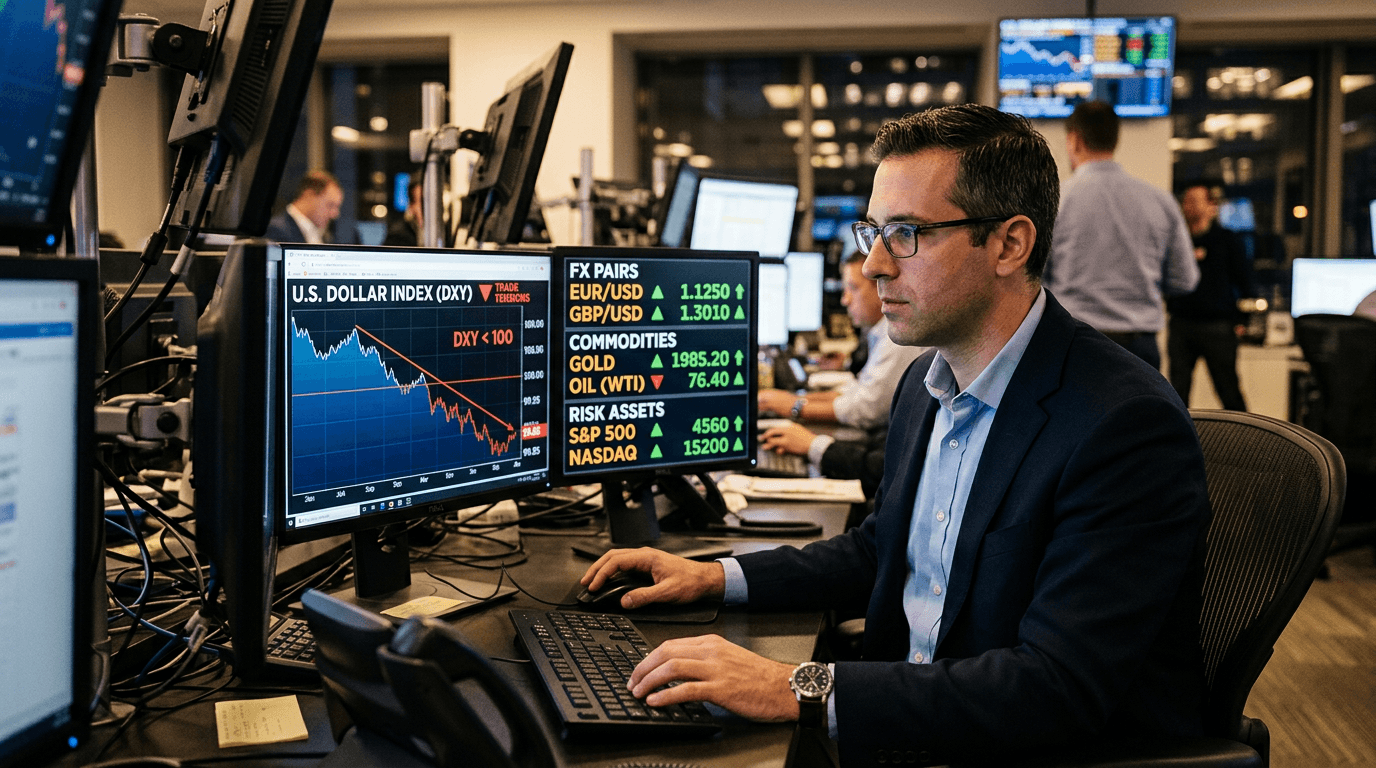
The U.S. dollar index futures gapping lower and slipping below the 100 handle is more than a quick headline for FX traders; it’s a signal that the macro backdrop around trade policy, growth expectations, and risk sentiment is shifting in real time. With tariff tensions back in focus and U.S.–China trade measures still casting a shadow, the greenback is losing altitude against a broad basket of major currencies, and that has implications far beyond a single morning’s price action.
What A Drop Below 100 Really Means
The U.S. Dollar Index (DXY) tracks the dollar against a basket of major currencies, heavily weighted toward the euro, but also including the yen, pound, Canadian dollar, Swedish krona, and Swiss franc.[6][10] An index reading below 100 means the dollar has depreciated versus this basket relative to its base period.[6][10] Crossing down through that level is psychologically important because it often marks a shift in how markets are pricing U.S. policy and global risk.
In previous moves through 100, traders have treated the break as a regime signal rather than a trivial technical move.[2] It typically reflects a narrative that the U.S. policy mix is becoming less supportive for the dollar—whether through expectations of easier Federal Reserve policy, concerns over fiscal sustainability, or, as now, mounting trade and tariff uncertainties that cloud the growth outlook.[2][6] For discretionary and systematic traders alike, that narrative shift can matter as much as the level itself.
Key takeaway: A sustained move below 100 is a market verdict that the dollar’s relative advantage is eroding, at least for now, and that the prior “strong USD” regime may be giving way to a more two-sided, volatile environment.[2][6]
How Tariff Tensions Pressure The Greenback
Tariffs influence the dollar through multiple channels, and the net effect is not always straightforward. On one hand, trade tensions can create risk aversion, which sometimes supports the dollar as a safe-haven asset. On the other hand, when tariffs are perceived as directly undermining U.S. growth, investment, and global supply chains, they can pressure the greenback by fueling expectations of future Fed easing or larger fiscal and current account imbalances.[6][10]
Renewed focus on U.S.–China trade measures and tariff threats raises exactly that second concern. Higher tariffs can weigh on corporate profits, capex, and global trade volumes. If markets conclude that these frictions are likely to persist, they may start to discount weaker U.S. growth and more dovish Fed policy down the line, both of which tend to be dollar-negative.[6][10] This is especially true if other central banks appear closer to the end of their easing cycles or are perceived as less exposed to the same tariff shock.
There is also a credibility angle. Repeated tariff escalations and unilateral trade actions can erode confidence in the stability and predictability of U.S. policy, prompting some global investors to diversify away from dollar assets over time, even if the shift is gradual. That diversification bid can show up as a softer dollar index when combined with tactical selling from macro funds and systematic models reacting to the price break.
Key takeaway: Tariffs don’t just hit trade flows; they reshape expectations about U.S. policy, growth, and credibility—and right now that mix is leaning against the dollar.
Cross-asset Impact: Fx Pairs, Commodities, And Risk Sentiment
A weaker dollar is rarely confined to the dollar chart. It tends to ripple across FX, commodities, and risk assets.[2][6] For traders, the move below 100 is a prompt to re-evaluate correlations and relative-value opportunities.
In FX, a softer DXY typically translates into stronger EUR/USD, GBP/USD, AUD/USD, and other major USD pairs, with beta varying by currency. Higher-yielding and commodity-linked currencies often benefit when the dollar eases and global risk appetite improves, although tariff-driven growth concerns can partially offset that tailwind.[2][6] USD/JPY can be more nuanced, balancing dollar weakness against the yen’s own safe-haven status.
In commodities, a weaker dollar is generally supportive for dollar-denominated assets like gold and some industrial metals, because they become cheaper in other currencies and often attract flows as alternative stores of value.[6] However, if tariffs significantly darken the global growth outlook, that can dampen demand for growth-sensitive commodities even as the dollar softens.
Equities and emerging markets can initially welcome a softer dollar, especially if it reflects easier future U.S. policy rather than outright recession fears.[2][6] But if the “why” behind the dollar’s decline is a deeper, prolonged trade conflict, equity markets may struggle to convert dollar weakness into sustained upside.
Key takeaway: Don’t assume “weaker dollar = risk-on” in a straight line. The driver—tariff stress versus benign easing expectations—will shape how FX, commodities, and equities respond.
Trading Playbook: Strategies And Risk Management
For active traders, a clean break below 100 is a signal to revisit both directional biases and risk frameworks. There are several ways to turn this macro event into a structured trading plan.
First, treat the move as a potential regime change, not just a one-off spike.[2] That means testing whether your strategies behave differently in “sub-100” DXY environments versus “above-100” regimes—particularly trend-following systems, carry trades, and mean-reversion models in USD pairs.
Second, be prepared for wider intraday ranges and more frequent trend extensions, especially around trade-related headlines and U.S. data releases.[2] Tariff news tends to hit with little warning, so it is critical to size positions with room for headline volatility and to avoid clustering stops around obvious technical levels where liquidity can thin out.
Third, think in relative-value terms. Instead of simply “short dollar everywhere,” consider where the macro story truly supports sustained strength against the dollar—such as currencies backed by central banks that are less dovish, or economies that are net beneficiaries of any U.S.–China supply chain reconfiguration. Conversely, some emerging markets may remain vulnerable despite dollar weakness if they are heavily exposed to global trade flows.
Key takeaway: Anchor your trading plan in scenarios (continued dollar downside vs. sharp snapback) and build position sizing, entry criteria, and exit rules that can withstand noisy tariff headlines.
Using Simulated Trading To Navigate A Weaker Dollar
A macro inflection like DXY breaking below 100 is an ideal use case for simulated trading environments. In SimFi platforms, traders can build and test rule-based systems that combine fundamental triggers—such as tariff escalations or shifts in Fed expectations—with technical confirmations like a sustained dollar breakdown.[2]
You can design and backtest strategies that go long higher-yielding or commodity-linked currencies against the dollar when DXY trades below defined thresholds, while hedging with correlated instruments like gold or equity index futures.[2] This allows you to observe how the strategy behaves during periods of headline-driven volatility without risking real capital.
Simulation is also a powerful tool for stress-testing. You can create scenarios where the dollar continues to grind lower on prolonged tariff tensions, as well as scenarios where a sudden de-escalation or hawkish Fed surprise triggers a violent short squeeze higher.[2] Testing your portfolio under both paths helps refine stop placement, maximum drawdown tolerances, and diversification choices before trading live.
Key takeaway: Use the current dollar breakdown as a laboratory—an opportunity to iterate on ideas, calibrate risk, and gain pattern-recognition in a controlled environment.
Ultimately, the U.S. dollar index slipping below 100 amid tariff tensions is a reminder that FX is where macro, policy, and sentiment collide. For traders, the opportunity lies not in predicting every headline, but in building robust frameworks—both discretionary and systematic—that can adapt as the regime evolves. Whether you are trading live or honing your edge in simulation, how you respond to this kind of inflection will often matter more than the move itself.