
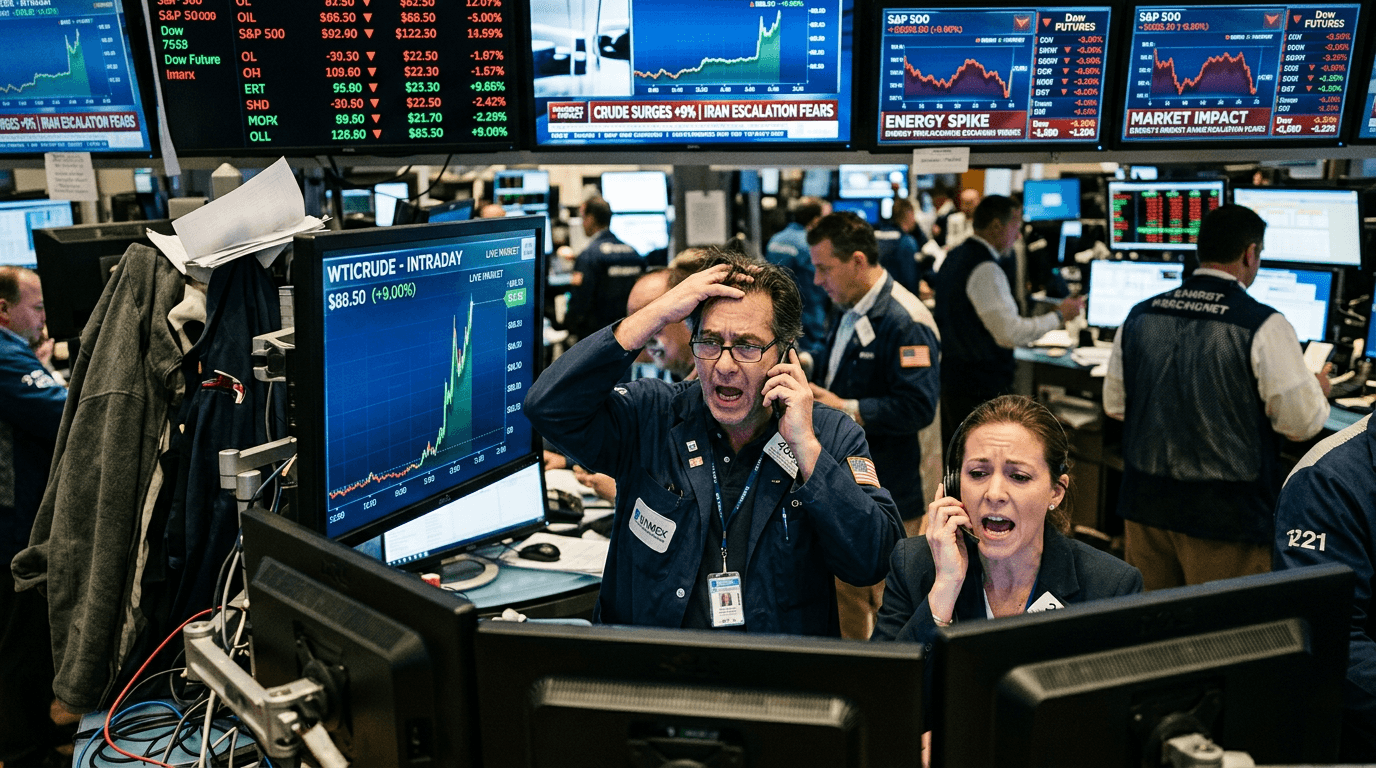
Oil markets were jolted as US crude spiked as much as 9% intraday on fresh Iran war headlines, sending West Texas Intermediate (WTI) into the low‑$80s and Brent into the mid‑$80s.[2] That kind of single‑session move in a major global benchmark is rare, and it immediately rippled through energy futures, equity index futures, and inflation‑sensitive assets as traders repriced geopolitical risk across the board.[2][3]
MARKETS ROCKED BY A 9% OIL PRICE SURGE
The immediate catalyst for the move was renewed concern that the widening Iran conflict could further disrupt production and shipping across the Middle East, especially in and around the Strait of Hormuz, a corridor that handles roughly 20% of global oil flows.[2][5] Headlines suggesting escalation or new attacks tend to trigger rapid repricing, because traders must account for the risk of suddenly impaired supply.
When benchmarks like WTI and Brent jump 9% intraday, it typically reflects not just current disruption, but the market’s collective reassessment of the probability of more severe outages.[1][2] In recent weeks, war‑related uncertainty has already pushed Brent and WTI to multi‑year highs at times, with prices briefly trading well above $100 as fears over shipping and insurance costs mounted.[2][3][5] The latest spike fits into that broader pattern of volatility rather than standing alone.
Crucially, such spikes are being driven more by risk premia than by a collapse in actual barrels produced. Even partial halts, rerouted flows, or higher insurance and freight costs can cause traders to add a geopolitical premium to prices, especially when conflict involves countries central to the global oil supply chain.[1][2][7]
Why Geopolitics Moves Oil So Fast
Oil is uniquely sensitive to geopolitical shocks because it is both a physical commodity and a financial asset. Physically, the Middle East remains a critical hub: seaborne exports from the Gulf typically total around 20 million barrels per day of crude and refined products, plus large volumes of liquefied natural gas.[1] Any threat to that flow—whether from direct damage, blockades, or risk‑averse shipowners—can tighten perceived supply.
Financially, crude is heavily traded via futures, options, and swaps, enabling rapid adjustments as news breaks. When Iran‑related headlines cross the tape, algorithmic trading models linked to news feeds and volatility signals can amplify moves, especially in thin liquidity hours. This helps explain frequent intraday swings that far exceed changes in underlying fundamentals.[2][8]
The Iran war has also increased the cost of shipping, insurance, and hedging, which feeds back into futures prices.[2][7] If insurers demand higher premia for tankers passing near conflict zones, or if some shipowners avoid key routes altogether, the effective cost of delivering oil rises. Markets price that in immediately, even before production volumes change materially.
Ripple Effects On Equity And Energy Futures
A 9% intraday jump in crude did not stay contained within the energy complex. Equity index futures, particularly US benchmarks, turned lower as traders worried that higher energy costs could pressure margins, dampen consumer demand, and complicate the inflation outlook.[2][6] Historically, sustained oil spikes are associated with weaker broad equity performance, especially in energy‑intensive sectors like airlines, transportation, autos, and consumer discretionary.[2][4]
At the same time, energy sector futures and oil‑linked equities found support. Higher benchmark prices tend to boost expected cash flows for producers and some service firms, particularly those with low lifting costs and minimal exposure to the conflict zone itself.[1][2] This creates a divergence: broader equity markets may sell off on growth and inflation fears, while energy names and commodity indices catch a bid.
Commodity‑linked currencies, such as those of major oil exporters, often strengthen when prices spike, reflecting improved terms of trade and revenue expectations.[2][3] Conversely, currencies of large importers can come under pressure as investors anticipate wider trade deficits or stronger inflation. As the Iran war has shown, one set of headlines can move foreign exchange, bonds, equities, and commodities within minutes.
Inflation, Central Banks, And Commodity Currencies
Beyond futures screens, higher oil prices ultimately filter through to consumers and inflation data. Since the start of the Iran conflict, gasoline and diesel prices have risen markedly in many countries, mirroring earlier surges in crude benchmarks.[3][4][6] In the US, analysts estimate that the jump in oil—from pre‑war levels around $70 to recent spikes above $100—could add meaningful percentage points to headline inflation.[2][6]
Rising fuel costs affect more than drivers. Nearly all goods rely on transportation, and diesel powers much of global freight and industrial activity.[3][6] As energy becomes more expensive, companies face higher input costs and may pass those on through higher prices, squeezing household budgets and potentially slowing discretionary spending.[2][6] This is one reason stock markets often react negatively to sharp oil spikes.
For central banks, the challenge is balancing inflation risks against growth. If oil prices remain elevated, inflation data may surprise to the upside, prompting markets to price in a longer period of tight monetary policy or slower rate cuts.[6] Interest‑rate expectations, in turn, influence bond yields, equity valuations, and currency moves. A single 9% intraday oil move will not set policy on its own, but repeated shocks can reshape the macro narrative.
How Traders Can Navigate Oil Shocks
For traders and investors, episodes like this highlight the importance of understanding geopolitical risk within a portfolio. A few practical approaches emerge from recent Iran war–related volatility:
First, distinguish between transitory headline spikes and structurally impaired supply. A ceasefire, diplomatic progress, or reopening of key shipping routes can reverse price spikes surprisingly fast, as seen when crude briefly traded near $120 before retreating below $90 on signs of de‑escalation.[2] Position sizing and leverage should reflect that potential for sharp reversals.
Second, think in terms of cross‑asset exposure. Oil shocks can simultaneously affect energy stocks, airlines, industrials, consumer names, bond yields, and commodity‑linked currencies.[2][3][6] Risk management should consider correlations: a portfolio heavily exposed to growth stocks and long‑duration assets may be more vulnerable to persistent energy‑driven inflation than one diversified into defensives or selective energy positions.
Third, focus on scenario analysis rather than point forecasts. Instead of asking where oil will trade next week, consider several paths: a rapid de‑escalation, a prolonged but contained conflict, or a broader regional disruption affecting multiple producers and shipping lanes.[1][2] Each scenario implies different trajectories for crude, refined products, and macro variables like inflation and growth.
Finally, practice in low‑risk environments can help traders improve their response to real‑world shocks. Simulated trading frameworks allow market participants to experiment with strategies around geopolitical events—such as hedging with options, rotating between sectors, or adjusting FX exposure—without capital at risk. That experience can be valuable when headlines suddenly send oil up 9% in a single session.