
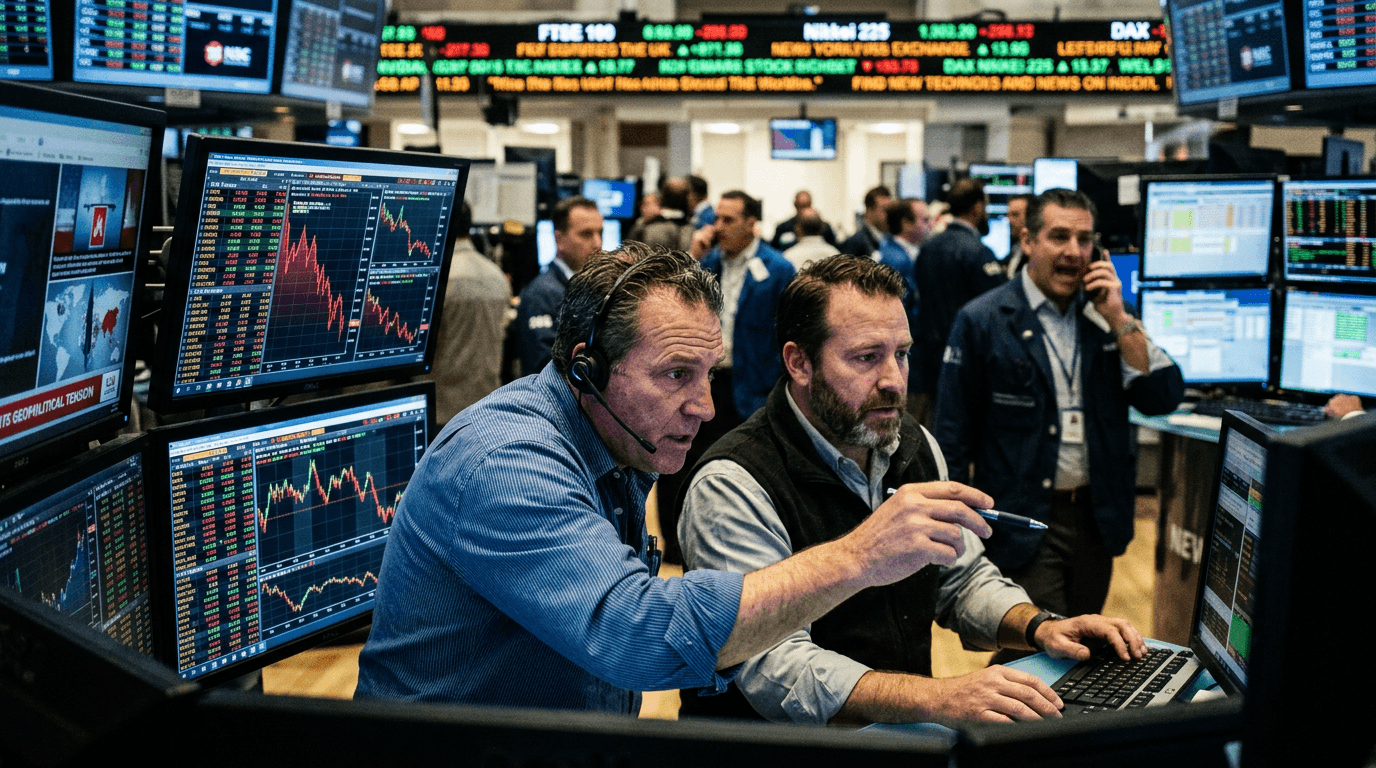
After one of the most powerful technology rallies in recent memory, US stock index futures and global equities are finally exhaling. Major benchmarks are drifting lower as investors take profits in AI leaders and semiconductor names, while a tense geopolitical backdrop in the Middle East adds another layer of uncertainty to risk assets.[1][8][9] For traders, this is a classic transition phase: from euphoria and momentum to consolidation and selectivity.
Markets Cool After A Record Tech Surge
US index futures are modestly weaker, with Dow, S&P 500 and Nasdaq 100 contracts all slipping after recent record or near‑record closes.[8][9] The move is not yet a dramatic risk‑off event, but it does signal a shift in tone from relentless buying to more cautious positioning.
This cooling is especially visible in tech‑heavy benchmarks. The Nasdaq 100 futures are leading the pullback after the underlying index suffered its biggest single‑day decline since April 2025, driven largely by profit‑taking in chipmakers and AI‑linked stocks.[3][9] When a prior market leader starts to lag, it often encourages broader rebalancing across sectors.
Global equities are tracking the US lower. European indices such as the Euro Stoxx 50 are down, while major Asian markets including Japan and China have also softened as investors pare exposure to high‑beta technology names and reassess risk around the Middle East.[1][3] These cross‑market linkages matter: when US tech stumbles, global growth and momentum trades frequently follow.
AI LEADERS FACE PROFIT‑TAKING
The current weakness in AI and chip stocks is not purely about deteriorating fundamentals; it is also about the mechanics of a historic rally meeting investor discipline. After months of rapid gains powered by enthusiasm around generative AI, data centers and high‑performance computing, many investors are choosing to lock in profits and reduce concentrated exposure.[1][3][9]
This dynamic has hit marquee AI‑linked names and semiconductor leaders. A disappointing AI‑chip sales forecast from a major US chipmaker recently sparked concerns that expectations had become stretched, triggering a broader slide in the sector.[1] When the market narrative assumes flawless growth, even a slight guidance miss can catalyze sharp selling.
Yet the sector remains highly bifurcated. While many chips and AI names are under pressure, some are still surging on company‑specific catalysts. Micron shares, for example, jumped around 7% on fresh plans for multi‑billion‑dollar US chip investments, underscoring how capital‑expenditure cycles and policy support can create winners even in a cooling sector. That kind of dispersion can significantly increase volatility in related futures and options markets, as traders recalibrate expectations name by name rather than treating “chips” as a single trade.
For traders, this is a textbook environment for rotation within the theme. The broad AI trade may be cooling, but select companies with clearer earnings visibility, strategic investment plans, or differentiated technology can still outperform. Understanding that nuance is essential when constructing long/short or relative‑value strategies.
Geopolitical Tensions Add To Volatility
Macro and geopolitics are not in the background. Heightened tensions in the Middle East, including evolving dynamics between the US, Israel and Iran, have become a key driver of recent volatility in equities, oil and safe‑haven assets.[2][3][8][9] Reports and headlines around ceasefire negotiations and potential escalations are influencing intraday price action.
Risk assets typically respond to such uncertainty through higher implied volatility and greater sensitivity to news flow. Equity index futures have dipped alongside rising energy prices and defensive positioning, as investors weigh the potential impact on global growth, inflation and corporate margins.[2][3][8][9] In practice, this means futures can swing on geopolitical headlines even when micro fundamentals remain intact.
For AI and chipmakers, geopolitical risk is a double‑edged sword. On one side, higher energy costs and potential supply‑chain disruptions could squeeze margins or delay capex plans. On the other, geopolitical competition often reinforces strategic investment in domestic technology and semiconductor capacity, as policymakers seek to secure critical infrastructure. Micron’s new US investment push sits squarely in that narrative, illustrating how policy and geopolitics can create company‑specific upside even in a choppy tape.
What This Means For Active Traders
For active traders, this environment blends three powerful forces: sector‑specific profit‑taking, macro‑driven volatility, and stock‑level dispersion. That combination demands flexible strategies and robust risk management.
First, profit‑taking in AI and chips often follows technical and behavioral patterns. After parabolic moves, momentum fades, breadth narrows, and intraday reversals become more frequent. Traders can track volume spikes, options activity, and relative strength indicators to gauge whether selling is likely to deepen or stabilize.
Second, futures markets offer a clean way to express views on the next phase of this tech cycle. Short‑term traders might use index futures to hedge concentrated exposure to AI leaders, while longer‑term investors may look to buy dips if they believe the structural story around data‑center demand, AI adoption and cloud spending remains intact. Understanding how futures prices incorporate expectations about earnings, rates and volatility is critical.
Third, dispersion within chips and AI means stock selection matters more than ever. Rather than a simple “own tech / avoid tech” binary, traders can explore pairs trades (long one chipmaker, short another), factor strategies (tilting toward quality balance sheets or stable cash flows), or options structures that benefit from elevated volatility without relying on directional calls.
Practical Takeaways For Simulated Traders
For traders using simulated finance platforms, periods like this are particularly valuable learning laboratories. Because you can trade without real capital at risk, it becomes easier to test how different strategies behave when market leadership is under pressure.
You might, for example, run parallel simulations: one strategy that systematically buys dips in AI leaders, another that rotates into less‑loved sectors benefiting from risk rotation, and a third that focuses on volatility trades in index or sector options. Comparing performance across scenarios helps you understand which approaches are more resilient when sentiment shifts.
It is also a good moment to practice event‑driven trading around policy announcements, capex news and geopolitical headlines. Micron’s investment plans and the evolving Middle East situation illustrate how single news items can move both individual names and broad indices. In a simulated environment, you can test how quickly you respond, how you scale positions, and how you manage exits when news flow becomes noisy.
Ultimately, the softening in US futures and global equities is not just a headline—it is a live demonstration of how narratives change. AI euphoria, chip‑cycle optimism, geopolitical anxiety and profit‑taking are all interacting in real time. For traders willing to study those interactions, this period offers rich insight into the mechanics of modern markets and a chance to refine strategies before the next leg of the cycle.