
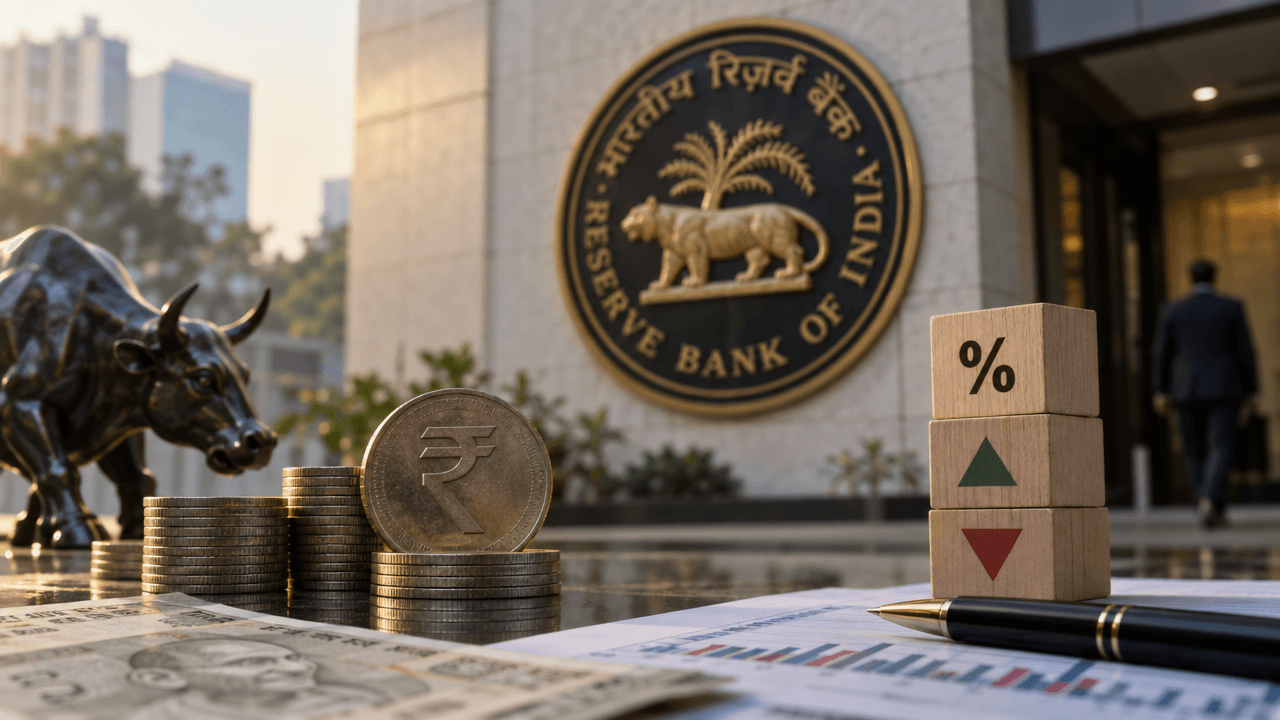
The Reserve Bank of India (RBI) has kicked off a new tightening cycle, raising the policy repo rate by 25 basis points from 5.25% to 5.50%—its first hike since February 2023.[1][7][8] This move marks a clear shift in the monetary policy narrative, with implications for the rupee, Indian bond markets, borrowing costs, and how traders think about interest-rate risk in emerging markets.[4][5][15]
WHAT HAS THE RBI DONE?
The repo rate is the benchmark interest rate at which the RBI lends short-term funds to commercial banks, who then transmit this cost through lending rates to businesses and households.[11] By increasing the repo rate to 5.50%, the RBI is signalling that containing inflation and anchoring expectations now take priority over further monetary accommodation.[1][8][9]
Importantly, the Monetary Policy Committee (MPC) has changed its stance from “neutral” to “calibrated tightening.”[1][7][8] A neutral stance suggests rates could move either way depending on data, but calibrated tightening implies that the bias is toward further hikes or at least keeping rates elevated until inflation risks are clearly under control.[7][9][15] While this is not an open-ended hiking cycle, it is a strong message that rate cuts are off the table for now.[10][11]
Why This Rate Hike Matters Now
The timing of this move reflects a combination of domestic and global pressures. Retail inflation has been edging higher, driven by food price volatility, elevated crude oil prices, and broader cost pressures in the economy.[6][8][14] In parallel, global interest-rate conditions remain tight, and several major central banks are signalling a “higher for longer” stance, which raises the risk of capital outflows from emerging markets that keep rates too low.[13][15]
The RBI is also reacting to a weaker rupee and the risk that imported inflation could intensify if the currency comes under sustained pressure.[5][9][14] At the same time, India’s growth backdrop remains relatively strong, giving the central bank more room to lean against inflation without severely undermining activity.[6][14] In short, this hike is about protecting macro stability rather than fighting a growth slump.
Impact On Rupee, Bonds And Credit
For the rupee, a rate hike is generally supportive at the margin, especially when markets had already priced in the possibility of a 25-basis-point move.[5][13] Higher domestic yields can help attract or retain foreign portfolio flows into Indian debt, providing a cushion against external shocks and helping stabilize the currency.[5][14][15] However, the rupee’s path will still depend heavily on global risk sentiment and commodity prices.
Indian government bond yields are likely to move higher across the curve as investors reprice the path of policy rates and term premia.[1][4][15] Shorter-maturity bonds tend to react most directly to policy changes, while longer tenors will reflect expectations about future hikes and inflation. A shift to “calibrated tightening” keeps fixed-income markets focused on the risk of additional increases, rather than an early pivot back to easing.[7][15]
On the credit side, floating-rate home, auto and personal loans are set to become more expensive as banks gradually pass on the higher cost of funds.[4][8][11] Corporates, especially those relying on short-term borrowing, will see financing costs rise, which can affect investment decisions and balance-sheet strategies. Rate-sensitive sectors like real estate, NBFCs and consumer discretionary could face valuation pressure as discount rates increase.
Implications For Traders And Investors
For equity traders, this decision reinforces the need to distinguish between rate-sensitive and rate-resilient sectors. Banks and financials may initially face margin questions but can benefit if higher rates support net interest margins and credit discipline.[15] In contrast, leveraged sectors and companies with weak cash flows could come under scrutiny as investors reassess their ability to handle higher borrowing costs.
Fixed-income traders must pay close attention to the yield curve’s reaction. A steeper curve could emerge if short-end yields rise faster than the long end, reflecting uncertainty about the depth of the hiking cycle.[1][4][15] Duration risk needs careful management; longer maturities may see price volatility as markets digest both inflation data and RBI guidance.
Currency traders will focus on pairs like USD/INR, where the rate differential with the US and other majors is a key driver of capital flows.[5][13] This hike may help limit downside in the rupee, but it does not eliminate the impact of global risk-off episodes or commodity shocks. Traders should be prepared for periods of higher volatility around data releases—especially inflation, trade, and RBI communication.
Using Simulated Finance To Navigate Rate Cycles
For many traders and aspiring market participants, a shifting rate environment is where strategy and risk management are truly tested. Simulated Finance (SimFi) platforms allow you to experience how a 25-basis-point move can ripple through currencies, bonds, and equities—without risking real capital. You can model scenarios where the RBI delivers further hikes, holds steady, or eventually reverses course, and see how portfolios respond.
This is particularly valuable for testing rate-sensitive strategies: carry trades in FX, duration positioning in bonds, or sector-rotation approaches in equities. By running simulations, traders can understand how changes in repo rate expectations affect volatility, correlations, and drawdowns across asset classes. The goal is not to predict every move, but to build playbooks for different policy paths and stress conditions.
Looking Ahead
The RBI’s move to raise the repo rate to 5.50% and adopt a calibrated tightening stance marks a clear turn in India’s monetary policy cycle.[1][7][8] Inflation risks, global financial conditions and currency dynamics are now firmly at the center of the conversation, and markets will dissect every data release and RBI communication for clues on the next steps.[6][9][15]
For traders and investors, the key takeaway is that interest-rate risk is back in play. Strategies that worked in a stable or easing rate environment may need recalibration, and active risk management around duration, leverage and currency exposure becomes more critical. Using tools like SimFi to rehearse scenarios and refine responses can help market participants stay prepared as India’s rate story evolves.