
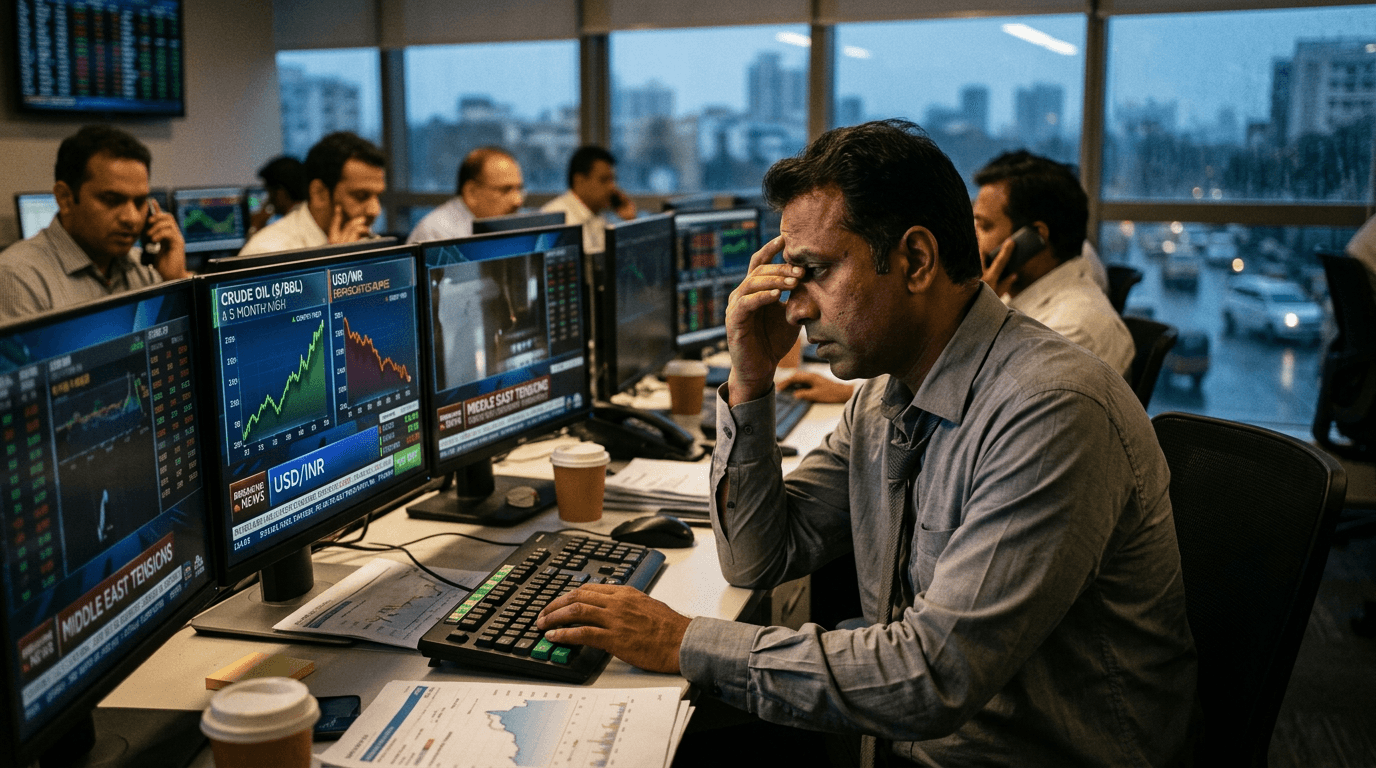
The Indian rupee is once again in the crosshairs of global geopolitics, as a renewed rally in crude oil prices and escalating tensions in the Middle East push Asia’s third‑largest economy into a more fragile position on the external front.[3][8] With traders watching how aggressively the Reserve Bank of India (RBI) defends the currency near record lows, the stakes are rising not just for policymakers, but also for anyone exposed to Indian assets, imports, or currency risk.[2][4]
Why The Rupee Is Under Pressure
At the core of the current pressure on the rupee is the classic “oil shock” channel. India imports close to 85–90% of its crude oil requirements, which makes the rupee highly sensitive to any sustained move higher in international oil benchmarks such as Brent.[11][14] Every sharp uptick in crude prices quickly translates into a larger import bill, raising the demand for dollars from refiners and other importers.
In recent weeks, oil prices have climbed as hostilities between the United States and Iran, as well as broader Middle East tensions, rekindled fears of supply disruptions and shipping risks in key chokepoints like the Strait of Hormuz.[3][8][14] Episodes of fresh strikes and flare‑ups in the Gulf have repeatedly triggered risk‑off moves in global markets, sending oil higher and risk‑sensitive currencies like the rupee lower.[4][12]
The rupee has repeatedly flirted with or broken past previous lows against the U.S. dollar during these bouts, with traders now accustomed to seeing it slide to new record or multi‑month lows whenever oil spikes and geopolitical headlines worsen.[2][9][10] The persistent risk is that, if the conflict drags on or escalates, the depreciation may become more structural rather than just a short‑term wobble.
HOW HIGHER OIL HITS INDIA’S MACRO FOUNDATIONS
To understand why markets react so sharply, it helps to follow the chain from crude prices to the broader Indian economy.
First, a higher oil import bill worsens India’s trade balance and widens the current account deficit (CAD).[11][14] When more dollars flow out to pay for energy, the rupee typically has to weaken to clear that demand, especially if capital inflows are not strong enough to offset the gap.
Second, rising crude costs feed into domestic inflation through higher fuel, transport, and input costs across the economy.[10][11][14] Even when governments cushion consumers via excise cuts or subsidies, that support has a fiscal cost, potentially pushing up the deficit and future borrowing needs.
Third, a weaker rupee and higher inflation together can complicate monetary policy. The RBI has to weigh the trade‑off between supporting growth and anchoring inflation expectations, particularly when imported inflation from fuel is rising and the dollar is strong on the back of higher U.S. yields or delayed Fed rate cuts.[3][7]
Equity markets feel the impact unevenly. Sectors such as airlines, logistics, and oil marketing companies typically see margin pressure when crude rises and the rupee weakens, whereas exporters, IT services, and some energy producers may gain from currency depreciation or higher commodity prices.[11][14] This cross‑current is one reason why volatility spikes around such events, creating both risks and opportunities.
RBI’S DEFENCE PLAYBOOK AND ITS LIMITS
The RBI has been an active player in the foreign exchange market, leaning against excessive rupee weakness and sharp intraday moves.[2][5][9] Traders frequently report suspected intervention whenever the currency approaches new lows or key psychological levels, with spot selling of dollars and use of forwards to smooth volatility.[5][13]
This approach serves several purposes: it signals policy intent, discourages speculative one‑way bets against the rupee, and buys time for markets to digest shocks such as sudden oil spikes or geopolitical escalations.[2][13] The central bank also relies on India’s sizeable FX reserves as a buffer, using them selectively to prevent disorderly conditions rather than to defend any specific level.
However, intervention has limits. If oil remains elevated for a long period, and foreign investors turn risk‑averse—pulling money from equities or bonds—the RBI would need to burn an increasing amount of reserves to offset the underlying demand for dollars.[2][10] In prolonged conflict scenarios, analysts warn that the rupee could weaken considerably more, especially if global growth slows and risk appetite deteriorates further.[10][12]
Markets therefore watch not just “if” the RBI steps in, but “how often” and “how forcefully.” A pattern of only light or sporadic intervention near record lows may be read as a signal that the central bank is willing to tolerate a gradually weaker rupee, as long as the move is orderly.
What This Means For Traders And Investors
For traders and investors, a period of rupee pressure driven by crude and geopolitical risk is both a challenge and a live classroom in macro linkages. Several practical implications stand out:
- FX traders need to pay close attention to the triangle of Brent prices, U.S.–Iran/Middle East news flow, and U.S. Treasury yields. Spikes in oil combined with a stronger dollar can create powerful downside moves in rupee pairs.[3][8][12]
- Corporate treasuries and import‑heavy businesses should reassess hedging strategies. When the rupee is testing lows and volatility rises, waiting for “the perfect level” to hedge can backfire. A staggered approach—layering in hedges over time—can help manage uncertainty.
- Equity traders should think in terms of sector rotations. Rising oil and a weaker rupee often weigh on aviation, autos, and oil marketing companies, while potentially supporting export‑oriented IT, pharma, and specialty chemicals.[11][14]
- Bond and rates traders need to map the inflation and fiscal path. Persistent oil‑driven inflation could limit the RBI’s room to cut rates and might nudge long‑term yields higher if fiscal risks increase.[10][11]
How Simulated Trading Can Help You Navigate Fx Shocks
Episodes like the current rupee sell‑off are exactly the kind of stress environment in which trading discipline is tested. But learning these lessons in live markets can be costly. This is where simulated finance (SimFi) platforms add real value.
In a simulated environment, traders can:
- Back‑test strategies that link FX positions to oil and geopolitical indicators, without risking real capital.
- Practice trading around central bank intervention—testing how to position when a currency approaches record lows and order books thin out.
- Experiment with risk management rules, such as maximum daily loss limits, position sizing in high‑volatility sessions, and diversification across asset classes.
- Build and refine macro playbooks: for example, how to respond if oil jumps another 10%, or if there is an unexpected de‑escalation and crude corrects sharply lower.
By repeatedly running through such scenarios, traders can convert today’s rupee pressure into tomorrow’s edge. When similar shocks inevitably return—as they have many times in the past—those who have trained in realistic simulations are more likely to react with a plan, rather than with panic.
In that sense, the current combination of surging crude, Middle East tensions, and a vulnerable rupee is more than just another headline risk. It is a live case study in how global politics, commodities, macroeconomics, and central bank policy intersect—and an opportunity for serious traders to sharpen their frameworks before the next big move hits the screen.