
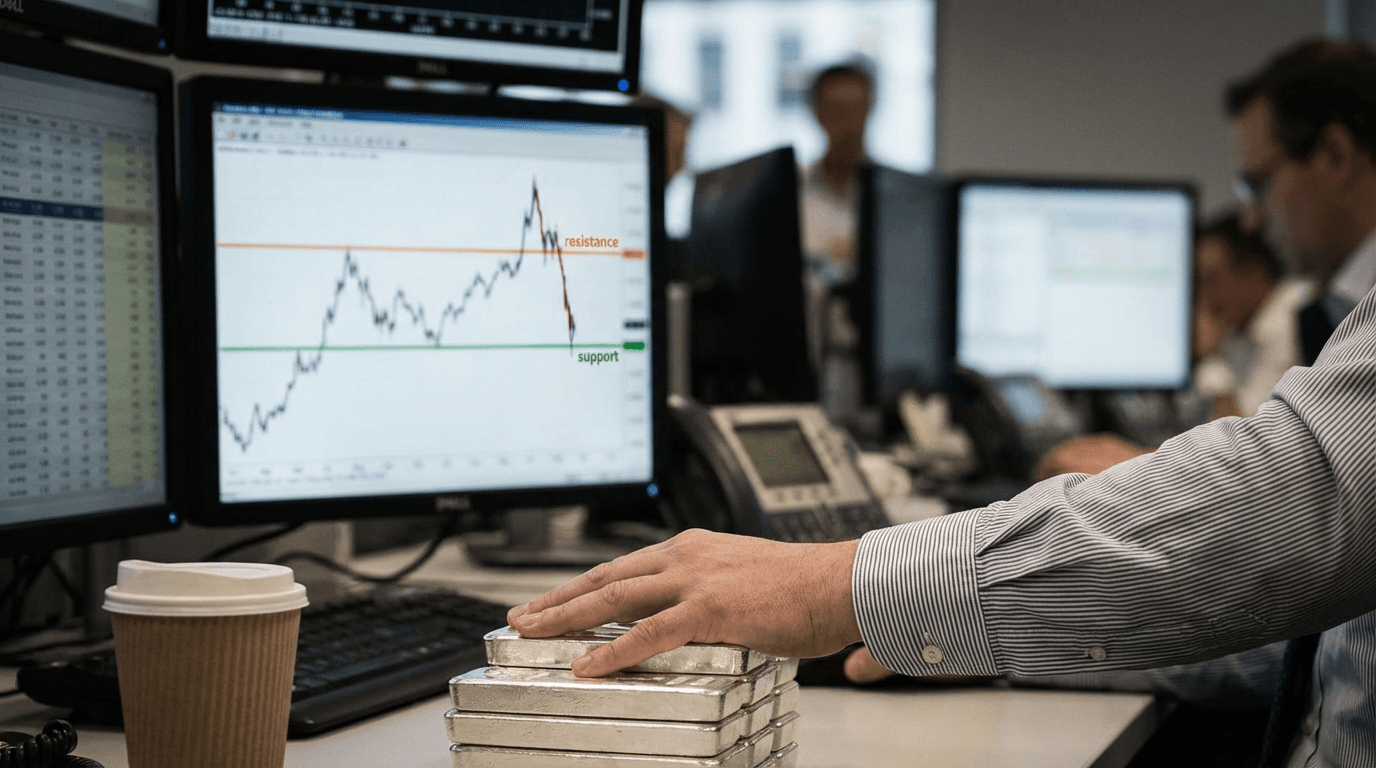
Silver prices pulled back from their 3-week high of $91.28 per ounce on Thursday amid persistent uncertainty surrounding US trade policy and mounting geopolitical tensions, though the white metal has still managed to post gains exceeding 3% for the week.[1] This modest retreat represents a critical juncture in silver's recovery narrative, as traders reassess the metal's fundamental drivers following a truly historic roller coaster ride that has defined the precious metals market so far in 2026.
To understand the significance of this pullback, context is essential. Silver exploded higher at the beginning of the year, reaching an all-time high of $121.67 on January 29, marking an extraordinary rally from its $50.96 low recorded in late November.[2] However, this euphoric ascent came to an abrupt halt just days later when silver crashed approximately 38% intraday on January 30, plummeting to lows near $70—one of the most violent precious metals selloffs in recent history.[6] What followed was a grinding, consolidation-heavy recovery throughout February, and now traders face a critical question: Can silver maintain momentum above the $91 resistance level, or will profit-taking pull prices back into the established trading range?
Understanding The Technical Setup
The technical picture for silver reveals a market caught between competing forces. Throughout February, silver has traded within a well-defined consolidation channel with clear boundaries, spending the entire month oscillating between specific price levels as buyers and sellers jockeyed for position.[6] The $91-92 price zone has emerged as significant resistance, with earlier trading this week showing silver attempting to breach this level.[1][3] Below that, the 50-day exponential moving average has provided crucial dynamic support, with traders using pullbacks to this level as buying opportunities.
The $80 level is considered an important secondary support, with the 50-day EMA potentially offering reinforcement should prices decline further.[1] However, a breakdown below $70 would represent a capitulation move with potentially far more severe consequences. This tiered support structure suggests that while near-term pullbacks may occur, the underlying technical setup remains constructive for those with medium-term bullish conviction.
Resistance, Momentum, And Market Structure
Despite the recent recovery, technical analysts have identified warning signals that warrant caution. Negative divergence on relative strength indicators (RSI), combined with overbought conditions reached during the parabolic move higher, suggests that some profit-taking may be justified at current levels.[3] When an asset rises too quickly, particularly after a crash of the magnitude silver experienced, technical consolidation becomes necessary for a sustainable advance.
This is precisely where silver finds itself today. The dramatic candlestick formation recorded on January 30—the day of the 38% crash—fundamentally altered the market's psychology, and analysts suggest that boring, sideways trading in the weeks following would represent the best-case scenario for long-term health.[1] Silver appears to be delivering exactly that outcome, albeit with more volatility than pure sideways movement might suggest.
The Drivers Behind Silver's Volatility
Multiple fundamental factors are exerting influence over silver prices during this pivotal period. Structural supply-demand dynamics continue to support the bull case, with JPMorgan forecasting that silver will average $81 per ounce in 2026—more than double its 2025 average—based partly on persistent supply deficits and robust industrial demand.[7] More aggressive analysts have even targeted $150-$400 per ounce, pointing to five consecutive years of deficit trading and China's export controls on rare earth materials and other strategic commodities.
However, recent volatility has been partially driven by speculative flows in China, with Chinese investment demand significantly influencing price formation across the entire metals complex.[7] When China's Lunar New Year holiday ended and traders returned to their desks, renewed liquidation activity initially created downward pressure, though subsequent stabilization above $88 suggested that panic selling had run its course.
The broader geopolitical environment, including 15% US global tariffs and upcoming nuclear talks with Iran, has created safe-haven demand dynamics that should theoretically support precious metals prices.[4] Yet this has offset only partially against other headwinds, underscoring how multiple competing narratives are shaping silver's trajectory.
LOOKING AHEAD: CONSOLIDATION OR BREAKOUT?
The fundamental question facing traders is whether silver can transform its February consolidation into a platform for a sustained breakout toward $100 and beyond, or whether prices will struggle to overcome resistance at $91-92 and retreat into a lower trading range. JPMorgan's cautious stance—suggesting investors wait for clarity on whether speculative "froth" has been fully removed—reflects the broader uncertainty permeating the market.
Year-to-date, silver remains up approximately 177-185% compared to a year ago, an extraordinary gain that demands respect regardless of near-term direction.[4][5] The pullback from $91 should be viewed not as a sign of weakness, but rather as a healthy consolidation in what remains structurally one of the most compelling commodity stories of 2026.