
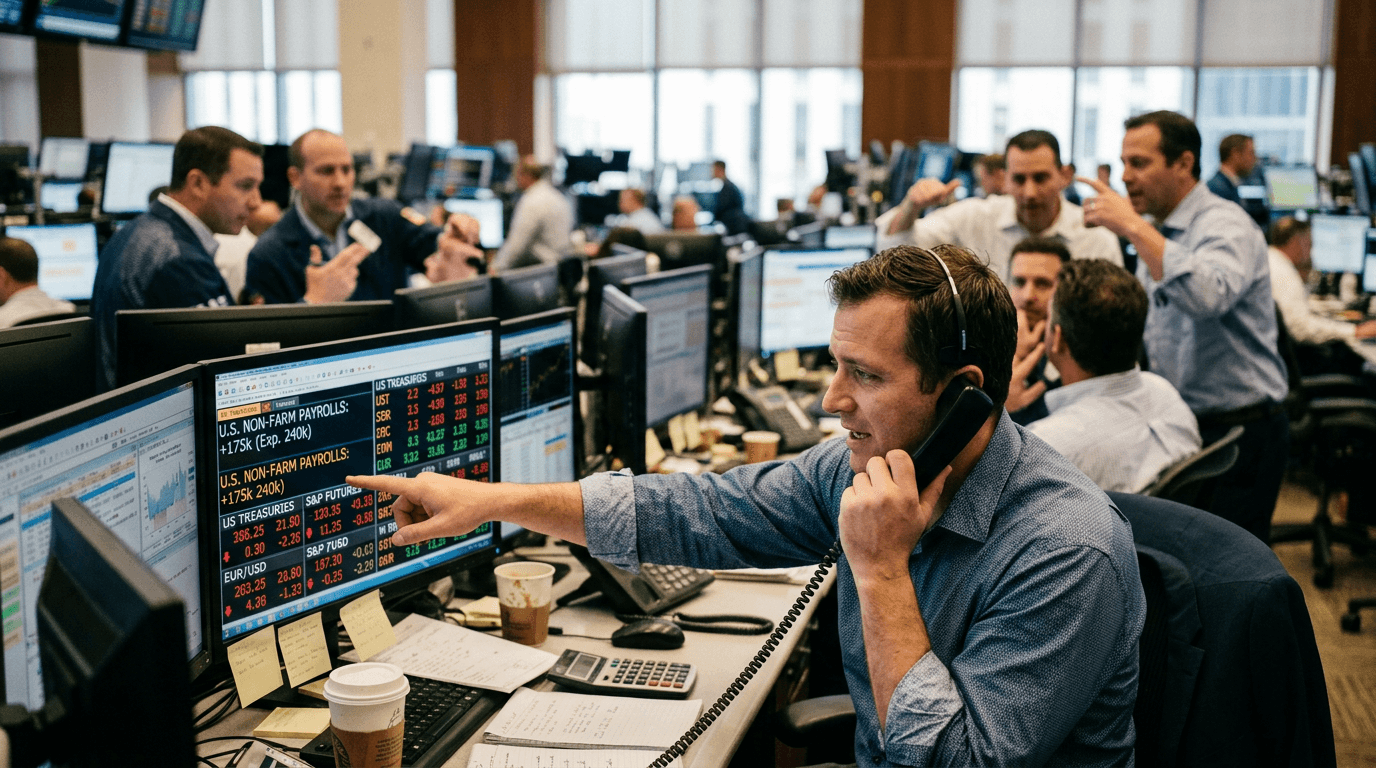
Nonfarm Payrolls sit at the heart of the US data calendar because they compress the state of the labor market into a single monthly snapshot that can quickly reshape expectations for Federal Reserve policy and ripple through rates, FX, and equity index futures.[12][14][15] In the current environment, softer payroll signals ahead of the next release are pushing markets toward a more balanced view of the Fed—less urgency to hike, but also no rush to cut—leaving traders highly sensitive to whether the upcoming data confirm a cooling yet still resilient economy.
Why Nonfarm Payrolls Matter For Rates And Futures
Nonfarm Payrolls (NFP) measure the change in the number of paid employees in the US economy, excluding farm workers and a few other categories.[14][15] Because employment is tightly linked to growth, wages, and inflation, the report is one of the Fed’s key inputs for assessing the health of the economy and calibrating interest rates.[10][11][15]
When NFP is strong—solid job gains, low unemployment, robust wages—markets often infer that the Fed has more room to keep policy tight or even raise rates to prevent overheating and contain inflation.[3][8][10][12] That tends to push short‑term yields and rate futures higher while supporting the US dollar and sometimes weighing on risk assets like equities and gold.[5][6][9][12]
Conversely, weak payroll data—slower job growth or rising unemployment—can increase the perceived likelihood of rate cuts or at least a more accommodative stance.[7][8][11][13] That usually drives rate futures to price lower policy paths, weighs on the dollar, and can support equity and index futures by easing concerns about restrictive policy.[3][8][12][13]
For futures traders, the key point is that NFP does not move markets in isolation; it reshapes the entire expected path of Fed policy, and that new path is immediately reflected in Fed funds futures, Treasury futures, and equity index futures.[4][6][12][13]
Soft Payroll Signals And A More Balanced Fed Outlook
Recent payroll‑related indicators—such as slower hiring in private surveys, modest declines in job openings, or softening in wage growth—have suggested the labor market may be cooling from its post‑pandemic strength without outright breaking. That nuance matters: a “soft, not weak” labor picture narrows the extremes in the policy debate.
In past episodes, strong upside payroll surprises have sharply increased the probability of future rate hikes, with interest rate futures swinging from pricing cuts to pricing additional tightening.[1][5][6] Similarly, disappointingly weak NFP prints have quickly reduced bets on near‑term hikes, as seen when markets marked down the probability of a July hike after a softer jobs report.[2]
The current softer tone in payroll signals is doing something different: it is encouraging markets to price a more symmetric distribution of outcomes. Instead of a one‑way “higher for longer” or “rapid cutting” narrative, futures curves increasingly embed scenarios where the Fed can:
- Hold rates steady for longer if employment remains resilient and inflation proves sticky
- Consider gradual cuts later if labor cooling broadens and inflation drifts closer to target
This middle‑ground expectation tempers extreme moves in short‑term rate futures, but it also sets the stage for potentially sharp repositioning if the upcoming NFP fundamentally challenges the “cooling but resilient” story.[6][11][12]
Implications For Fx, S&p 500, And Nasdaq Futures
Because NFP feeds directly into rate expectations, it naturally influences the US dollar, major FX pairs, and equity index futures.[3][9][12][13]
In FX, traders typically respond by recalibrating the interest rate differential between the US and other economies. A stronger‑than‑expected NFP, reinforcing the idea of higher US rates for longer, tends to support the dollar against currencies whose central banks are closer to cutting or already easing.[3][6][9][12] A softer print, especially if it hints at earlier US easing, can weaken the dollar and benefit those pairs where the non‑USD central bank is perceived as relatively hawkish or stable.[9][11][12][13]
For S&P 500 and Nasdaq futures, the relationship is more nuanced. Strong jobs can be positive for earnings and growth, but if markets conclude that resilient labor means a slower path to rate cuts, higher discount rates can reduce the present value of future cash flows, particularly for long‑duration growth stocks.[3][6][12][13] Conversely, soft but not disastrous data can be seen as the “goldilocks” outcome: enough cooling to justify easier policy down the line, without signaling imminent recession, which often supports index futures.
Right now, positioning across major FX pairs and equity index futures is increasingly built around one central question: does the next NFP confirm a gentle cooling that allows the Fed to stay patient, or does it force a more decisive shift either toward renewed tightening or toward earlier cuts?
Trading And Risk Management Around Nfp In A Simfi Environment
For traders using both live markets and simulated finance (SimFi) platforms, NFP offers a recurring opportunity to practice trading macro catalysts under uncertainty. The typical playbook around NFP includes three elements:
1. Scenario planning Traders sketch out base, bullish, and bearish labor scenarios—e.g., strong beat, in‑line, and clear miss—and map each to likely moves in rate futures, FX, and equity index futures.[6][9][13] This helps pre‑define which trades might benefit under each outcome.
2. Position sizing and optionality Given the potential for large moves on surprise prints—historically, NFP surprises have produced noticeable shifts in bond yields and futures curves—many traders prefer smaller directional positions or use options structures to express views with limited downside.[4][6][12][13]
3. Post‑release adaptation Once the data hit, the focus shifts to whether the print changes the Fed narrative meaningfully or not. There are notable cases where disappointing payrolls had little impact on the Fed’s path because inflation remained the dominant concern.[2][3][12] Recognizing when labor data is secondary to inflation helps avoid over‑reacting.
SimFi environments allow traders to test these approaches without capital at risk, refining their reaction function to NFP and building discipline around event‑driven volatility.
Key Takeaways For Futures And Fx Traders
In the current backdrop of soft payroll signals and a still‑resilient economy, three practical takeaways stand out:
- Watch the interaction between labor and inflation NFP can change the tone, but it rarely operates alone. If inflation is still above target, even a modestly soft jobs report may have a limited impact on the Fed’s path.[2][3][12]
- Focus on the surprise versus expectations Markets care more about the gap between NFP and consensus forecasts than the absolute level of job gains.[13] A seemingly “okay” number can be market‑moving if expectations were materially different.
- Link every trade to a clear rate narrative Whether you are trading EUR/USD, S&P futures, or front‑end rate futures, tie your view back to how the print alters the expected policy path—higher for longer, lower sooner, or a prolonged pause.[6][8][11][12][13]
Understanding how Nonfarm Payrolls and soft payroll signals steer rate and futures expectations is essential for navigating today’s data‑driven markets. With positioning increasingly anchored to the labor story, the upcoming NFP will be less about a single number and more about whether it validates or challenges the delicate balance traders have priced in.