
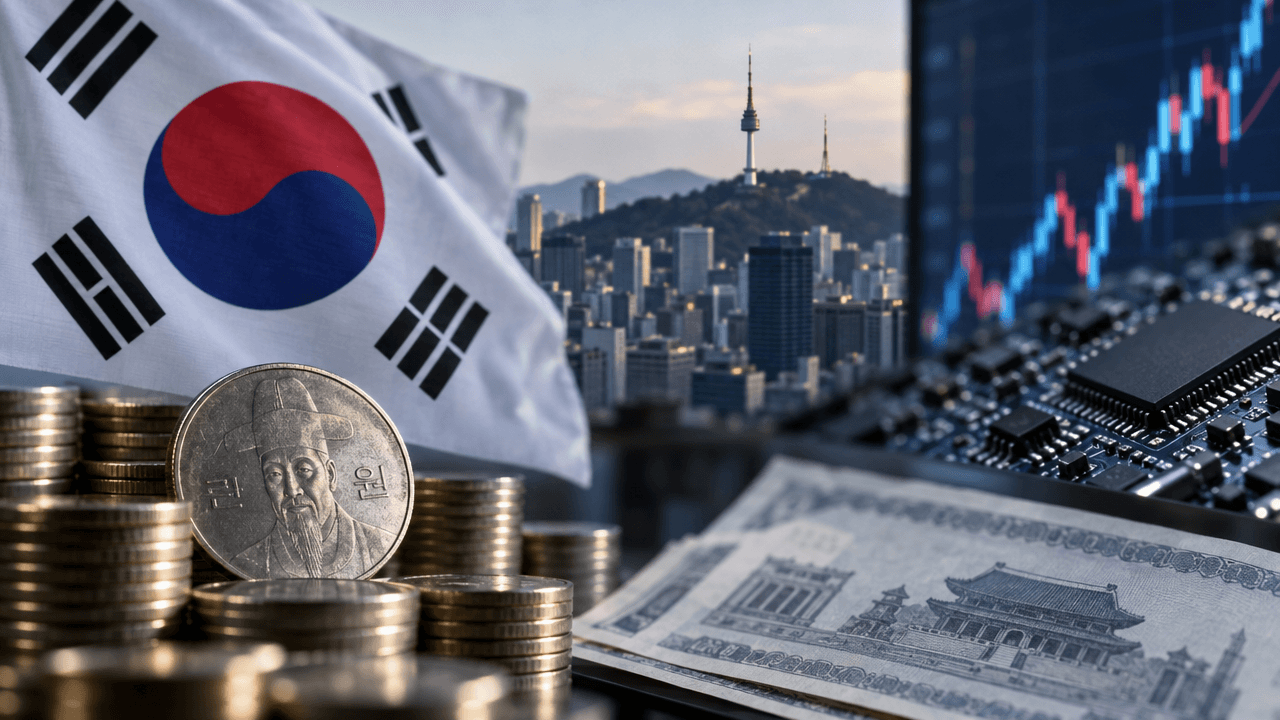
South Korea’s central bank is approaching a critical policy decision as persistent inflation strengthens expectations for another interest-rate increase. Markets are increasingly pricing a 25-basis-point hike at the Bank of Korea’s November 26 meeting, which would lift the benchmark rate from 3.00% to 3.25%. October consumer inflation remained at 2.8% year over year, well above the central bank’s 2% target. [1][2]
For traders, the decision extends beyond South Korea’s domestic economy. A rate increase could influence the Korean won, government bonds, technology stocks and broader Asian risk sentiment at a time when weakness across the technology sector is already creating uncertainty. The key question is whether the Bank of Korea is preparing one final move or signaling that borrowing costs may remain restrictive for longer.
Why Inflation Is Keeping Pressure On The Bok
The Bank of Korea’s challenge is that inflation has not returned sustainably to its target. Consumer-price growth eased only slightly from 2.9% in September to 2.8% in October, while underlying price pressures remain persistent. The central bank expects headline inflation to stay in the high-2% range in November, with global oil prices adding another layer of uncertainty. [1][9]
A 2.8% inflation rate may not appear extreme compared with the inflation surges seen in some developed economies, but it is important relative to the BOK’s 2% objective. If inflation remains above target for an extended period, consumers and businesses may begin adjusting their expectations upward. That can make inflation harder to control, especially when wage costs, services and domestic demand continue to support prices.
The BOK has also indicated that accumulated cost pressures and gradually strengthening demand-side pressures could keep inflation above target for some time. This gives policymakers a reason to prioritize price stability even if higher rates create challenges for households and companies.
Why A 25-basis-point Hike Matters
A move to 3.25% would represent a measured tightening step rather than an aggressive shock. The BOK raised rates by 25 basis points in July and August before holding at 3.00% in October. The October pause was widely viewed as a hawkish pause because policymakers left the door open to another increase. [11][14]
The likely purpose of another hike would be to reinforce the central bank’s credibility. By raising rates while economic growth remains relatively firm, the BOK could demonstrate that it intends to prevent inflation from becoming entrenched. It could also reduce the risk that the won weakens sharply against the U.S. dollar, which would make imported energy and other goods more expensive.
However, the decision is not without risks. South Korean households carry significant debt, and higher interest payments can reduce disposable income. Companies may also delay investment when financing costs rise. Policymakers must therefore balance inflation control against domestic demand, housing-market stability and financial stress.
Market Impact: Won, Bonds And Equities
The Korean won is likely to be one of the most immediate markets affected by the decision. A rate hike can support the currency by improving the relative return on won-denominated assets. The reaction will depend on whether the BOK delivers what markets already expect. If the hike is fully priced in, the won could see only a limited gain. A stronger rally would be more likely if policymakers signal additional increases.
Government bonds may react differently. A rate increase generally pressures bond prices and pushes yields higher, particularly at the short end of the yield curve. Yet if traders interpret the move as the final hike in the tightening cycle, longer-term yields could fall as markets begin anticipating eventual rate cuts. Recent trading reflects this tension: South Korea’s three-year government bond yield closed at 3.642% on November 20, while the 10-year yield ended at 3.857%. [1]
Technology stocks and other growth-oriented assets are especially sensitive to interest rates because their valuations depend heavily on future earnings. Higher discount rates can reduce the present value of those earnings. Continued weakness in the global technology sector could therefore amplify the effect of a BOK hike on South Korean equities, particularly exporters and companies with high valuations.
What Traders Should Watch
The rate decision itself is only one part of the market reaction. Traders should focus closely on the policy statement, Governor Shin Hyun-song’s press conference and any changes to the central bank’s inflation and growth forecasts.
Three signals deserve particular attention.
First, policymakers may describe 3.25% as the likely terminal rate, suggesting that the tightening cycle is nearing an end. Bond yields could stabilize or decline under that scenario.
Second, the BOK could emphasize that core inflation remains too high and that another increase may be necessary in early 2027. Some forecasts already expect a further move to 3.50% next year. [10][12]
Third, the central bank may highlight currency volatility, housing prices or household debt. Even if inflation begins to slow, financial-stability concerns could keep policy restrictive.
For SimFi traders, this event offers a useful scenario-planning exercise. Rather than predicting a single outcome, build separate plans for a hike with a hawkish message, a hike with a dovish message and an unexpected hold. Define entry levels, maximum risk and invalidation points before volatility increases. Track the won, three-year bond yields and major technology indices together instead of analyzing one market in isolation.
The Bigger Picture
South Korea’s expected rate increase illustrates how central banks are navigating a narrow path between persistent inflation and rising financial risks. A 25-basis-point hike to 3.25% would likely be interpreted as a serious commitment to price stability, but the market’s longer-term reaction will depend on what comes next.
If inflation remains above target, the BOK may need to keep rates elevated even as household debt and technology-sector weakness weigh on growth. If inflation falls steadily, November’s hike could become the final step before an extended pause.
The most important lesson for traders is to distinguish the headline decision from the policy direction. Markets move not only on whether rates rise, but also on how long policymakers expect them to remain high. In a highly connected Asian market, that guidance could shape the won, bonds and regional risk appetite well beyond the day of the announcement.