
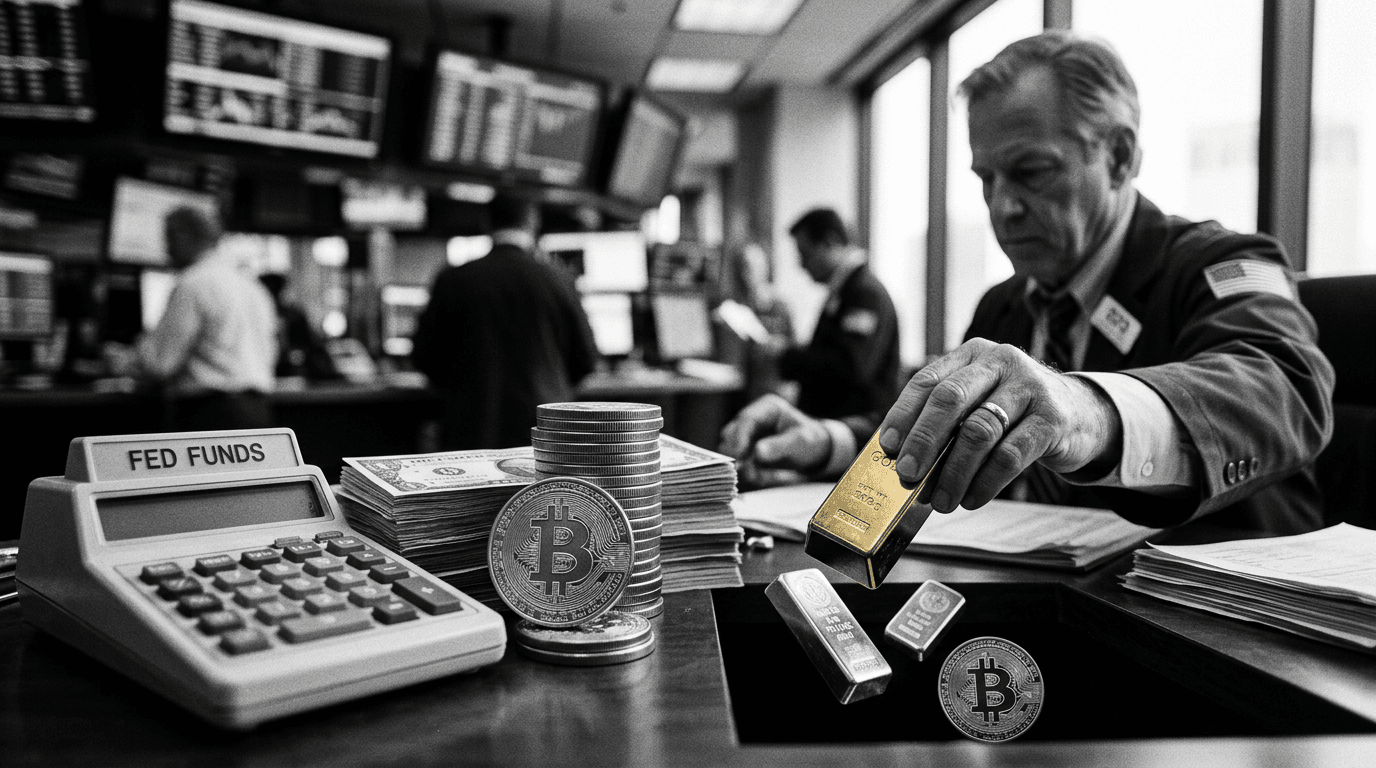
A stronger U.S. dollar and renewed fears of additional Federal Reserve rate hikes have pushed gold, silver and bitcoin down to their lowest levels of the year, shaking confidence in the popular “debasement trade.” Investors who had piled into hard assets and crypto as protection against inflation and currency debasement are now reassessing those positions as the opportunity cost of holding non‑yielding assets rises.
WHAT’S DRIVING THE LATEST SLUMP?
At the core of this move is the combination of a firm dollar and higher real yields. When the Fed signals that rates could stay higher for longer, or even rise further, yields on cash and short‑term bonds become more attractive relative to assets that do not pay income, such as gold, silver and bitcoin.
A stronger dollar effectively tightens global financial conditions. Since most commodities are priced in dollars, a rising U.S. currency makes them more expensive for non‑U.S. buyers, dampening demand and pressuring prices. That dynamic has been on display as gold and silver have slipped despite lingering geopolitical risk and still‑elevated headline inflation.
Real yields—nominal yields adjusted for inflation expectations—are particularly important. As real yields rise, the logic of holding gold or silver as an inflation hedge becomes less compelling. Investors can earn a positive real return in high‑quality fixed income without taking commodity or crypto volatility risk.
This backdrop has prompted a broad repositioning. Recent data show gold trading near $4,100 per ounce, silver around $61, and bitcoin near $62,000, all hovering around year‑to‑date lows after sharp reversals from earlier 2026 highs[6]. For traders, the message is clear: macro forces still dominate the narrative in “store‑of‑value” assets.
Gold And Silver: Sensitive To Real Yields
Gold remains the classic macro hedge, but its behavior is closely tied to interest rates, the dollar and real yields. When real yields fall or turn negative—as they did in earlier inflation waves—gold tends to outperform as investors seek protection from currency debasement and policy uncertainty. When real yields rise, gold can quickly look “expensive,” leading to profit‑taking.
Silver amplifies many of these same dynamics. It is both a monetary metal and an industrial commodity, used in electronics, solar panels and other manufacturing. That dual role creates more volatility. Silver often rallies harder than gold when the macro narrative is supportive, but it can sell off more sharply when the dollar strengthens or growth concerns emerge.
Leverage is another factor. Precious‑metals markets are heavily traded via futures and leveraged products. When prices fall and margin calls increase, forced selling can accelerate declines, even beyond what fundamentals alone would justify. The recent slide in silver following an attempted recovery shows how quickly sentiment can turn when leveraged positions unwind[3].
For longer‑term investors, these moves do not necessarily invalidate the case for precious metals, but they highlight timing risk. Buying gold or silver purely on inflation fears, without accounting for real yields and dollar trends, can lead to uncomfortable drawdowns.
Bitcoin: From Inflation Hedge To Liquidity Trade
Bitcoin’s narrative has evolved dramatically over the past few years. It was once marketed as “digital gold”—a hedge against inflation and fiat debasement—but recent market action suggests it now behaves more like a high‑beta liquidity asset.
In real terms, priced against gold, bitcoin has been declining for over a year[9]. Data show bitcoin near two‑year lows when measured in ounces of gold, signaling that the market is assigning less value to its “hard money” characteristics relative to the traditional metal[5]. Over the past 12 months, bitcoin’s price is down more than 40%, underscoring its sensitivity to risk appetite and liquidity cycles rather than pure inflation trends[7].
When the Fed tightens or the market anticipates further hikes, speculative positions in crypto are often among the first to be reduced. Higher funding costs, more attractive yields in traditional assets, and regulatory uncertainty all squeeze the crypto complex. That has contributed to an unwinding of leveraged bets and a broader sell‑off across major tokens, with bitcoin leading the move lower[3].
For traders, the key takeaway is that bitcoin’s performance is no longer reliably tied to the safe‑haven trade. It reacts strongly to macro liquidity, positioning and sentiment in risk markets. Treating it as a pure inflation hedge without considering those factors can be misleading.
ROTATION OUT OF THE “DEBASEMENT TRADE”
The “debasement trade” refers to buying assets such as gold, silver and bitcoin to protect against central‑bank money printing, fiscal deficits and perceived long‑term currency erosion. This trade flourished during periods of near‑zero rates, quantitative easing and intense inflation anxiety.
Today, the landscape is different. With cash yields and short‑term government bond yields materially higher, investors have viable alternatives to park capital and earn income. That reduces the urgency to hold non‑yielding hedges at any price.
As a result, we are seeing:
- Rotation into cash and short‑duration fixed income, where investors can earn relatively attractive yields with lower volatility.
- Selective re‑risking into equities and credit, as some participants bet that growth can persist even with higher rates.
- Reduced allocations to commodities and crypto from multi‑asset portfolios, especially where those exposures were added purely for debasement hedging.
Importantly, this is less about a complete abandonment of gold, silver or bitcoin, and more about price discipline. Investors are demanding better entry points and clearer macro justification before adding to positions.
Practical Takeaways For Traders
For active traders and those using simulated environments to refine strategies, this episode offers several actionable lessons:
1. Watch the dollar and real yields. Moves in DXY, nominal yields and breakeven inflation often lead price action in gold, silver and bitcoin. Building indicators or dashboards around these macro drivers can improve timing.
2. Separate narratives from behavior. Gold and silver still respond primarily to real yields and currency dynamics. Bitcoin responds more to liquidity and risk appetite. Treat them as distinct assets rather than a single “anti‑fiat” block.
3. Respect leverage and positioning. Crowd trades in precious metals and crypto can unwind quickly when policy expectations shift. Monitoring futures positioning, funding rates, and volatility can help anticipate forced‑selling risk.
4. Use simulation to stress‑test strategies. Simulated trading environments allow you to run scenarios of stronger‑for‑longer dollar, higher‑than‑expected Fed path, or abrupt pivots. Testing how your gold, silver and bitcoin strategies behave under different macro regimes can reveal hidden vulnerabilities before real capital is at risk.
5. Define role and time horizon for each asset. Are you using gold as a long‑term portfolio hedge, silver as a tactical trade on industrial demand, or bitcoin as a liquidity‑driven momentum play? Clear role definitions help avoid mixing investment and trading timeframes, which can be costly in volatile markets.
As the dollar remains firm and rate‑hike fears linger, volatility in gold, silver and bitcoin may persist. For disciplined traders, that volatility is not just a risk, but an opportunity—provided it is approached with robust macro awareness, scenario planning and a clear framework for each asset’s role in the portfolio.