
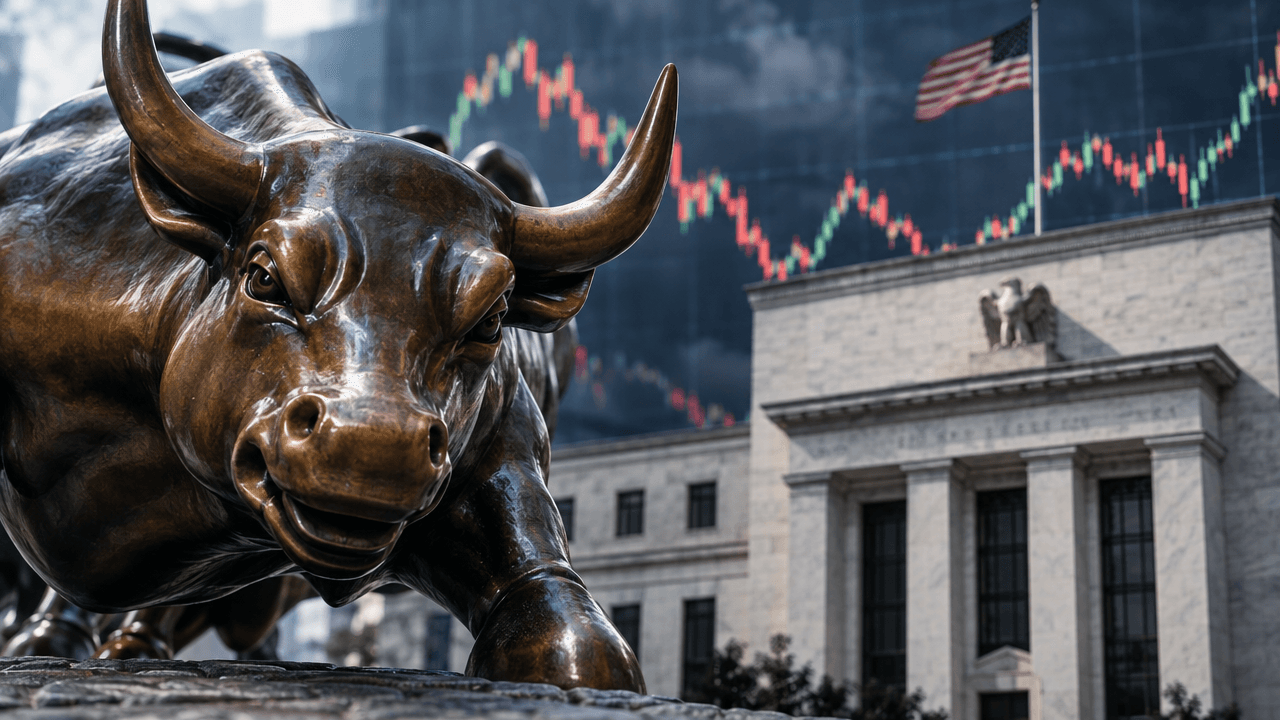
The U.S. economy delivered a powerful surprise in the third quarter, forcing traders and policymakers to rethink the path of interest rates. Real gross domestic product grew at a 4.3% annualized rate, sharply above the initial 3.4% estimate and well ahead of economists’ expectations for a revision to 3.5%. The result marked the fastest quarterly expansion in three years. [1]
For markets, the message is complicated: economic growth is strong enough to withstand restrictive monetary policy, but inflation remains too elevated for the Federal Reserve to comfortably declare victory. That combination could keep interest rates higher for longer and increase volatility across stocks, bonds, currencies, and simulated trading markets.
What Drove The Gdp Revision
The stronger GDP figure was not the result of a single statistical adjustment. Revisions showed greater strength in consumer spending and business investment, including spending related to intellectual property and technology. These gains outweighed a modest downward revision to residential construction. [5]
Consumer demand remains particularly important because it represents the largest part of the U.S. economy. When households continue spending despite elevated borrowing costs, businesses often maintain investment and hiring plans. That can create a self-reinforcing cycle of economic resilience.
Technology investment has added another layer to the growth story. Companies are spending heavily on software, data infrastructure, artificial intelligence, and other forms of intellectual property. These investments may improve productivity over time, but they also support current economic activity and can make the economy less sensitive to moderate interest-rate increases.
The revised data therefore suggests that the U.S. economy entered the final months of the year with considerable momentum. It also challenges the assumption that restrictive policy will quickly produce a sharp slowdown.
Inflation Keeps The Fed On Alert
Strong growth would normally be welcome news for financial markets. The difficulty is that inflation has not cooled enough to remove pressure from the Federal Reserve.
The core personal consumption expenditures price index, which excludes food and energy, increased 3.3% year over year in October, up from 3.1% in September. That was its largest annual increase since November 2023. Monthly core inflation rose 0.3% for the third consecutive month, while headline inflation accelerated to 3.8% from 3.6%. [11]
Core inflation is closely watched because it is generally viewed as a better guide to persistent price pressures than the more volatile headline measure. A sustained reading above the Fed’s 2% target suggests that demand, wages, services, or other underlying pressures remain strong.
The GDP report contained one more nuanced detail: the price index for the third quarter was revised lower, showing prices rising at a 1.9% annualized rate during the quarter. [5] That softer quarterly reading is encouraging, but the more recent October inflation data points in the opposite direction. Traders must now weigh an earlier period of moderate price growth against evidence that inflation has begun to broaden again.
What It Means For Interest Rates
The economic data strengthens the case for a cautious Federal Reserve. A central bank is more likely to maintain or raise rates when growth is accelerating, consumers are still spending, and inflation is moving away from its target.
Financial markets were pricing in a 25-basis-point rate increase at the Fed’s December 8–9 meeting, lifting the benchmark range from 3.75%–4.00%. Markets were also anticipating another increase in January. [3]
That outlook is not guaranteed. Monetary policy works with a lag, and the Fed must consider the possibility that earlier rate increases will eventually slow hiring, investment, and household spending. Policymakers also need to monitor financial conditions. If bond yields rise sharply or equity prices fall, the economy could face additional tightening even without an immediate policy move.
The new figures make rapid rate cuts less likely, while the possibility of additional hikes remains firmly on the table. For traders, the key question is no longer simply whether the Fed will ease policy. It is whether inflation can cool without requiring a significantly weaker economy.
Practical Takeaways For Traders
First, interest-rate-sensitive assets may remain volatile. Strong growth and persistent inflation can push Treasury yields higher, which may pressure long-duration stocks, growth companies, and other assets whose valuations depend heavily on future cash flows.
Second, the U.S. dollar could receive support if markets continue to price in higher rates. However, currency moves will also depend on economic data from other major economies and on whether investors view U.S. growth as sustainable.
Third, traders should avoid treating one GDP revision as a complete forecast. GDP is backward-looking, and later estimates can change. Upcoming employment, inflation, retail-sales, and consumer-confidence reports may provide more timely evidence about whether momentum is continuing.
Finally, risk management becomes more important when market expectations are shifting. Traders can define position sizes in advance, identify invalidation levels, and avoid assuming that a strong economic report automatically means stocks will rise. Good news for the economy can be negative for equities if it causes interest rates to climb.
The Broader Market Outlook
The latest data presents a U.S. economy that is stronger than previously understood, but not necessarily easier for policymakers to manage. Growth at a 4.3% annualized pace gives the Federal Reserve room to keep policy restrictive. Rising core inflation, meanwhile, limits the argument for rapid easing.
For SimFi traders, this is a useful example of why markets react to the relationship between data points rather than to a single headline. Strong GDP can support corporate earnings, yet the same strength can prolong high interest rates. Lower inflation can support bonds and growth stocks, but weakening demand may hurt profits.
The next phase of the rate outlook will depend on whether inflation resumes its decline or continues to accelerate. Until that question is answered, markets may remain sensitive to every major release. The central theme is clear: resilient growth has reduced recession fears, but it has also made the Federal Reserve’s policy decision more difficult.