
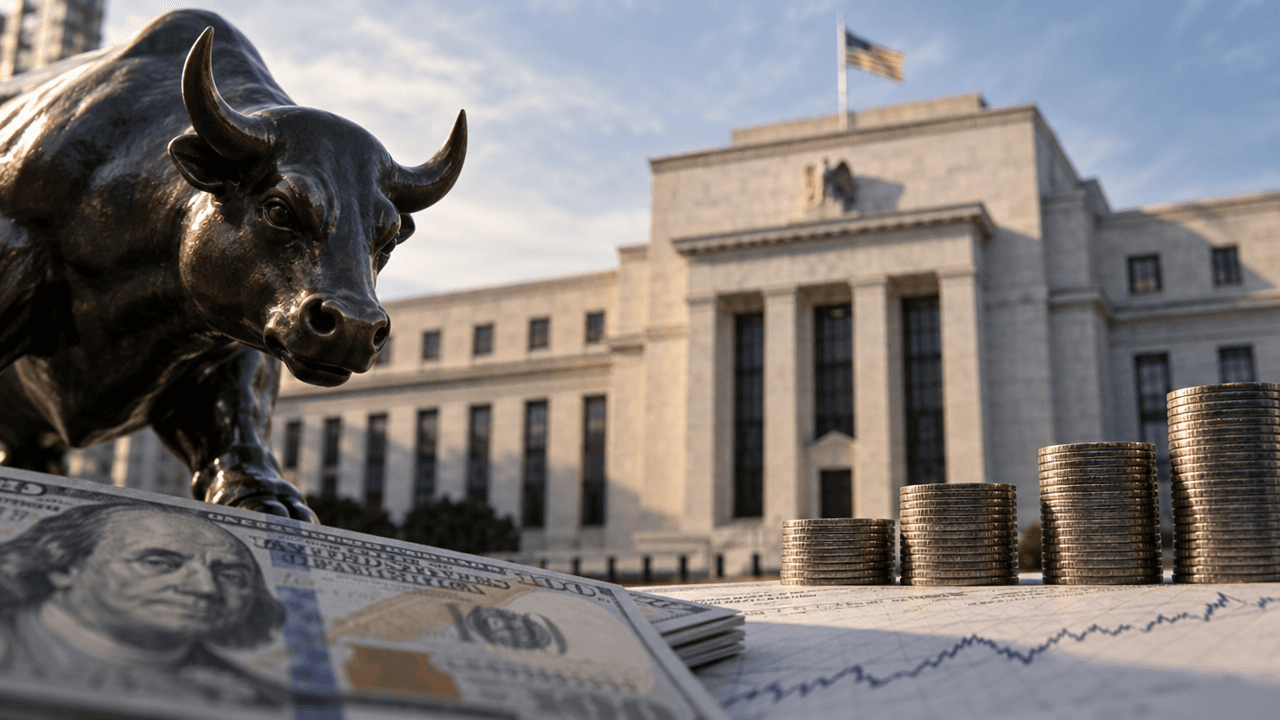
A stronger-than-expected U.S. jobs report has changed the market’s interest-rate conversation. Employers added 165,000 jobs in October, far exceeding forecasts near 65,000, while the unemployment rate declined to 4.1%. September payroll growth was also revised higher, from 29,000 to 60,000. [1][2]
The report suggests that the U.S. labor market remains more resilient than recent economic uncertainty had implied. For traders, that resilience matters because it gives the Federal Reserve more flexibility to keep monetary policy restrictive—or even raise rates again—to contain inflation.
Why The Payrolls Report Matters
Payrolls are among the most closely watched economic indicators because employment influences consumer spending, wage growth, inflation, and overall economic momentum. A weak report can encourage expectations for lower interest rates, while a strong report can produce the opposite reaction.
October’s gain was particularly notable because economists had anticipated a much smaller increase. The consensus forecast was around 65,000 jobs, meaning the actual result was roughly two and a half times stronger than expected. The unemployment rate also moved lower, reinforcing the impression that labor-market conditions have not deteriorated as sharply as some investors feared. [3][9]
The report does not guarantee that the economy is accelerating across every sector. Monthly payroll data can be volatile, and revisions are common. However, the size of the surprise was large enough to affect expectations for the Federal Reserve’s next decision.
Rate-hike Expectations Move Higher
Before the employment data, traders were already debating whether the Fed would raise its benchmark interest rate at its December 8–9 meeting. The October payrolls figure strengthened the case for another quarter-point increase.
Market-based estimates placed the probability of a December rate hike near 77% after the report, up from approximately 67% previously. [5][8] Other measures put the probability close to 70%, but the direction was consistent: investors became more confident that policymakers could raise rates again.
The reasoning is straightforward. A labor market that continues to generate jobs can support household income and spending. If demand remains firm while inflation is still above the Fed’s preferred level, policymakers may worry that price pressures could remain persistent. Higher rates are one way to slow borrowing, investment, and consumption.
The Fed must still consider additional information before December, including inflation data, wage growth, and financial conditions. A strong payrolls report increases the probability of a hike, but it is not the only factor determining policy.
Bonds And The Dollar Respond
The immediate reaction appeared most clearly in fixed-income and currency markets. Treasury yields moved higher as traders adjusted expectations for short-term interest rates. The two-year Treasury yield, which is especially sensitive to Fed policy, rose about six basis points to 4.52%, while the ten-year yield increased roughly three basis points to 4.87%. [13]
Bond prices and yields move in opposite directions. When traders expect interest rates to remain higher, they generally sell existing bonds, pushing their prices lower and their yields higher. The payrolls report therefore created pressure across the Treasury curve, although the initial move moderated in some maturities.
The U.S. dollar also benefited. The dollar index rose approximately 0.7% to 102.22 after the data, reflecting the prospect of relatively higher U.S. interest rates compared with other major economies. [13]
A stronger dollar can affect markets in several ways. It may reduce the overseas value of U.S. companies’ international revenue, make commodities priced in dollars more expensive for foreign buyers, and tighten financial conditions for emerging-market borrowers with dollar-denominated debt.
Why Rate-sensitive Equities Feel Pressure
Higher yields can be challenging for rate-sensitive equities, particularly growth and technology stocks. Many growth companies are valued partly on profits expected years in the future. When bond yields rise, those future cash flows are discounted at a higher rate, which can reduce their present value.
Real estate investment trusts, utilities, small-cap companies, and highly leveraged businesses can also face pressure because their financing costs rise as interest rates remain elevated. Investors may rotate toward financial companies or defensive sectors that are less sensitive to borrowing costs.
The market response was not uniformly negative. One report showed the S&P 500 higher after the release, while Treasury yields rose and equity movements remained relatively contained. [11] That combination suggests investors viewed the data as important but not necessarily as a reason to radically change their broader market outlook.
For traders, the key lesson is that a strong economic report can be bearish for some assets and supportive for others. “Good news” for employment is not automatically good news for every investment. The market reaction depends on how the data changes interest-rate expectations.
Practical Takeaways For Traders
First, compare economic data with expectations, not just with the previous month. The 165,000 payroll gain mattered because it substantially exceeded forecasts.
Second, watch the two-year Treasury yield and Fed funds futures when evaluating rate-sensitive market reactions. These instruments often reveal shifts in policy expectations faster than longer-term economic narratives.
Third, avoid treating one monthly report as a complete trend. Revisions, seasonal adjustments, participation data, wage growth, and inflation will help determine whether the October strength is durable.
Finally, build scenarios rather than relying on a single forecast. A December hike could support the dollar and short-term yields while weighing on growth stocks. A weaker inflation report, however, could still reduce the likelihood of further tightening even after strong payroll growth.
Conclusion
October’s payrolls report delivered a clear message: the U.S. labor market remains stronger than expected. The 165,000-job increase and lower unemployment rate lifted expectations for a December Fed hike, pushed Treasury yields higher, and supported the dollar. [1][13]
For financial-market participants, the report is a reminder that economic data influences prices through monetary policy expectations. The next phase of the market reaction will depend on whether inflation and wage data confirm that the economy is strong enough—and price pressures persistent enough—to justify another rate increase.