
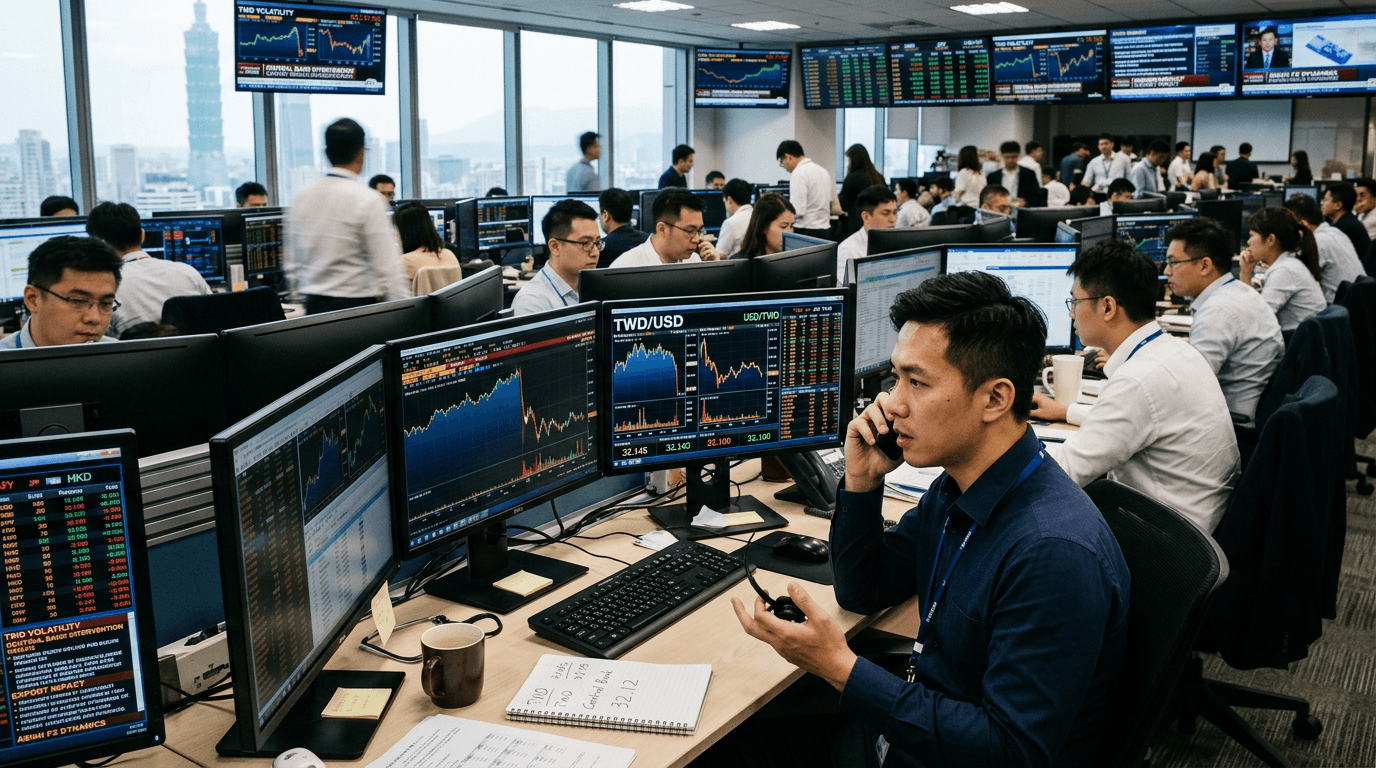
Taiwan’s dollar is trading in a very different world today: the central bank has moved from quietly “leaning against the wind” to actively stamping out sharp currency swings, reshaping how the TWD behaves, how exporters hedge, and how traders think about Asian FX risk.[11][12] This shift matters far beyond Taipei, because Taiwan sits at the heart of global tech supply chains and regional capital flows.
TWD UNDER THE BIG BOSS: WHAT’S CHANGED
Taiwan operates a managed floating exchange rate regime, where the New Taiwan dollar is in principle set by market supply and demand, but the central bank intervenes when volatility becomes excessive or disorderly.[7][9][20] Historically, that meant periodic smoothing operations and quiet guidance to banks; today, the approach is more visible and more assertive.
The central bank has emphasized that interventions are reserved for episodes of “excess volatility” or disruptive moves that threaten economic and financial stability, echoing language also used in its joint statements with the U.S. Treasury.[8][9] In practice, however, the scale of recent operations shows how serious the commitment to stability has become.
In 2024, the bank’s two-way smoothing operations—buying and selling FX to counter sharp moves—resulted in net FX sales of about US$16.4 billion, a clear sign it was actively leaning against depreciation pressure.[11] In one recent month, reserves fell by roughly US$8.6 billion to around US$596.9 billion, mainly because the bank sold dollars to stabilize the TWD during capital outflows.[11] For traders, that level of activity is a strong signal: the “Big Boss” will not just watch from the sidelines when volatility spikes.[12]
How The Cbc Smooths Currency Swings
Under the hood, Taiwan’s FX playbook is built around real-time surveillance, targeted controls, and liquidity provision tools designed to keep the market orderly.[2][7][9]
Key elements include: - A real-time reporting system for large foreign exchange settlements, allowing the bank to track big capital inflows and outflows as they happen.[2][7][9] - On-site and off-site supervisory mechanisms to ensure that forward FX transactions are backed by real trade or investment flows, curbing pure speculation.[2][7][9] - “Leaning against the wind” operations—two-way FX interventions that smooth sharp moves without pegging the currency to a fixed level.[7][9]
On the liquidity side, the central bank can provide foreign currency through call loans and swaps via authorized banks, helping corporates and insurers meet their hedging and funding needs during stress periods.[2][7] It also uses standard monetary policy tools—discount window, open market operations, re-deposits—to ensure domestic funding markets remain well supplied, even when global risk sentiment turns.[2]
More recently, the toolkit has expanded into explicit FX-related controls. The bank introduced a daily US$10 million cap on corporate FX transactions for large manufacturers, a T+1 settlement rule for overseas investors’ securities-related remittances, and tighter limits on foreign investors’ use of inverse ETFs to speculate on TWD via equity hedges.[13][14] These measures directly constrain the ability of large players to push the currency around, reinforcing the drive to lower volatility.
Impact On Exporters, Investors, And Traders
For Taiwan’s exporters—especially in electronics and semiconductors—exchange-rate stability reduces the risk that profits are unexpectedly wiped out by a sudden TWD surge.[11] A smoother currency path makes pricing in dollars easier, stabilizes margins, and allows firms to plan hedging programs with more confidence.
There is a trade-off. A very stable or slightly weaker TWD can support export competitiveness in global markets, but aggressive intervention carries the risk of being perceived as “backdoor currency manipulation” if it systematically leans in favor of exporters.[5] Taiwan has been careful to frame its actions as volatility management rather than targeting a specific level, aligning with the managed float principles it has communicated to international partners.[8][9]
For local insurers and asset managers, the central bank’s measures to reduce hedging costs and allow more flexible FX asset management are designed to strengthen balance sheets and improve resilience to exchange-rate swings.[14] Lower hedging costs free up capital, which can then be deployed more productively or used to absorb shocks when volatility returns.
For traders, both on live markets and in simulated environments, the message is clear: the TWD has become more of a “mean-reversion” currency in the short term. Sudden spikes or mini-crashes are more likely to be met with smoothing operations, and speculative extreme moves face growing constraints via reporting systems and position limits.[7][9][13][14] Strategies that relied on repeated breakout moves in TWD may now face a tougher environment, while those designed around range-trading, carry, or relative value across Asian FX baskets may find more consistent conditions.
Regional Fx Ripple Effects
Taiwan’s approach is not happening in isolation. Across Asia, central banks are increasingly treating FX as a key channel of systemic risk, not just a passive macro outcome.[11] Taiwan’s assertive stance on volatility management, backed by large reserves and a sophisticated monitoring framework, contributes to a broader regional pattern of “active but flexible” currency management.
When Taiwan steps in to smooth TWD moves, it can influence regional portfolio flows. For example, selling dollars to support TWD during outflows may dampen USD strength against other Asian currencies at the margin, while tighter controls on speculative behavior can redirect risk-taking into more liquid markets like KRW, SGD, or CNH. Over time, such interventions can narrow implied volatility and option premiums on TWD, prompting traders to adjust how they hedge broader Asia FX exposure.
At the same time, the central bank’s commitment to avoid formal capital controls and to keep the currency broadly market-driven reassures international investors that Taiwan is not closing its doors.[11] The balance between openness and active management is delicate—but if managed well, it can enhance Taiwan’s reputation as a stable yet tradable FX market.
How Traders Can Adapt
For traders and SimFi participants looking to navigate this new regime, a few practical adjustments stand out:
- Focus on regimes, not just levels Understand when the central bank is likely to step up interventions—periods of sharp portfolio outflows, global risk-off episodes, or rapid one-way moves in TWD against USD. Those regimes shape whether trend-following or mean-reversion strategies are more effective.[11][12]
- Adjust expectations for intraday volatility With more frequent smoothing operations and tighter controls on speculative flows, intraday ranges may compress, and extreme tails become less common. This favors strategies that harvest small, repeated edges rather than hunting for rare, explosive moves.[7][9][13][14]
- Watch policy signals as closely as price action Statements about “adequate capacity” to maintain stability, references to “disorderly” moves, or updates to FX-related regulations can be as important as technical levels on a chart.[1][10][11][13][14] In a managed float, the policymaker’s reaction function becomes a key trading input.
- Think in cross-asset terms Because Taiwan’s central bank coordinates FX operations with broader financial stability tools, episodes of TWD smoothing may coincide with moves in rates, equities, and credit spreads.[2][4][11] For risk managers and portfolio traders, TWD is not just a currency; it is a signal about the broader stance of Taiwanese policy.
As Taiwan’s “Big Boss” continues to prioritize exchange-rate stability, the TWD is evolving into a currency where volatility is managed, not eliminated.[11][12] For exporters, that offers valuable predictability; for traders, it demands more nuanced, regime-aware strategies. In both live and simulated markets, understanding how and why central banks like Taiwan’s step into FX is becoming a core skill for navigating the next era of Asian currency management.