
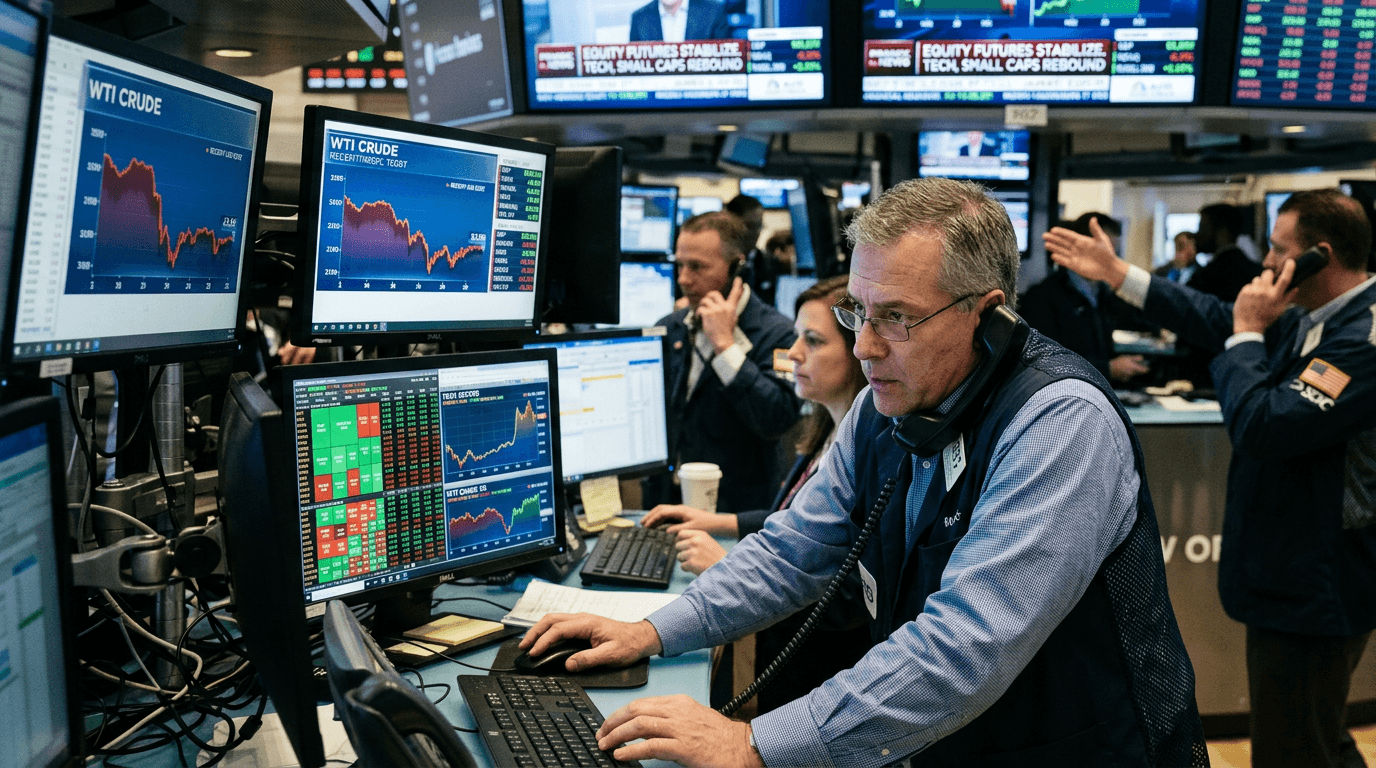
US equity futures are catching their breath after a bruising selloff, with tech and small-cap names attempting a rebound that mirrors the late-session recovery in cash markets. After a risk-off rush tied to an oil spike and geopolitical tensions, major US indices closed higher, led by the Nasdaq and Russell 2000, as dip-buyers stepped back into growth and smaller companies.[2][3] Futures have shifted from flashing stress to signaling a more balanced stance, but headline risk from Iran and tariffs is keeping intraday volatility elevated.[2][3]
Markets Catch Their Breath After A Turbulent Selloff
The latest bout of volatility began with a sharp drop in US equities, as investors reacted to a combination of surging oil prices and escalating geopolitical headlines. Higher energy costs can act like a tax on consumers and businesses, while geopolitical uncertainty tends to push traders into safer assets and away from high-beta stocks.
In that environment, equity futures initially traded deep in the red, reflecting expectations for a weaker open and further de-risking. The S&P 500 recently endured a near 3% single-day decline, its worst session of the year, driven in part by concerns about tighter financial conditions and geopolitical risk.[2] Rate-sensitive sectors, especially technology, came under pressure as Treasury yields climbed and traders reassessed the path of monetary policy.[2]
What made this episode notable is how quickly sentiment flipped. By the close, the Nasdaq and Russell 2000 had led a move higher in cash markets, signaling renewed appetite for growth and small-cap exposure after the selloff.[2][3] Futures have followed suit: instead of extreme risk-off pricing, index futures now reflect a more neutral, wait-and-see stance, even as intraday swings remain wide.[6]
Tech And Small Caps Lead The Rebound
Tech and small caps are often the first to move both down and up when markets are stressed. They tend to be more sensitive to changes in interest rates, risk appetite, and growth expectations, which makes them central in any reversal from panic to cautious optimism.
In the latest rebound, semiconductor and broader tech names have played a leading role. Chip stocks, which slumped heavily during the rout, were among the strongest gainers as sentiment improved and investors rotated back into growth themes.[2][3] Indices tracking semiconductor performance have posted outsized gains, and several major chipmakers have ranked among the top percentage winners on the Nasdaq.[2]
Small caps, tracked by the Russell 2000, have also bounced as traders looked for oversold opportunities and rebalanced away from defensive mega caps. Because smaller companies are typically more domestically focused and more sensitive to economic and policy uncertainty, their recovery can signal a shift from pure risk aversion toward selective risk-taking.
For active traders, this pattern reinforces a familiar lesson: when volatility spikes, the sectors that drop hardest can also be the ones that rebound fastest if the macro narrative stabilizes. That dynamic is now visible both in cash indices and in futures pricing.
What Futures Are Signaling Now
Equity index futures are one of the best real-time gauges of market sentiment. They trade almost around the clock, digesting new information long before the opening bell. When we say US equity futures have “steadied,” it means prices have moved off extreme risk-off levels and are now implying a relatively modest move at the next open.
Premarket dashboards for Dow, S&P 500, and Nasdaq futures show how quickly implied opens can flip from sharply negative to slightly positive as headlines evolve.[7][8] Following the initial shock, futures tied to tech-heavy indices such as the Nasdaq 100 have shifted from deep losses to mild gains, reflecting growing confidence that the selloff may have overshot fundamentals.[3][6] Meanwhile, small-cap futures echo the Russell 2000’s late-session bounce, hinting at renewed interest in higher-risk domestic names.
This does not mean the risk has disappeared. Futures remain highly sensitive to updates on Iran, tariffs, and energy markets. A single headline can widen bid-ask spreads and push prices sharply in either direction, especially during thinner overnight liquidity. For traders, “steadied” futures should be read less as a guarantee of calm and more as a sign that the immediate panic phase has passed, giving way to a more two-sided debate about the path forward.
Key Takeaways For Active And Simulated Traders
For traders operating both in live markets and on simulated finance platforms like E8 Markets, the current environment offers several practical lessons:
First, understand that futures are a sentiment barometer, not a certainty. A deeply negative futures session may attract aggressive dip-buyers if the news flow improves, just as a positive futures session can reverse if new risks emerge. Treat futures levels as probabilities, not predictions.
Second, recognize the role of sector beta. Tech and small caps typically have higher volatility and greater sensitivity to macro surprises. When conditions are fragile, these segments can move multiples of the broader market both on the downside and the upside. In a simulation environment, tracking how different sectors respond to the same macro shock is a powerful way to learn about correlation and risk.
Third, risk management must adapt to headline-driven markets. Wide intraday swings increase the importance of position sizing, stop-loss discipline, and scenario planning. Traders can benefit from running through “what if” drills—how their portfolio or strategy reacts if oil spikes again, if geopolitical tensions re-escalate, or if new tariff headlines hit across sectors.
Finally, the recent pattern illustrates the psychology of dip-buying. When selling is driven more by fear and forced positioning than by fundamentals, sharp reversals are common. Simulated trading can help participants practice distinguishing between genuine regime shifts and short-lived panic moves, refining their timing and entry criteria without real capital at risk.
What To Watch Next
Looking ahead, several drivers will determine whether this rebound in tech and small caps has legs or proves to be just another reflex rally in a choppy tape.
Oil prices remain central. Another sharp spike could reignite inflation concerns and pressure rate-sensitive assets, while sustained stabilization would support the thesis that the worst of the shock is behind us. Geopolitical risk, especially around Iran and broader regional tensions, will continue to shape safe-haven flows and risk appetite.[2][3]
Tariff headlines and trade policy are another key swing factor. New or expanded tariffs can hit small caps and cyclical sectors particularly hard, given their exposure to supply chains and input costs. Conversely, signs of de-escalation or negotiated solutions tend to favor higher-beta segments like tech and small caps.
On the macro front, labor market data, inflation releases, and central bank communication will influence the path of yields and, by extension, the valuation of growth stocks.[2] If bond markets stabilize and policy expectations become more predictable, that backdrop could support a more durable rotation back into growth and smaller companies.
For traders, the message is clear: futures may have steadied, but the narrative is still evolving. Monitoring futures alongside cash markets, sector indices, and macro indicators helps build a coherent picture of risk and opportunity. In both live and simulated environments, this kind of structured, data-driven approach is essential for navigating the kind of fast-changing conditions highlighted by the recent selloff and rebound.