
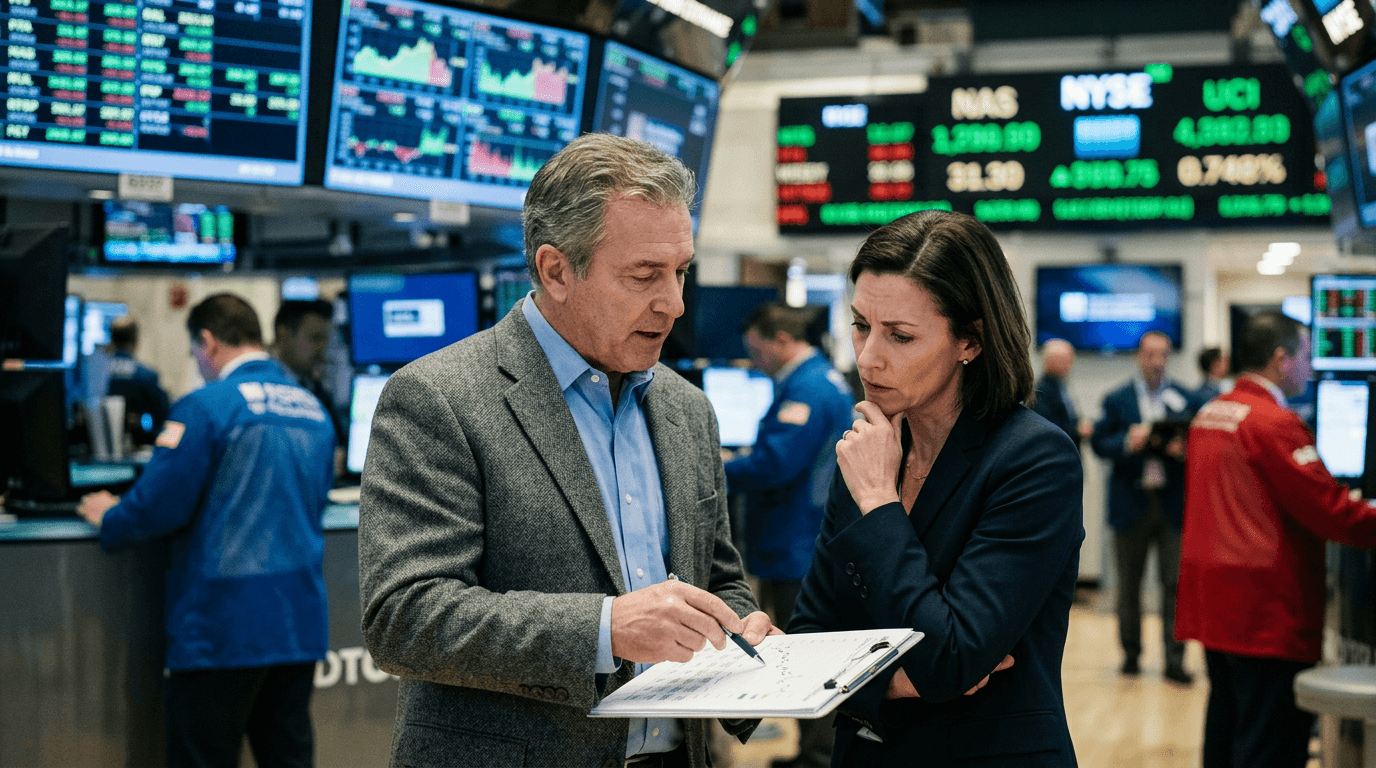
Equity index futures were little changed after a powerful tech- and AI-led rally, suggesting a market catching its breath rather than signaling an immediate reversal.[4] Nasdaq 100 futures are consolidating near recent highs, while S&P 500 futures hold steady as traders rotate into more defensive sectors and wait for fresh economic data and central bank commentary to validate the latest risk-on move.[4][6] For active traders, this mix of optimism and caution creates a nuanced backdrop that rewards preparation and disciplined scenario planning rather than bold directional bets.
Markets Pause After A Tech-led Surge
The recent rally has been driven largely by mega-cap technology and AI-related names, which have pushed growth indices like the Nasdaq 100 to or near record territory.[6] When a single group leads so strongly, it often leaves traders asking whether the move is sustainable or vulnerable to a sharp mean-reversion if sentiment shifts.
Steady futures after a strong session typically indicate that investors are in “information-gathering” mode rather than rushing to chase prices higher or aggressively lock in profits.[4] In this phase, futures markets act as a real-time barometer of how comfortable traders are with current valuations and the economic narrative underpinning them.
For SimFi traders, this is an ideal time to step back and assess whether their strategies are overly dependent on one theme—such as AI or large-cap tech—or whether they are diversified enough to weather a shift in leadership.
What Steady Futures Are Telling Us
S&P 500 futures and Nasdaq 100 futures are standardized contracts that allow market participants to speculate on or hedge against the future level of these equity indices.[3] E-mini S&P 500 futures, for example, are electronically traded contracts tied to the S&P 500 and widely used by both institutional and individual traders for index exposure and risk management.[1][5] When these futures trade flat after a big move, it can mean several things:
First, it often reflects a balance between buyers who believe the uptrend can continue and sellers who see stretched valuations or macro risks. Neither side is dominant enough to move the market significantly before new information arrives.
Second, flat index futures alongside sector rotation can signal a “maturing” phase of a rally, where the market broadens out or tilts toward quality rather than simply rewarding the most speculative names.
Third, the relative performance between S&P 500 futures and Nasdaq futures can provide a read on style rotation—growth vs. value, cyclical vs. defensive—and how traders are positioning for the next macro data releases.[4]
In a simulated trading environment, monitoring index futures alongside sector performance can help you test ideas about leadership shifts, factor rotations, and hedging strategies without putting real capital at risk.
Rotation Into Defensives: What It Really Means
While tech continues to dominate the headlines, flows are increasingly rotating into classic defensive sectors such as utilities, consumer staples, and healthcare—areas that tend to hold up better when growth expectations become less certain. This rotation often occurs when traders want to stay invested in equities but reduce portfolio sensitivity to economic surprises or policy shocks.
Defensive leadership does not automatically imply an imminent downturn. Instead, it can signal a more balanced, late-cycle character to the rally: risk assets still find support, but capital gravitates toward companies with stable cash flows, pricing power, and lower earnings volatility.
For traders, the key takeaway is that the market narrative may be shifting from “pure AI euphoria” to a more nuanced story that values resilience and quality. In practice, this can be explored through:
Rotating part of a simulated portfolio from high-beta tech into defensives to test how it impacts volatility and drawdowns during macro surprises.
Evaluating whether correlated exposures—such as multiple AI-related positions—are amplifying risk beyond what headline index levels suggest.
Simulating sector-pair trades, such as long defensives vs. short a cyclical or high-beta sector, to learn how relative-value strategies behave around data releases.
Data, Central Banks, And The Next Catalyst
The next leg for futures and equities will likely be driven by upcoming macro releases and central bank communication. Traders are focused on data that shape the inflation and growth outlook—such as price indices, employment reports, and consumer spending—as these metrics influence expectations for interest rate paths and financial conditions.
Central bank speeches and meeting minutes are equally important, as they can either validate the market’s optimistic scenario of cooling inflation and resilient growth or challenge it with a more hawkish tone. Because index futures incorporate these expectations in real time, their behavior around such events is often a leading indicator of sentiment shifts.
For SimFi traders, this environment is ideal for:
Practicing trading around event risk—building and testing rules for when to scale down leverage or reduce exposure ahead of major releases.
Backtesting how different strategies (trend-following, mean-reversion, sector rotation) would have performed during prior periods of intense macro focus.
Tracking how implied volatility and futures pricing change as key events approach, to better understand how the market prices uncertainty.
Practical Strategies For Traders In A Steady-futures Environment
When futures are steady but underlying sector leadership is rotating, the opportunity set shifts from directional index calls to more nuanced strategies:
First, focus on risk management rather than prediction. In both live and simulated markets, this is an ideal period to refine position sizing rules, stop-loss placement, and diversification guidelines. The goal is not to guess the next headline, but to build a framework robust enough to handle different outcomes.
Second, watch market breadth, not just index levels. If the major indices remain near highs while fewer stocks participate in the upside, the rally may be narrowing—a potential warning sign. Conversely, if defensives and quality names join the advance, it can indicate a healthier, more sustainable bull phase.
Third, use scenarios, not forecasts. Map out at least two or three macro paths—such as “soft landing,” “sticky inflation,” or “growth scare”—and design simulated portfolios for each. Then track which scenario the data and price action appear to be validating over time.
Outlook: Balancing Opportunity And Caution
The current setup—Nasdaq and S&P 500 futures steady near elevated levels, tech still strong, and money rotating into defensives—reflects a market that is optimistic but cautious. Traders are not abandoning risk, but they are increasingly selective about where they deploy it and are looking to upcoming data and central bank communication for confirmation.
For traders on a simulated platform, this is a valuable learning environment. It allows you to experiment with sector rotation, event-driven strategies, and risk management techniques when markets are neither in full-blown panic nor complacent euphoria. Use this period to build and test a playbook—so that when the next major data release or policy shift arrives and futures move decisively, you are not reacting emotionally, but executing a well-thought-out plan.