
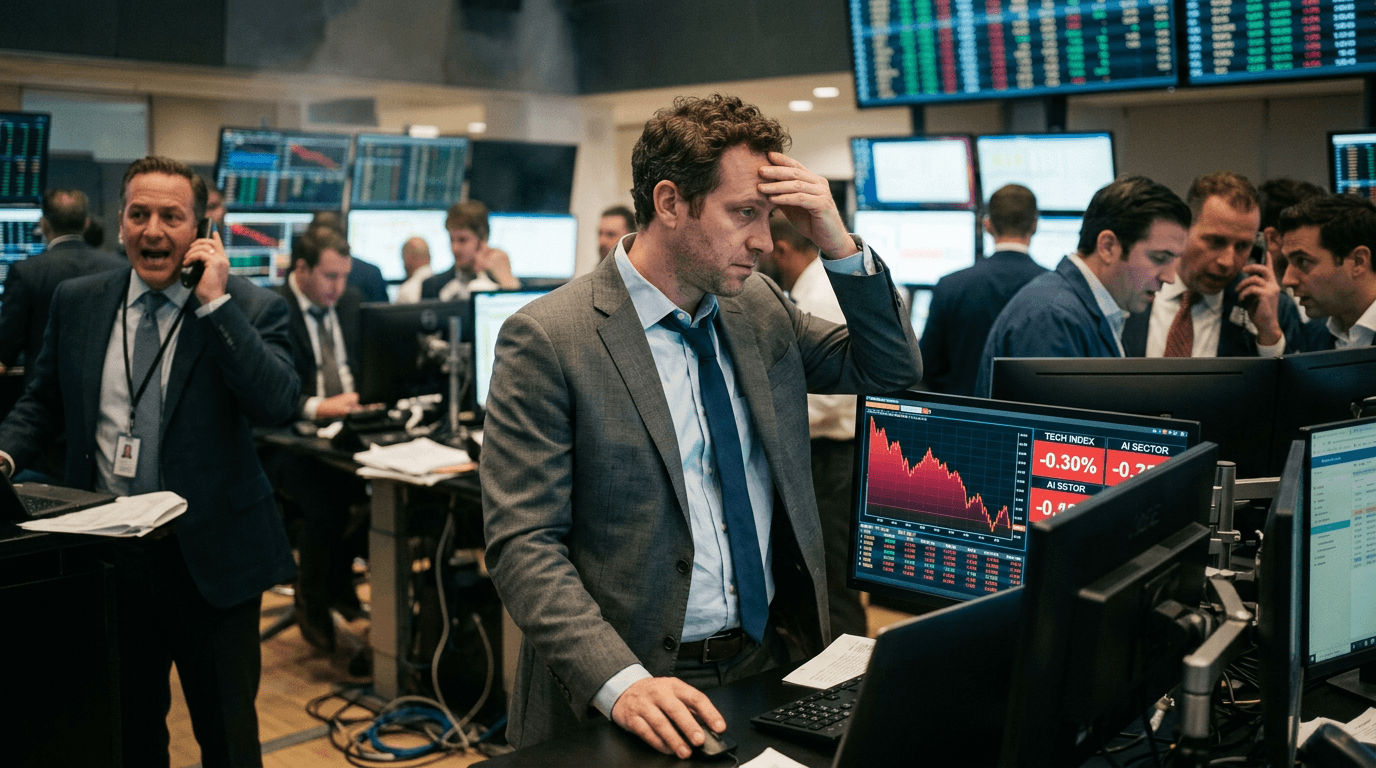
A sharp, tech-led selloff has put the AI trade under the microscope and sent a wave of risk aversion through global markets, with U.S. equity futures, FX, commodities, and crypto all feeling the impact.[2][5][6] What began as heavy profit-taking in AI and semiconductor names has evolved into a broader repricing of growth expectations, valuations, and interest-rate risk.[1][2][3][4][8] For active traders, this is less a surprise shock and more a stress test of how much enthusiasm around AI can withstand a reality check.
WHAT TRIGGERED THE TECH‑LED SELLOFF?
The immediate catalyst was a global rout in chipmakers and AI-linked stocks, starting in Asia and rippling into Europe and the U.S.[5][6][7] South Korea’s KOSPI, heavily weighted toward memory chip giants like Samsung and SK Hynix, plunged around 8–10%, even triggering a circuit breaker as those stocks dropped more than 12%.[5][6] That set the tone for a risk-off session globally, as investors questioned whether the pace of AI-driven gains in tech had run ahead of fundamentals.[4][6]
In the U.S., the tech-heavy Nasdaq futures fell more than 2.5% at one point, with S&P 500 futures down about 1% and Dow futures modestly lower.[2][6] Once cash trading opened, the pressure persisted: the Nasdaq Composite dropped more than 2%, the S&P 500 about 1.4%, while the Philadelphia Semiconductor Index cratered nearly 8%.[2][3][4][8] High-profile names in memory, storage, and AI hardware – including Micron, Sandisk, Marvell, and Lam Research – were among the biggest percentage losers, with some declines in the double digits.[2][3][4][8]
Importantly, this wasn’t just a single-name story. AI proxies across Big Tech were hit as well, with companies like Alphabet (Google) and newly listed SpaceX extending prior losses in premarket trading before finding only partial relief.[4][6] When sector leaders and market darlings start to falter together, it sends a powerful signal that investors may be rethinking the entire theme, not just a few overextended stocks.
Why Ai Valuations Are Under Scrutiny
The selloff is rooted in growing doubts about the sustainability of the AI trade, particularly around valuation, capital intensity, and funding.[1][2][4][8] After a multi-quarter surge in AI-related stocks, many names were priced for aggressive growth, flawless execution, and cheap money. Now, several pressure points are converging:
First, concerns are rising about the scale and financing of AI infrastructure spending. Hyperscale cloud and platform companies have poured tens of billions into data centers, GPUs, and networking – often with substantial debt funding.[1][4][8] If borrowing costs stay higher for longer, those investments must generate strong cash flows to justify their cost of capital. Any sign of slower monetization or weaker demand can quickly translate into valuation compression.
Second, the rate environment is less supportive than during earlier tech booms. Traders have become more attuned to the possibility of further Federal Reserve hikes or at least a prolonged period of elevated rates, as inflation remains persistent and growth metrics like PMI show resilience.[1][2] Higher discount rates mechanically lower the present value of long-duration growth stories – exactly what many AI and chip stocks represent.
Third, the market is recognizing that not all AI beneficiaries are equal. While some companies have clear revenue visibility tied directly to AI demand, others are more speculative or indirectly exposed. In a risk-off phase, investors differentiate, rotating out of names where the link between AI narratives and near-term earnings is weakest.
The Ripple Effect Across Equity Futures And Risk Assets
As the tech rout intensified, its impact quickly spilled beyond cash equities into futures and other risk assets.[2][5][6] Equity index futures, especially Nasdaq and S&P 500 contracts, came under sustained pressure in overnight and early U.S. trading, reflecting both hedging activity and directional downside positioning.[5][6] For traders, futures became the primary instrument to express views on the AI trade at scale and speed.
Risk sentiment also weakened across FX, commodities, and crypto. A stronger dollar index during the selloff signaled a classic flight to perceived safety and liquidity.[5] Growth-sensitive currencies and EM FX typically lag in such episodes, while haven flows tend to favor the dollar and, at times, the Swiss franc or yen.
In commodities, a tech-led risk-off move doesn’t always translate one-for-one, but it can feed into lower demand expectations for industrial metals and energy, especially when AI infrastructure spending is seen as a key driver of future consumption. At the same time, geopolitical factors and inflation concerns – including conflicts and supply-chain risks – complicate the picture, reinforcing the link between macro uncertainty and asset-price volatility.[4]
Crypto markets, often treated as high-beta risk assets, tend to move in sympathy with tech and growth equities. When AI and chip names are unwinding, many leveraged and momentum-driven strategies in digital assets also come under pressure, leading to higher volatility and abrupt price swings. For traders operating across asset classes, this interconnection is critical: AI-related equity stress can be an early warning signal for broader risk sentiment shifts.
What Traders Are Repricing: Growth, Rates, And Risk
The depth and breadth of the selloff suggest the market is doing more than just short-term profit-taking. Several key expectations are being repriced simultaneously:
- Growth trajectories: Investors are reassessing how fast AI-related revenues can scale, and how much of the recent optimism was pulled forward in prices. Any downgrade to medium-term growth assumptions hits high-multiple stocks hardest.
- Valuation frameworks: The market is re-evaluating what constitutes a “reasonable” multiple for AI and semiconductor names in a higher-rate world. Forward P/E, EV/EBITDA, and price-to-sales metrics are being compared against more conservative scenarios.
- Rate and policy paths: A more hawkish Fed profile, or even just less dovish, raises the hurdle for speculative growth trades. Traders are incorporating tighter financial conditions and a higher opportunity cost for capital into their models.[1][2]
- Liquidity and positioning: After a strong AI-led run, positioning in tech and chips was crowded. When sentiment flips, the unwind can be sharp as stop-losses trigger, margin calls rise, and systematic strategies de-risk.
For futures and options traders, this environment can present both elevated risk and opportunity. Volatility surfaces shift rapidly, skew can widen, and term structures in index futures can reflect changing expectations about the path of the selloff versus potential rebounds.
How Active And Simulated Traders Can Navigate An Ai Rout
For both live and simulated trading environments, an AI-led risk-off phase is a valuable stress test of strategy robustness. Several practical takeaways stand out:
- Respect sector concentration risk: When a single theme – like AI – drives performance across many holdings, portfolio drawdowns can be tightly correlated. Diversification across sectors, geographies, and styles can mitigate shock impact.
- Use futures and options for risk management, not just speculation: Index futures, sector futures, and volatility products are powerful tools for hedging tech-heavy exposure. Simulated trading platforms are ideal for practicing how to size and time such hedges without capital at risk.
- Focus on liquidity and execution: During sharp selloffs, spreads can widen and depth can thin, especially in smaller names. Liquid index futures and major ETFs often provide more reliable, tradable exposure.
- Revisit assumptions in AI-related models: Whether you trade single stocks, indexes, or multi-asset portfolios, review the growth rates, margins, and discount factors embedded in your scenarios. Testing alternative paths – slower AI adoption, higher rates, lower multiples – can improve resilience.
- Embrace scenario-based learning: SimFi environments allow traders to replay and stress scenarios like a tech-led rout, analyzing how strategies behave when volatility spikes and correlations change. That experience can be invaluable when similar episodes emerge in live markets.
Ultimately, the current tech-led selloff is less about the end of AI and more about a recalibration of expectations. The underlying structural story around artificial intelligence and data infrastructure remains powerful, but markets are reminding participants that narratives must eventually reconcile with cash flows, capital costs, and macro realities. For thoughtful traders, this is an opportunity to sharpen risk management, refine valuation discipline, and use both live and simulated markets to prepare for the next leg of the AI journey – whichever direction it takes.