
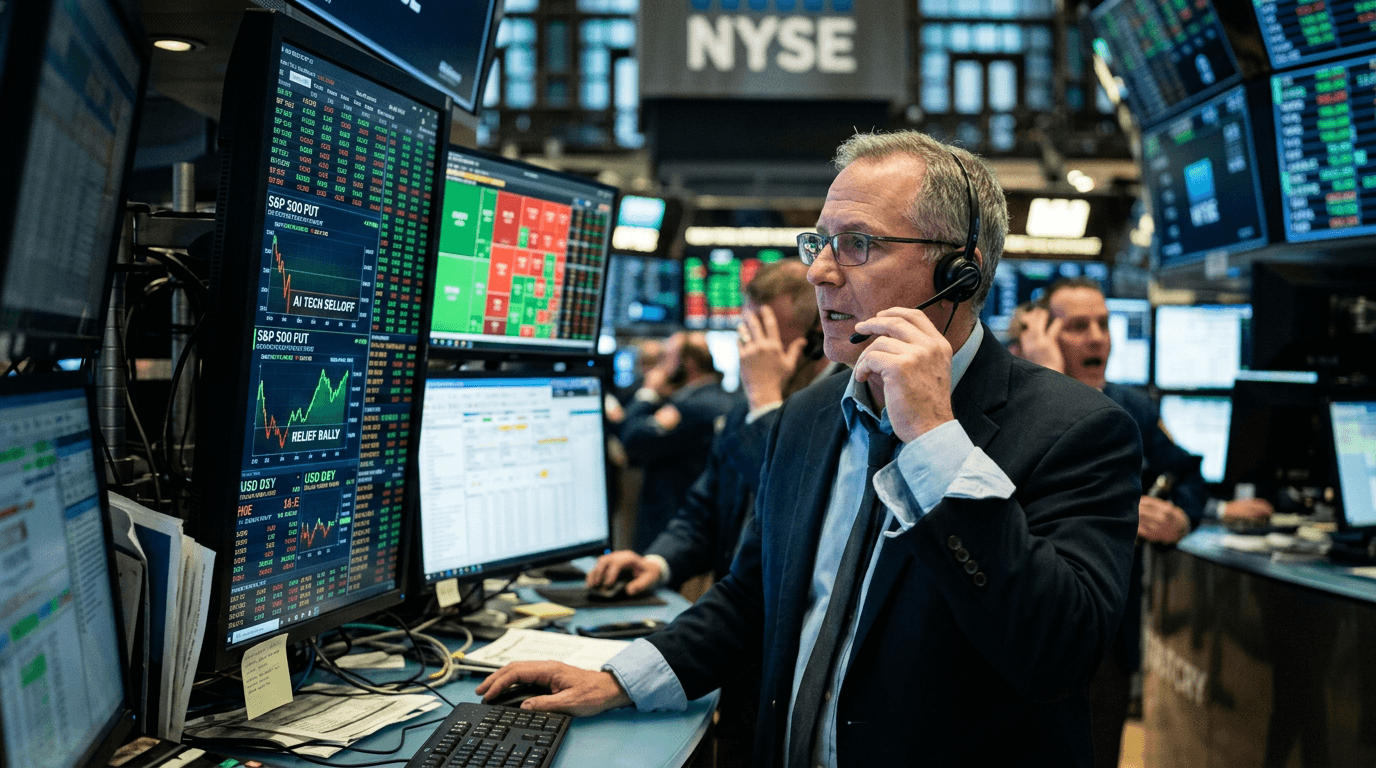
A sharp tech-led selloff has given way to a relief rally in US equity futures, with index contracts snapping back and the Dow staging a 550+ point rebound in early trade. The move follows a steep, AI-driven shakeout that dragged bellwether names like Microsoft to one-year lows and erased over a trillion dollars in tech market value in just days, before futures started to recover.[1][10] For traders, the question now is not just whether the bounce holds, but how it interacts with index rebalancing flows, persistent equity outflows, and shifting dollar dynamics.
Markets Snap Back After Tech Rout
US technology stocks saw nearly $1.3 trillion in market value wiped out over a two-day stretch as investors questioned the near-term payoff from massive AI-related capital expenditure plans.[1] Futures are now rebounding, with Nasdaq and S&P 500 contracts pointing higher alongside a strong move in Dow-linked futures, easing some of the immediate stress in risk sentiment.[1][4]
The pattern is typical of a “liquidity air pocket”: when positioning is crowded in a single theme—in this case, AI and big tech—any disappointment or cost concern can trigger outsized moves as investors rush to de-risk. In recent sessions, the S&P 500 technology sector fell sharply, with one move seeing a drop of around 3–4% in a single day as investors reassessed the pace and scale of AI-related spending.[10][14]
For traders, index futures are the first place the market expresses that shift in mood. Overnight and pre-market moves in Nasdaq and S&P futures offer an early read on whether dip buyers are stepping in or whether the selling is broadening beyond tech into cyclicals, defensives, and small caps. Understanding that futures are a sentiment and liquidity barometer—rather than a guarantee of how the cash session will close—is crucial when interpreting these rebounds.
Why Ai Capex Concerns Hit So Hard
The recent tech selloff is less about AI’s long-term potential and more about the near-term cost of building that future. Major technology and cloud companies are pouring tens of billions of dollars into AI data centers, chips, and infrastructure, a surge in capital expenditure that has started to worry investors about profit margins and free cash flow.[2][5][8][14]
Investors are asking three key questions: 1) Are AI investments front‑loaded to such an extent that earnings will lag for several quarters? 2) Will all this spending generate a clear return, or will some projects never scale? 3) Are valuations already pricing in years of flawless AI execution?
News highlighting companies’ heavier-than-expected AI spending has sparked several sharp pullbacks in individual stocks, even when headline earnings beat expectations.[8][14] Markets have moved from rewarding AI narratives at any price to demanding clearer evidence of monetization and disciplined capital allocation. That shift in mindset amplifies volatility: any hint that AI spending is rising faster than revenue can trigger aggressive de‑rating in tech leaders, which then cascades into index-level selling because these names are such large index weights.[1][10]
Flows, Rebalancing And The Dollar
Beneath the surface of the price action, flow dynamics are becoming as important as fundamentals. Month‑end and quarter‑end equity rebalancing can generate powerful one‑off demand or supply in major currency pairs and stock indices, especially after big performance swings across regions.[3] Recent research has highlighted how strong or weak equity performance in a given month can create some of the largest rebalancing signals, with certain currencies—like the euro or Scandinavian FX—sometimes facing selling while the US dollar and commodity-linked currencies benefit.[3]
Over the last decade-plus, US stocks have significantly outperformed many international markets in US dollar terms, while developed ex‑US currencies have trended lower against the dollar.[6] That combination of equity leadership and currency weakness has concentrated global capital in US assets, reinforcing the dollar’s central role in global portfolios.[6][9] When outflows emerge from US equities, or when rebalancing pushes investors to trim US exposure, it can have notable knock‑on effects in FX markets as investors adjust currency hedges and rotate into other regions.[3][9][15]
Academic and market studies alike emphasize that exchange rates can be heavily influenced by equity rebalancing flows, particularly when risk-averse FX liquidity providers demand compensation for absorbing large order imbalances.[15] In practice, that means days with big global index flows—such as major rebalances—can see outsized moves in the dollar even if macro data is quiet. For active traders, ignoring these calendar and flow effects can be as costly as ignoring an interest‑rate decision.
Dollar Moves In Focus
The dollar sits at the intersection of these equity dynamics. When global investors de‑risk from US equities, they may sell dollars to reallocate abroad—or, in stress episodes, buy more dollars as a safe haven while trimming risky assets. The net effect depends on whether risk aversion or diversification dominates.[9][12]
A stronger dollar tends to weigh on US multinationals’ overseas earnings and can tighten global financial conditions by raising the effective debt burden for entities that borrow in dollars.[9] For international investors, changes in the dollar’s value can meaningfully alter returns: an unhedged foreign investor in US stocks benefits from both equity gains and dollar appreciation, but faces a double hit when US equities fall and the dollar weakens.[12]
For traders focused on equity index futures, tracking the dollar is a way to gauge whether a move is purely equity-specific or part of a broader global risk re‑pricing. If futures rebound while the dollar softens, it can signal a shift back toward “risk‑on” conditions. If futures bounce but the dollar stays firm or strengthens, the rally may be more fragile, driven by short‑covering rather than renewed risk appetite.
How Traders Can Respond In A Simulated Environment
For active traders and aspiring professionals using simulated finance platforms, episodes like this are ideal live‑fire exercises—without the capital at risk. A few practical applications stand out:
1) Scenario testing: Recreate the recent tech shock by simulating large, fast drawdowns in AI‑related stocks and observing how index futures, volatility, and FX pairs respond. This builds intuition about cross‑asset contagion.
2) Flow‑aware strategy design: Incorporate month‑end and quarter‑end dates, major index rebalances, and large options expiries into your trading plans. Test strategies that scale risk down around known flow events and ramp up when flows have cleared.[3][15]
3) Dollar‑equity correlation tracking: Log how equity futures and the dollar move relative to each other during stress and recovery phases. Use simulated trades to explore when it makes sense to hedge equity exposure with FX positions and when it might be better to trade them separately.[9][12]
4) Risk management under volatility clusters: The recent tech rout and rebound underscore how volatility can cluster in specific sectors and themes. In a simulated environment, practice dynamic position sizing, intraday stop management, and diversification techniques to avoid over‑reliance on a single narrative like AI.
Conclusion
The rebound in US equity futures offers some breathing room after a bruising AI‑driven tech selloff, but it does not erase the underlying questions about the pace of AI capex, stretched valuations, and the durability of global flows into US assets.[1][5][10] With index rebalancing, equity outflows, and shifting dollar dynamics all in play, traders need to look beyond headline index moves and focus on the interaction between equities, flows, and FX.[3][6][9][15] Using a simulated environment to rehearse these complex cross‑asset scenarios can turn short‑term volatility into a long‑term edge, preparing traders to navigate the next bout of market stress with greater discipline and clarity.