
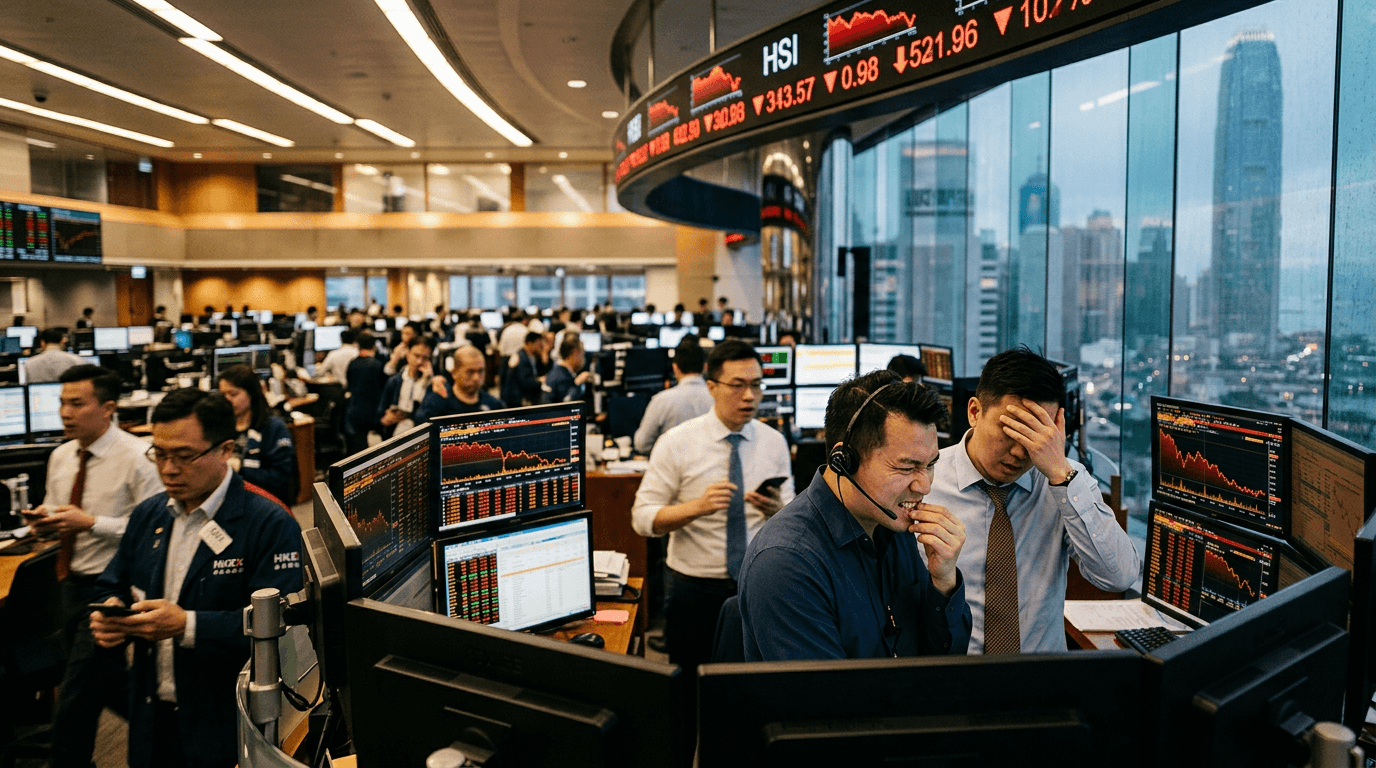
A deep, tech-led selloff has left Asian stocks wobbling and traders on high alert, as volatility ripples across equity index futures, FX markets, and safe-haven assets. The move follows a sharp global correction in high-growth technology and semiconductor names, driven by concerns over overstretched AI-related valuations and shifting macro risks.[2][4] In Asia, major benchmarks are struggling for direction, alternately clawing back losses and giving up ground as investors reassess how much risk they really want to hold in this part of the cycle.[1][2]
Market Snapshot: Asia Feels The Tech Aftershock
Across the region, price action has been choppy rather than outright panic, but the message is clear: the easy phase of the AI-driven rally is over, and markets are repricing exposure to crowded tech trades.[1][2][4] South Korea’s Kospi — at the epicentre of the semiconductor story — plunged around 10% in its sharpest one-day drop since March before rebounding more than 3% as bargain hunters stepped in.[1][2][4] Japan’s Nikkei and Taiwan’s tech-heavy indices have been swinging between modest gains and losses, echoing the uncertainty around how far the correction will run.[1][2][7]
MSCI’s broad index of Asia-Pacific shares outside Japan has been oscillating between positive and negative territory as investors rotate selectively rather than abandoning risk wholesale.[2] At the same time, crude oil prices have slipped towards four‑month lows, reflecting both improved supply expectations and a more cautious global growth narrative.[2][4] With the dollar pushing to its strongest level in about a year against major currencies, the backdrop is one of risk being rebalanced rather than removed — but that rebalancing can generate sharp, tradable moves across assets.[2][4]
From Equities To Futures: How Volatility Spreads
Equity volatility rarely remains confined to the cash market. Index futures are the primary tool large players use to hedge or express views quickly, which means they tend to amplify and transmit stress across regions and time zones. After the global tech selloff, equity index futures have seen wider intraday ranges and heavier volumes as funds cut exposure to growth stocks, add protection, or pivot into value and cyclicals.[3][6] This dynamic is visible both in Asian futures linked to local benchmarks and in US futures, where tech-linked contracts had slumped before staging a tentative recovery.[4][6]
For traders, heightened futures volatility affects several dimensions of strategy. Intraday price swings increase the risk of slippage and stop‑outs, making execution discipline and order placement more critical. Margin requirements can rise as clearing houses respond to bigger moves, which in turn influences leverage and position sizing. Volatility also changes the signal-to-noise ratio for systematic strategies: what looked like a stable uptrend in tech a few weeks ago now behaves more like a two-way market with frequent mean-reversion and sharp squeezes. In a SimFi environment, this is an ideal moment to stress-test trend-following, mean-reversion, and volatility breakout systems under more extreme conditions.
Fx Markets: Risk-sensitive Currencies Under Pressure
The tech-driven shake-up is also visible in FX, particularly in risk-sensitive and high-beta currencies. The US dollar index has extended gains to a fresh one-year high as investors seek relative safety and price in the prospect of rates staying higher for longer.[2][4] That strength has weighed on the euro and sterling, which have edged lower, and has contributed to pressure on several Asian currencies that are sensitive to global growth and risk appetite.[2]
When equity investors move into “risk-off” mode — even moderately — they often reduce exposure to cyclical currencies such as the Australian dollar, New Zealand dollar, and some emerging-market FX, while favoring the dollar and, at times, the yen or Swiss franc. Currency markets are also responding to shifting expectations around US‑Iran peace talks and broader geopolitical risks, adding another layer of uncertainty to the mix.[2] As volatility picks up, carry trades can become more fragile, and cross-asset correlations tend to tighten, meaning that shocks in equities transmit faster into FX. For active FX and futures traders, monitoring these correlation shifts is just as important as watching price charts.
Safe-haven Flows And Positioning Shifts
The current episode is not a classic “flight to safety” yet, but there are clear signs of investors rebalancing away from crowded, high-valuation tech trades toward more defensive and income-oriented exposure.[1][2][3] Some money is rotating into value sectors, small caps, and cyclicals that had lagged the AI rally, while others are using safe-haven assets tactically to dampen portfolio volatility.[3][6] The stronger dollar illustrates this defensive tilt, as does the pick-up in demand for liquid instruments that can be adjusted quickly, such as index futures and major FX pairs.[2][4]
Interestingly, traditional havens like gold have not surged; spot gold has been under pressure as higher rate expectations reduce the appeal of non-yielding assets.[2] This highlights a key point for traders: safe havens are not static labels but dynamic functions of the macro environment. When rates are rising or expected to stay high, cash and short‑duration instruments can “feel” safer than gold, even during equity turbulence. Meanwhile, cryptocurrencies are seeing mixed performance, with bitcoin slightly higher and ether marginally lower, reinforcing the idea that crypto behaves more like a risk asset than a pure hedge.[2]
Practical Takeaways For Traders
The immediate headline is that Asian stocks are wobbling after a global tech selloff, but the deeper story is about how crowded positioning, rich valuations, and macro uncertainty can quickly change volatility regimes. For traders operating in equities, futures, and FX — whether in live markets or via SimFi — several practical lessons stand out.
First, treat volatility as a core variable, not a side effect. Adjust position sizing, leverage, and stop placement to current volatility rather than historical norms; a strategy calibrated to calm conditions can become dangerously aggressive when ranges expand. Second, watch cross‑asset signals. Moves in the dollar, oil, and index futures often provide early clues about whether a tech correction is stabilizing or broadening into a wider risk-off phase. Third, respect crowded trades. AI and semiconductor names have been market darlings, but when sentiment turns, the exit door can be narrow, producing outsized swings that spill into correlated assets.
Finally, use periods like this to refine process, not to chase headlines. Simulated trading environments are particularly valuable for rehearsing how your strategies behave when markets flip from momentum-driven rallies to choppy, range‑bound volatility. By stress-testing risk management, execution, and cross‑asset awareness now, you’ll be better positioned the next time a tech-led selloff sends ripples across Asian equities, futures, and FX.