
The Strait of Hormuz: A Critical Chokepoint
Understanding the Strait of Hormuz requires recognizing it as more than a mere geographical landmark. This crucial artery for global trade, stretching 167 kilometers in length and narrowing to just 39 kilometers at its tightest, separates Iran to the north from Oman to the south. Its significance lies in being the sole maritime route between the Persian Gulf and the open ocean. As of 2024, a staggering 25% of the world's seaborne oil and 20% of global LNG volumes passed through this channel, with daily traffic hitting around 20 million barrels. The current blockade, starting March 4, 2026, has slashed vessel transits by 94%, underscoring the gravity of this disruption.
Market Reactions and Economic Ramifications
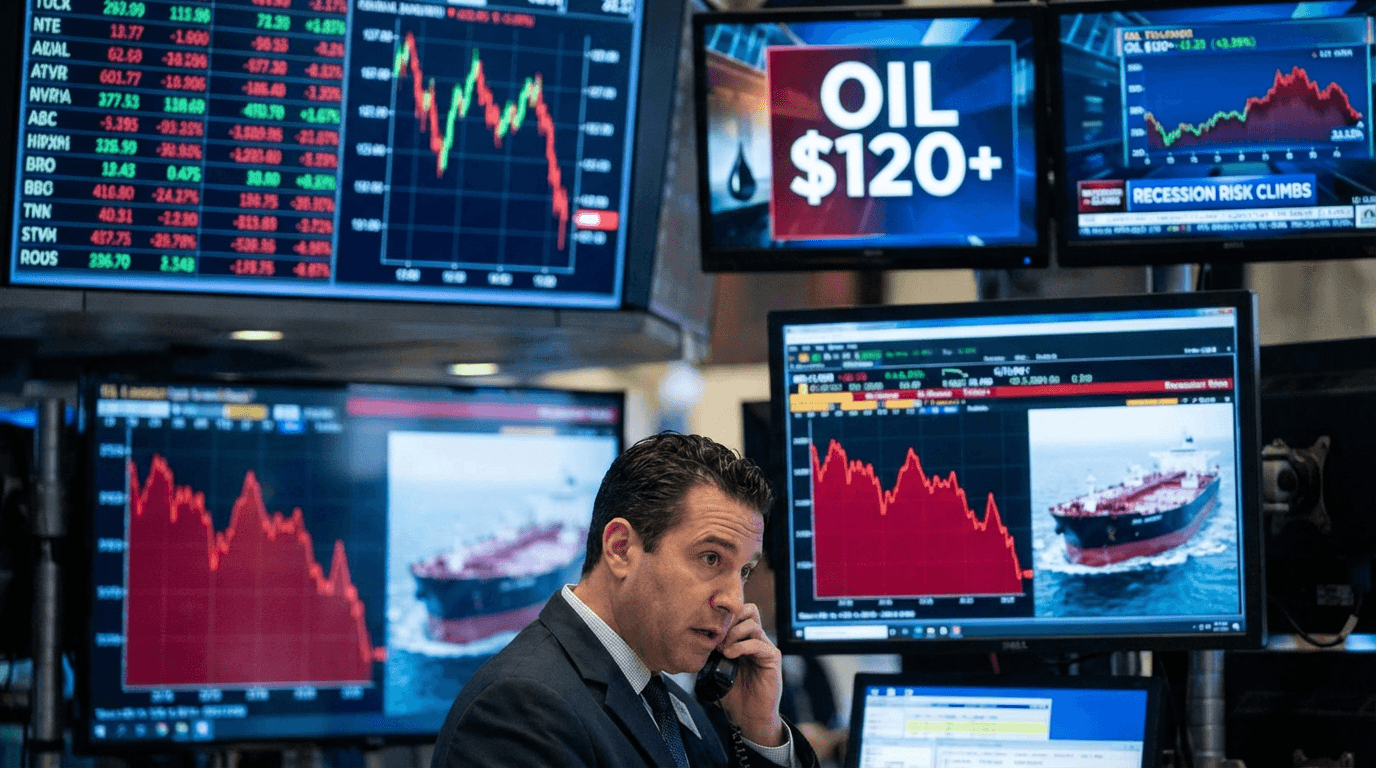
The closure's impact on markets has been immediate and severe. Brent Crude's surge past $120 per barrel signals dire implications for inflation and growth forecasts. Goldman Sachs has adjusted its 2026 U.S. inflation forecast up by 0.8 percentage points to 2.9% and reduced GDP growth projections by 0.3 percentage points to 2.2%. Under more severe conditions, predictions include inflation hitting 3.3% and GDP growth slipping to 2.1%, with recession odds climbing to 25%.
Equities have reacted with volatility: the Dow Jones tumbled over 400 points, and the S&P 500 saw a 0.7% drop on March 2 alone. This increased volatility is expected to persist as traders grapple with the potential for prolonged disruptions. Forex markets, too, are in flux as investors reassess currency valuations amid differing inflation impacts. Futures markets, particularly in energy, are experiencing dramatic swings as various supply recovery scenarios are priced in.
Global Disparities and Supply Chain Strains
The Strait's closure impacts regions unevenly. Asia, heavily reliant on energy imports through this chokepoint, faces severe consequences. Following attacks on production facilities, Qatar has declared force majeure on all exports, crippling Asian industrial plants already constrained by limited storage capacities. Europe, though less impacted, still grapples with reduced imports and strained petrochemical supply chains. The U.S., with its domestic oil production, enjoys some insulation but remains vulnerable to global price spikes.
Beyond oil and gas, the closure disrupts supplies of critical materials. The Gulf region, responsible for about 45% of global sulfur production, sees spikes in fertilizer costs, copper industry disruptions, and rising sulfuric acid prices, compounding inflationary pressures across industries.
Geopolitical Dynamics and Trump's Ultimatum
President Trump's 48-hour ultimatum marks a willingness to escalate diplomatic and potentially military confrontations. The threat to target Iranian power plants signifies a significant escalation, with markets pricing in this tail risk. The core issue isn't just Iran's legal capacity to close the Strait but the potential for it to become commercially unusable due to congestion, electronic interference, drone and missile threats, and uncertain insurance conditions. Many shipowners might avoid transit altogether, reinforcing the closure's impact.
Trump's ultimatum presents a binary outcome: Iranian cooperation could lead to a swift reopening, while military escalation could deepen the crisis. Either scenario carries substantial market implications. A diplomatic resolution might unwind energy premiums and currency volatility, while military action could drive oil prices toward the $140 per barrel threshold, identified by Oxford Economics as a potential "breaking point" for the global economy.
Strategic Insights for Traders and Investors
For market participants, the immediate strategy involves defensive positioning across equity indices and monitoring energy volatility as a leading indicator. The 48-hour ultimatum creates binary risk, likely manifesting in elevated implied volatility in options markets. Currency markets demand close attention as central banks adjust monetary policies based on regional inflation impacts. Commodities beyond energy, especially agricultural inputs affected by fertilizer disruptions, offer hedging or tactical opportunities. Traders should closely monitor geopolitical news, as developments around the ultimatum deadline could trigger sharp repricing across asset classes.
The Strait of Hormuz crisis embodies a genuine systemic risk to global markets, with Trump's ultimatum injecting acute urgency into an already tense situation.