
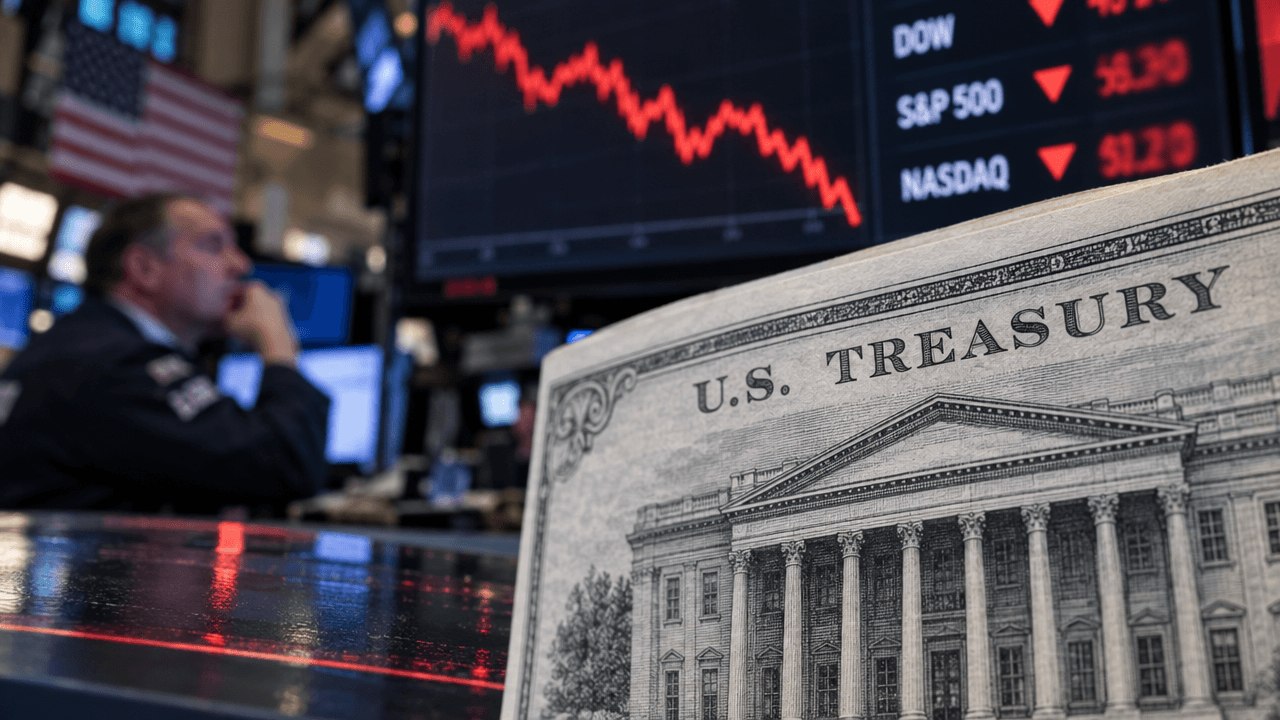
U.S. Treasury yields pushed higher on Wednesday, with the 10-year note climbing toward 5.32%, a level not seen since the early 2000s, while equity index futures traded lower ahead of the U.S. cash open.[1][4][7] The 30-year yield near 5.70% reinforced the message that long-term borrowing costs are resetting sharply higher, challenging risk assets that have benefited from years of low rates.[1][4] For traders, this shift is more than a headline—it’s a fundamental repricing of risk across the entire market.
Market Snapshot: Bonds Up, Futures Down
The climb in longer-dated Treasury yields has been one of the most persistent moves of 2026, with the 10-year rising from around 4% in March to over 5.3% in early October.[1][6] As yields moved toward multi-decade highs, Dow, S&P 500, and Nasdaq futures traded in the red, reflecting investor concerns that higher discount rates could pressure valuations, particularly for growth and technology names.[2][12][13] This pattern—bond yields up, equity futures down—captures a classic risk-off rotation driven by macro rather than company-specific news.
Elevated long-term yields also influence key benchmarks beyond the stock market, including mortgage rates, corporate borrowing costs, and credit spreads.[1][12] When the “risk-free” rate at 10 or 30 years reprices higher, every asset that is valued using discounted cash flows must adjust, from blue-chip equities to private credit and commercial real estate.
Why Higher Yields Pressure Equity Futures
At the core of the equity reaction is the discount rate. In simple terms, a stock’s value today is the present value of the cash it is expected to generate in the future. When the 10-year Treasury yield rises, the risk-free component of the discount rate increases, raising the hurdle for equity returns.[1][12] This disproportionately impacts long-duration assets—companies whose expected cash flows are further out in time, such as high-growth tech and speculative innovation plays.
There is also the issue of competition for capital. As Treasuries offer yields above 5% on a long-term basis, they become more attractive on a risk-adjusted basis relative to equities.[1][4] Institutional investors who can allocate across asset classes may rebalance away from stocks and into government bonds, particularly if they perceive macro uncertainty rising. That shift shows up first in futures markets, where hedging and repositioning can be done quickly and cheaply.
Finally, higher yields tend to tighten broader financial conditions. As credit becomes more expensive, leveraged strategies are less attractive, buybacks can become harder to finance, and corporate investment plans may be reconsidered. All of this feeds into expectations for future earnings, which equity futures attempt to price in advance.
Drivers Behind The Surge In Treasury Yields
The latest leg higher in yields is not occurring in a vacuum. Several macro drivers are converging: sticky inflation concerns, rising oil prices, and heavy Treasury supply.[1][4][9] Investors are demanding a greater term premium—the extra compensation for holding long-dated debt—in light of uncertainty about the Federal Reserve’s path and the U.S. fiscal outlook.[4][7][11]
A key near-term catalyst is the $39 billion auction of 10-year notes, which will test demand at these elevated yield levels.[1][4][11] Strong bidding could signal that investors view yields above 5% as attractive, potentially stabilizing the market. Weak demand, on the other hand, might require even higher yields to clear the supply, adding further pressure on risk assets.
Later in the day, traders will parse Federal Reserve meeting minutes for clues on how policymakers view inflation risks, growth momentum, and the balance between fighting price pressures and avoiding overtightening.[1][7][11] Any hint that the Fed is comfortable with higher-for-longer policy rates, or concerned about reacceleration in inflation, can reinforce the upward bias in longer-term yields.
Actionable Takeaways For Traders And Investors
For active traders, the current environment favors disciplined risk management and scenario analysis. Elevated yields tend to increase volatility across asset classes, making position sizing and use of stops more critical. Equity index futures may remain sensitive to intraday moves in the 10-year and 30-year yields, so monitoring bond market price action alongside stock indices is essential.
Sector rotation is another key theme. Higher yields often weigh more heavily on rate-sensitive segments such as utilities, REITs, and highly leveraged growth companies, while potentially benefiting financials that can earn more on lending spreads.[12] Traders can explore relative value ideas—long financials vs. short growth indices, for example—while recognizing that macro shocks can disrupt these relationships.
For longer-term investors, rising yields may present an opportunity to lock in more attractive income in high-quality fixed income while reassessing equity exposure. Portfolios heavily tilted toward long-duration growth and speculative assets may warrant rebalancing, especially if the higher-rate regime looks durable rather than transient.
Implications For Simulated Finance And Practice Trading
For users of SimFi platforms like E8 Markets, this kind of macro episode is a valuable real-world case study. Simulated trading environments allow participants to test strategies in conditions where rates are rising, correlations are shifting, and volatility is elevated—without risking real capital.
Traders can use simulations to study
How equity index futures respond to intraday moves in the 10-year yield.
The impact of economic releases—like Fed minutes—on both bonds and equity indices.
Cross-asset strategies that hedge equity exposure with Treasuries or interest-rate products.
By experimenting with different approaches to risk management, hedging, and sector allocation, traders can build playbooks for navigating higher-rate environments. That preparation becomes critical if elevated yields persist, as many market participants today have limited live-trading experience in a world where the 10-year consistently sits above 5%.
Looking Ahead: What To Watch Next
In the short term, attention will center on the 10-year auction outcome and the tone of the Fed minutes.[1][4][11] Strong demand and a more balanced Fed narrative could help stabilize yields, while weak bidding and hawkish language might push them higher still, deepening the pressure on equity futures.
Beyond today’s events, the bigger question is whether the market is transitioning to a structurally higher-yield regime. If investors continue to demand greater compensation for inflation and fiscal risk, higher long-term rates could become the new normal. That would have far-reaching implications for valuations, portfolio construction, and the relative appeal of bonds versus stocks.
For now, the message from markets is clear: when long-term Treasury yields march toward multi-decade highs, equity futures take notice. Traders who understand the mechanics of this relationship—and practice navigating it in both live and simulated environments—will be better positioned to respond as the rate cycle evolves.