
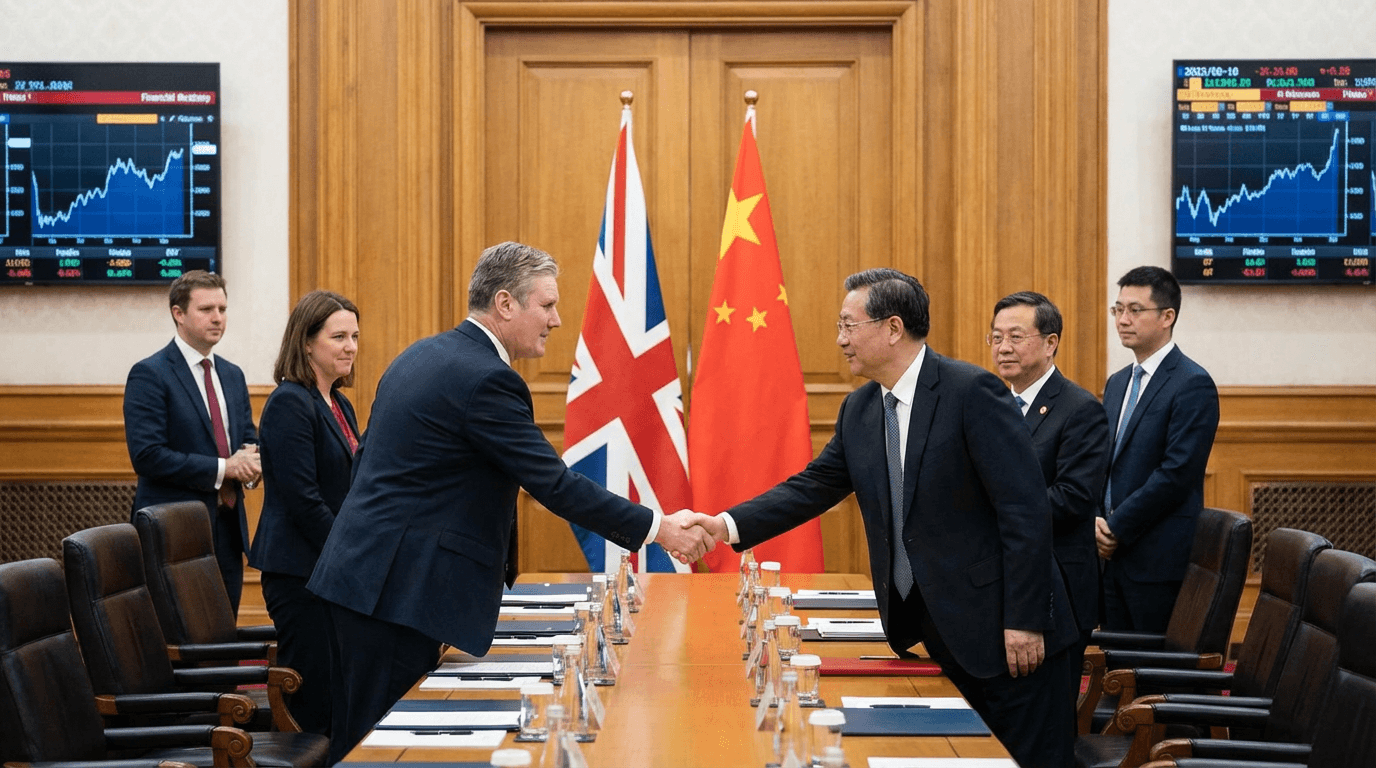
UK Prime Minister Keir Starmer's visit to China marks a significant pivot in British foreign policy and has immediate implications for global markets. Following productive talks with Chinese President Xi Jinping in Beijing, Starmer has characterized the UK-China relationship as being in a "good, strong place," signaling renewed engagement between two major economic powers. For traders and investors monitoring currency pairs, commodity flows, and geopolitical risk factors, this diplomatic thaw carries measurable consequences across multiple asset classes, particularly GBP/CNY and broader emerging market sentiment.
Strategic Outcomes From Beijing Talks
The bilateral meetings have yielded concrete, measurable outcomes that extend beyond diplomatic rhetoric. Starmer confirmed progress on whiskey tariffs, with both nations working through the timeline and reduction methodology. Visa-free travel arrangements for Chinese citizens to the UK are also advancing, addressing a friction point in people-to-people exchange. Perhaps most significantly from a market perspective, the two countries have committed to enhanced cooperation on irregular migration and trafficking networks, focusing particularly on small boat smuggling operations. These aren't symbolic gestures—they represent operational agreements with real economic implementation timelines.
The timing of these announcements matters for market participants. Tariff reductions on UK whiskey, a historically contentious trade issue, signal willingness to remove barriers on both sides. Visa-free travel typically precedes expanded business travel and investment flows. In the SimFi trading environment, these developments translate to potential volatility adjustments in GBP/CNY spreads as traders recalibrate their assessment of UK-China trade friction premium.
Currency And Forex Implications
The GBP/CNY pair faces directional pressure from improved diplomatic sentiment. Historically, UK-China tensions have created a risk premium in this currency pair, reflecting political uncertainty and potential trade disruptions. Starmer's successful negotiation reduces this premium as market participants price in lower geopolitical risk and higher probability of sustained trade flows. The British pound should theoretically strengthen against the Chinese yuan as traders reduce their hedging demands against UK-China disputes.
Beyond the direct sterling-yuan dynamic, this visit influences broader forex volatility. The commentary around Western countries realigning away from over-reliance on US markets under the Trump administration positions the UK as a bridge between traditional Western institutions and emerging economies. This narrative positioning affects GBP positioning more broadly, particularly against currencies of nations that depend heavily on US trade relationships. For algorithmic traders tracking geopolitical risk indices, this represents a measurable shift in systemic risk parameters.
Business Investment And Market Opportunities
The business delegation accompanying Starmer isn't decorative—it signals serious commercial intent. AstraZeneca, a UK pharmaceutical giant, has already announced a $15 billion investment commitment in China, setting the tone for broader corporate engagement. Additional business deals are expected across electric vehicles, agriculture, education, and pharmaceuticals sectors. These aren't speculative opportunities; they represent bilateral agreement on sectors where both nations have comparative advantages.
For investors tracking emerging market opportunities, this escalation matters. UK firms gaining expanded access to Chinese markets should see improved earnings forecasts and potentially increased capital allocation to China-focused divisions. Conversely, Chinese firms gain clearer pathways into UK and European markets. In the SimFi environment, tracking sector rotation between UK-exposed and China-exposed equities provides trading signals. Companies explicitly benefiting from improved UK-China ties offer directional plays on this diplomatic thaw.
Geopolitical Context And Broader Implications
Starmer's visit occurs within a larger realignment of global power dynamics. The Chinese leader acknowledged past "twists and turns" in UK-China relations but emphasized that engagement is "unavoidable"—a phrase indicating pragmatic recognition of mutual economic dependence. More significantly, Beijing appears to be positioning the UK as a counterweight to Washington's current trajectory, emphasizing British commitment to multilateral institutions and free trade as contrasting with the Trump administration's protectionist approach.
This geopolitical positioning has consequences for risk-on and risk-off trading dynamics. When Western nations cooperate more with China rather than enforcing unified sanctions or trade restrictions, global volatility typically decreases. Market participants pricing in reduced deglobalization risk should experience opportunities in emerging market assets and currencies. The Chinese yuan could see broader support across the entire currency complex as de-escalation narratives reduce safe-haven demand.
Key Takeaways For Traders And Investors
The immediate trading implications include watching for GBP/CNY movements as market makers digest this news flow. Monitor UK equity market reactions among firms with significant China exposure, particularly in pharmaceuticals, technology, and manufacturing. Track emerging market volatility indices, as reduced UK-China friction contributes to broader risk-on sentiment. Finally, consider the positioning implications for Western equities that depend on stable emerging market growth, which benefits from improved international cooperation.
Starmer's successful China visit represents more than diplomatic theater—it's a recalibration of global trade relationships with measurable market consequences. Traders should adjust their geopolitical risk models accordingly.