
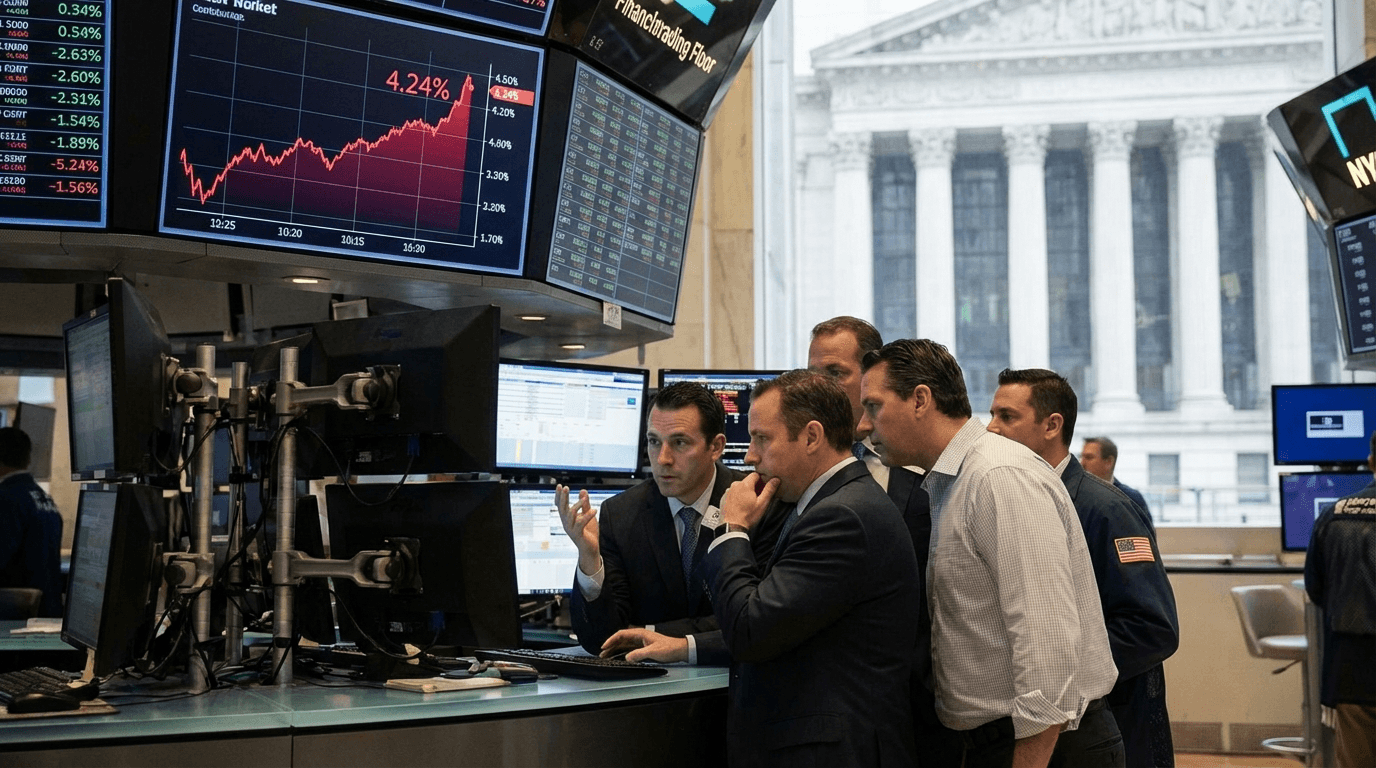
The US Treasury market is sending clear signals that bond traders should be watching closely. The 10-year Treasury yield has maintained its recent surge, holding around 4.24% as of late January 2026, with strong momentum that reflects shifting expectations about Federal Reserve policy and inflation dynamics.[1] This stability at elevated levels represents a meaningful shift for fixed income markets and carries important implications for traders across multiple asset classes, from equity valuations to currency pairs like USD/JPY.
Understanding The Current Yield Environment
The 10-year Treasury yield's resilience at 4.24% marks a significant development in the bond market's narrative.[1] Over the past month, yields have climbed 0.07 percentage points, though they remain 0.30 points lower than a year ago, suggesting we're still in a relatively moderate rate environment compared to 2025 levels.[1] For context, the 6-month Treasury bill rate settled at 3.525%, indicating a yield curve structure where longer-duration securities offer additional compensation to investors.[1]
What makes this current holding pattern noteworthy is the conviction behind it. Treasury yields don't hold elevated levels without reason. They typically rise when markets price in either higher inflation expectations or stronger economic growth, both of which reduce the appeal of fixed income returns. The sustained yield reflects a market consensus that borrowing costs will remain elevated, directly impacting everything from mortgage rates to corporate financing costs and ultimately influencing equity valuations.
The Fed Chair Nomination And Market Reaction
The appointment of Kevin Warsh as Federal Reserve chairman has become a key driver of recent yield movement. Warsh, a former Federal Reserve Governor, is widely perceived as hawkish on monetary policy, particularly regarding balance sheet expansion and inflationary pressures.[1] His nomination has shifted market expectations away from an accommodative Fed policy stance, supporting the case for maintaining higher interest rates longer than some market participants previously anticipated.
This development matters considerably for bond futures and derivative strategies. When the Fed chair is seen as inflation-conscious and skeptical of easy money, bond markets recalibrate their expectations for future rate cuts. Markets are now pricing in a more cautious Fed that will prioritize price stability over growth stimulation. For traders, this signals reduced likelihood of aggressive rate cuts in the near term, which supports current Treasury yield levels and affects trading strategies across the entire fixed income universe.
Yield Forecasts And Market Positioning
Looking ahead, market analysts expect the 10-year yield to trade around 4.20% by the end of the first quarter, with longer-term expectations targeting 3.99% within the next 12 months.[1] This forward-looking guidance suggests a potential moderate decline from current levels, but notably not a dramatic collapse in yields. The forecasts imply that while some yield compression may occur, the market expects rates to stabilize in a range that reflects the reality of persistent inflation concerns and active Fed tightening cycles.
For traders operating in simulated or real markets, these forecasts represent a key planning tool. A 25 basis point decline over 12 months is modest compared to historical volatility. This suggests a sideways to slightly declining trading environment rather than a dramatic shift. Traders positioned for higher yields may face headwinds if the Fed ultimately becomes more dovish than Warsh's appointment suggests, while those betting on rate cuts may find their positions supported if economic data weakens.
Implications For Multi-asset Strategies
The strength in US Treasury yields has cascading effects across multiple trading venues. Higher US yields make dollar-denominated assets more attractive relative to other currencies, supporting pairs like USD/JPY as Japanese interest rates remain comparatively low.[1] Bond futures markets are pricing in this elevated yield environment, creating trading opportunities for those managing duration risk and curve positioning.
Equity traders should also note the interaction between Treasury yields and stock valuations. Higher discount rates reduce the present value of future corporate earnings, creating headwinds for growth stocks while potentially supporting value-oriented equities. Understanding the Treasury market's direction is essential for constructing balanced multi-asset trading strategies.
Actionable Takeaways For Traders
The current Treasury market setup offers several clear signals. First, the yield stability at elevated levels suggests strong conviction behind the current rate environment. Second, the Fed chair nomination reinforces expectations of a hawkish central bank, supporting higher-for-longer rate narratives. Third, analyst forecasts suggest modest yield compression over the next year rather than dramatic repricing, indicating a potentially range-bound trading environment.
For traders in simulated finance platforms or real markets, this environment rewards active management. Currency traders should monitor USD strength, bond traders should consider duration strategies aligned with the 4.20% near-term forecast, and equity traders should remain aware of the growth stock headwinds from elevated discount rates. The key is recognizing that the 10-year yield at 4.24% represents an equilibrium that's unlikely to shift dramatically without significant changes to Fed expectations or inflation data.
The Treasury market has spoken clearly about its outlook, and that message reflects a belief that elevated rates are here to stay for the foreseeable future. Trading with that conviction, while remaining vigilant for shifts in Fed communications, represents a prudent approach to the current environment.