
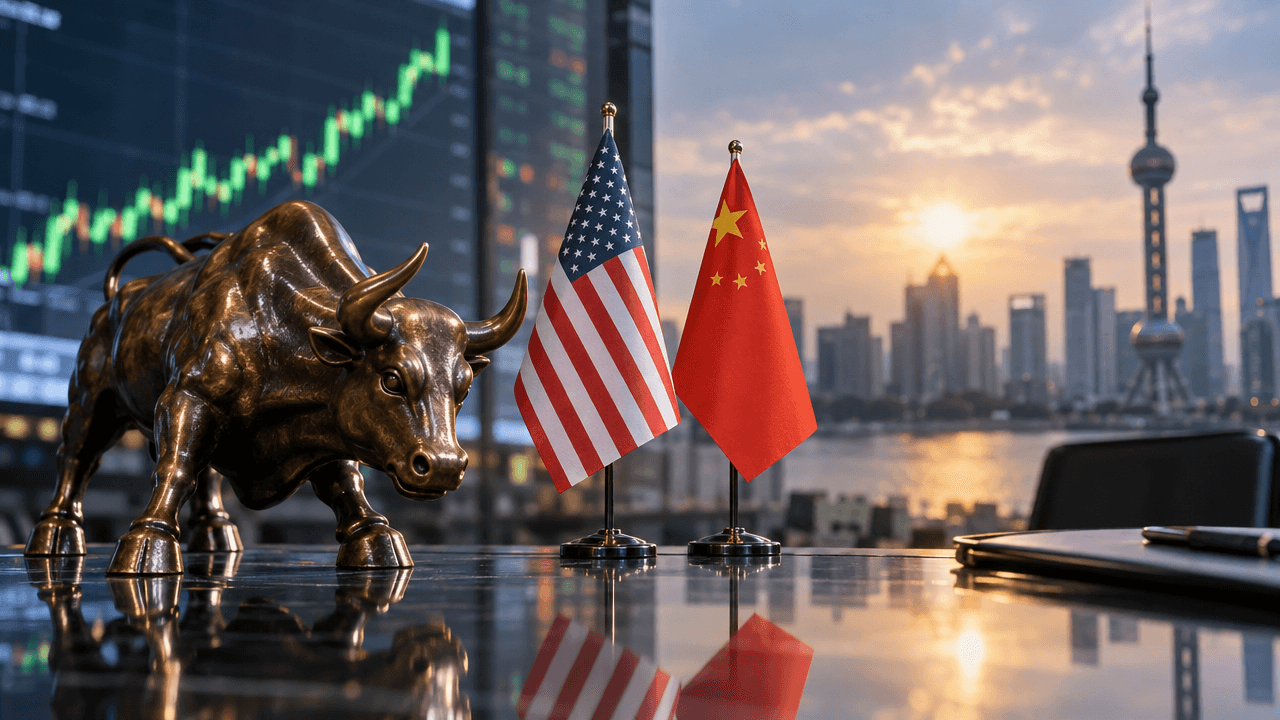
U.S. stock futures were nudging higher to start the week, signaling a cautiously optimistic tone as traders look ahead to a packed calendar of policy and trade events centered on a high-stakes meeting between President Donald Trump and China’s President Xi Jinping.[1][2][3] In early Asian trading, S&P 500 and Nasdaq 100 futures posted modest gains, reinforcing the idea that investors are positioning rather than chasing risk, with sentiment in both equities and FX markets highly sensitive to headlines.[1][5]
Market Snapshot
As the new week begins, major U.S. equity index futures are pointing to a positive open, with S&P 500, Dow, and Nasdaq contracts all trading higher by roughly half a percent in early indications.[1][7][15] Asian equities have also advanced, helped by upbeat remarks from U.S. officials that recent trade talks with China were “very successful,” which has further underpinned risk appetite ahead of the leaders’ summit.[4][5] The broader backdrop includes softer oil prices and a relatively steady U.S. dollar, a combination that tends to support equity valuations by easing cost pressures and financial conditions.[6][7]
For traders, this setup feels more like a sentiment reset than an outright risk-on surge. Futures strength is notable, but not extreme, suggesting markets are leaving room to react to incoming news rather than pricing in a definitive outcome ahead of time.[1][15] This kind of moderate move is typical when investors are reluctant to take aggressive positions before clarity emerges on trade, tariffs, and the policy path.
Policy And Trade Catalysts In Focus
The dominant catalyst this week is the Trump–Xi summit in Washington, where trade, tariffs, technology, and geopolitics are all on the agenda.[2][3][5] Discussions are expected to cover the future of U.S. tariffs on Chinese goods and a fragile trade truce that is set to expire in the coming weeks, leaving markets alert to any hint of extension, escalation, or restructuring.[2] The two leaders are also poised to delve into artificial intelligence and its regulation, a topic with direct implications for semiconductor and big-tech valuations.[2][3]
Ahead of the summit, U.S. Treasury Secretary Scott Bessent described preliminary talks with Chinese counterparts as a “very successful engagement,” while Chinese officials referenced a “preliminary consensus” on key issues.[4][5][12] These comments have reduced immediate tail risks around a breakdown in negotiations and encouraged traders to price a slightly higher probability of constructive outcomes. At the same time, investors remain mindful of other policy drivers, including recent Federal Reserve rate moves and ongoing guidance about how long restrictive monetary policy could remain in place.[1][8]
Geopolitical developments beyond U.S.–China relations also sit in the background. Markets are watching Middle East tensions and potential diplomatic contacts with Iran, factors that could influence energy prices and safe‑haven flows if they intensify.[2][3][6] This mix of interconnected catalysts means equity, FX, and commodity markets are all sensitive to the direction and tone of official statements over the coming days.
What It Means For Equity, Fx, And Rates Traders
For equity traders, modestly higher futures ahead of major events often signal a “balance of risks” mindset. Rather than betting on a dramatic breakthrough or breakdown, participants lean into the idea that incremental progress on trade and clearer policy communication can support current valuations. Any indication of extended tariff relief or a more predictable framework for U.S.–China technology cooperation would likely favor cyclical sectors, exporters, and high‑beta tech names, while disappointment could trigger rotation into defensives and quality.
FX traders have their own lens. A constructive summit that reduces uncertainty around tariffs and AI regulation could support risk‑sensitive currencies and weigh on traditional safe havens, while a hawkish Fed tone or escalation in geopolitical tensions would tilt flows back toward the dollar and lower‑yielding “safety” currencies. In rates markets, the combination of trade headlines and central bank guidance will shape expectations for growth, inflation, and future policy moves, driving volatility in yields across the curve.
Because the week is packed with potential inflection points, intraday swings can be sharp even if the ultimate move over several days is modest. Short‑term traders need to recognize that sentiment can turn quickly on a single statement, while longer‑term investors may focus on whether the summit delivers structural clarity on tariffs, tech exports, and regulatory coordination.
How Simulated Finance Traders Can Position
For traders using simulated finance platforms like E8 Markets, this environment is an ideal test bed for developing and refining macro‑aware strategies. SimFi allows participants to build and stress‑test positions around scenarios such as “constructive summit with modest tariff relief,” “stalemate with increased uncertainty,” or “unexpected escalation with renewed trade tensions,” without putting real capital at risk.
One practical approach is to create paired scenarios: in one, equity futures continue to grind higher as leaders signal progress; in the other, futures reverse as markets reassess the probability of agreement. Simulated traders can map out how they would adjust exposure to equity indices, tech stocks, and export‑oriented sectors under each case, including entry levels, stop‑losses, and profit targets. By reviewing the outcomes once actual headlines hit, traders gain insight into whether their risk management and reaction times align with market reality.
Another valuable simulation involves cross‑asset relationships. Traders can explore how a shift in tariff expectations might impact both stock index futures and FX pairs linked to China or broader emerging markets. Running these correlations in a simulated environment helps build intuition about how equity, currency, and rates markets interact under different policy regimes.
Practical Takeaways For The Week Ahead
1) Expect higher headline sensitivity. With leaders meeting and policymakers speaking throughout the week, price action can change quickly on new information, so having predefined rules for reacting to news can prevent emotional decision‑making.
2) Focus on scenarios, not predictions. Instead of trying to guess the exact outcome of the Trump–Xi summit, build a set of plausible paths and outline how you would adjust positions in each case. This approach works in both live and simulated trading.
3) Watch cross‑market signals. Moves in oil, the dollar, and rates can either reinforce or contradict equity futures’ message about risk appetite, offering valuable confirmation or early warning for traders.
4) Use SimFi to rehearse volatility. Simulated trading allows you to practice operating in fast‑moving markets, refine your execution around major events, and assess how your strategy performs when news flow is dense and uncertain.
Conclusion
U.S. stock futures pointing higher ahead of major policy and trade catalysts reflect a market that is cautiously constructive but acutely aware of the stakes.[1][2][3] The Trump–Xi summit, ongoing Fed policy signals, and geopolitical developments together form a dense cluster of events that can reshape expectations for growth, inflation, and corporate earnings in the months ahead.[2][5][8] For traders, the challenge is less about predicting every headline and more about building robust, flexible playbooks that can adapt as information evolves. Simulated finance platforms offer a powerful way to refine those playbooks in real time, helping both new and experienced traders turn complex macro weeks into structured learning opportunities and, ultimately, better decision‑making.