
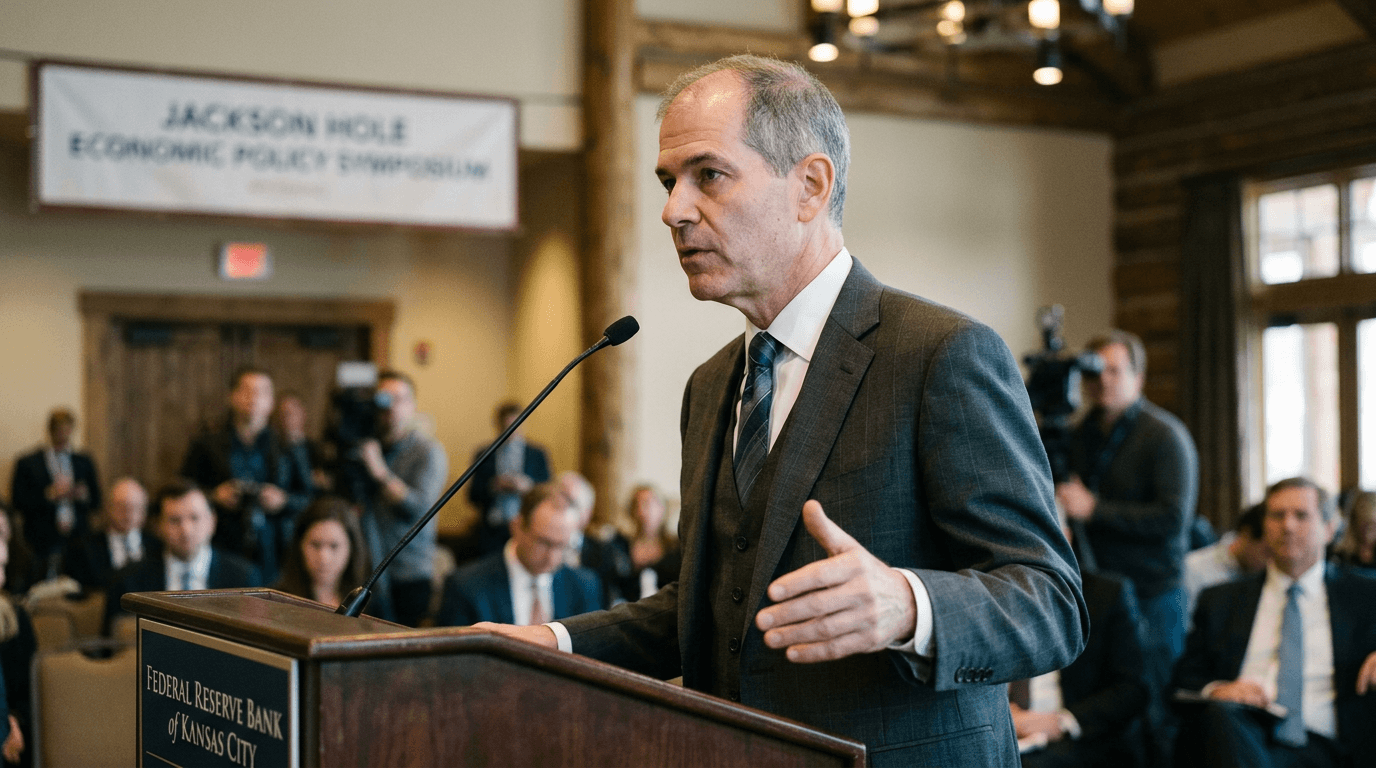
A hawkish debut from Federal Reserve Chair Kevin Warsh at the Jackson Hole symposium has quickly reshaped market expectations, propelling US bond yields and the dollar higher while weighing on risk assets from equities to crypto.[2][3][8][15] For traders across FX, futures and digital assets, the speech delivered a clear message: the inflation fight is not over, and policy may need to tighten further to restore price stability.[3][5][9][10]
Jackson Hole: Warsh's Message On Inflation
In his keynote remarks, Warsh emphasized that recent inflation data, including both PCE and CPI, has come in “better than expected” but has not “meaningfully improved.”[4][5][8] The Fed’s preferred measure, the 12‑month change in the PCE price index, remains around 3.7%, with the six‑month pace closer to 4.1%, notably above the 2% target.[3][7] Warsh reiterated that the 2% inflation goal is “firm” and “fixed,” rejecting any notion of a soft or flexible target and framing price stability as the central bank’s predominant focus.[1][6][7] He warned that if policymakers are not confident that underlying inflation is clearly moving toward that objective at sufficient speed, the Fed “has work to do,” a phrase markets interpreted as a strong hint toward additional rate hikes.[3][5][9][10]
This messaging represents a sharper, more hawkish tone than earlier communications, reducing ambiguity around the Fed’s reaction function to persistent above‑target inflation.[2][12] For traders, the key takeaway is that the bar for easing or even pausing tightening has risen: modest improvements in headline inflation may not be enough without convincing progress in underlying trends.[3][4][5]
Rates And Yields: How The Market Reacted
Bond markets moved swiftly in response, with short‑dated Treasury yields—most sensitive to policy expectations—leading the move higher.[8][15] The 2‑year yield jumped more than 10 basis points to roughly the mid‑4.3% area, marking one of the largest single‑day reactions to a Jackson Hole Fed Chair speech in decades.[8][11][15] Benchmark 10‑year yields climbed by around 5 basis points toward 4.7%, while the 30‑year yield edged above 5.2%, extending a multi‑week uptrend in long‑term borrowing costs.[8][13][15] This bear‑steepening of the curve reflects a market that is repricing both the near‑term path of policy and the longer‑term equilibrium for rates in an environment of sticky inflation.[13][14]
Higher yields tighten financial conditions by raising discount rates for future cash flows, pressuring valuations in rate‑sensitive assets such as growth equities and high‑beta sectors.[13][14] For futures traders, this environment tends to favor strategies that lean into rate volatility, duration hedging, and curve trades, as markets constantly reassess the probability and timing of the next Fed move.[11][13]
Fx And Risk Assets: Dollar Dominance Returns
The hawkish tone also fed directly into FX markets, lifting the US dollar against major peers as rate differentials moved further in its favor.[2][8][15] In the hours following the speech, EUR/USD slipped below 1.1600, while GBP/USD weakened toward the 1.3530 area, reflecting renewed demand for the dollar as a yield‑advantaged safe‑haven.[2][3][4][15] Emerging‑market currencies and high‑yield FX crosses similarly saw pressure, as higher US yields raise the cost of carry and increase vulnerability to capital outflows.[13][15]
Risk assets—especially commodities and crypto—came under strain as the prospect of tighter policy and higher real yields dampened the appeal of speculative and duration‑heavy trades.[2][3][4][8] Crypto markets, which have traded closely in line with real‑yield and liquidity cycles, saw notable volatility as Warsh’s comments underscored that the era of easy money is not yet returning.[2][3][4][15] For multi‑asset traders, this reinforces the importance of watching the dollar and US yields as primary macro drivers across FX, futures, and digital assets.
What This Means For Simulated Traders On E8 Markets
For SimFi participants and strategy builders on platforms like E8 Markets, Warsh’s Jackson Hole debut offers a real‑time case study in how central bank communication can cascade through global markets.[2][3][10][15] First, it highlights the need to anchor scenarios around the policy reaction to inflation, not just the inflation prints themselves; traders should model paths where inflation remains above target longer than expected, forcing the Fed to stay restrictive.[3][5][7] Second, it underscores the sensitivity of short‑end rates and FX to shifts in forward‑guidance language, making it essential to simulate both baseline and “hawkish surprise” outcomes around key events.[8][11][15]
Simulated portfolios can stress‑test exposure to rate shocks by varying the magnitude and speed of yield moves similar to the post‑speech reaction—double‑digit basis‑point jumps in 2‑year yields and mid‑single‑digit moves in 10‑year yields.[8][15] On the FX side, traders can build scenarios where the dollar extends gains, pushing major pairs through technical levels, and then study how those moves propagate into commodities and crypto through liquidity and risk‑sentiment channels.[2][3][4][15]
Practical Playbook: Actionable Next Steps
There are several practical angles traders can explore in simulations following Warsh’s remarks. One is to design rate‑driven macro strategies that fade or follow yield spikes depending on incoming data, incorporating conditional rules such as “add to dollar longs if PCE remains above 3% and Fed rhetoric stays hawkish.”[3][7][12] Another is to test hedging frameworks that use US dollar strength to offset drawdowns in risk assets; for example, pairing long USD positions against EUR or GBP with long equity or crypto exposure to see how the combined portfolio behaves under tightening shocks.[2][3][4][15]
Traders can also examine volatility regimes: how options pricing on FX, rates, and crypto changes when the market shifts from “data‑dependent” to “inflation‑focused” central bank guidance.[2][6][10] Building scenarios around future speeches, Fed meetings, and inflation releases allows SimFi users to rehearse decision‑making under stress, improving discipline when real‑world events unfold.[11][12][13] Finally, incorporating risk‑management rules—such as maximum exposure to long‑duration assets when 10‑year yields break above key thresholds—can help align strategies with the realities of a higher‑for‑longer rate environment.[13][14][15]
Conclusion
Kevin Warsh’s hawkish Jackson Hole debut has reinforced a simple but powerful message: until inflation convincingly returns toward 2%, the Fed is prepared to keep policy tight, and may tighten further if needed.[3][5][7][9] Markets responded by pushing US yields and the dollar higher, pressuring FX crosses, commodities, and digital assets that have benefited from easier liquidity in recent years.[2][3][8][15] For traders and SimFi participants, the event is both a warning and an opportunity—a reminder that central bank communication can rapidly reprice assets, and a chance to refine strategies that are robust to an extended period of elevated rates and a strong US dollar.[2][10][13][15]