
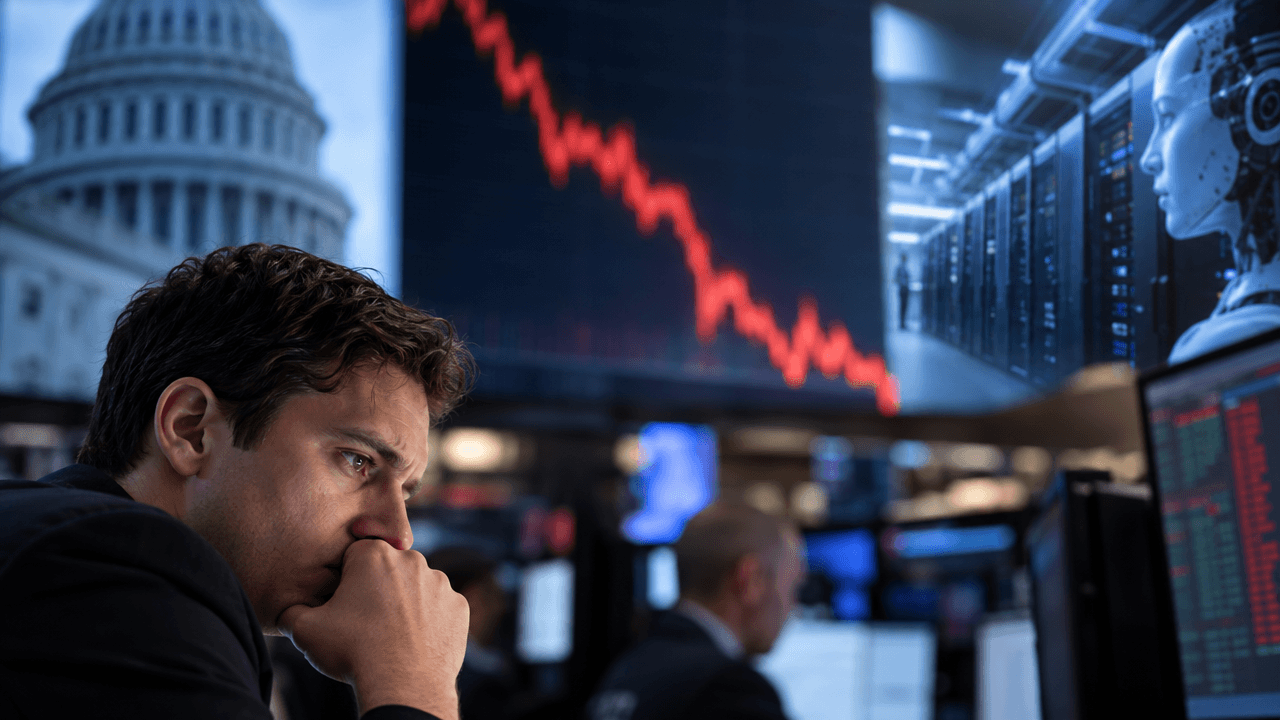
U.S. equity-index futures are facing renewed pressure as investors question whether the extraordinary pace of artificial-intelligence investment can continue without stronger evidence of near-term returns. Nasdaq futures have been especially vulnerable, with technology shares caught between enthusiasm for AI’s long-term potential and concern that spending, regulation, financing costs, and data-center expansion may be moving ahead of actual demand.
The latest pressure follows a sharp technology-led selloff that erased trillions of dollars in market value. The Nasdaq Composite entered correction territory after its steepest one-day decline in 19 months, while semiconductor companies, data-center developers, and electricity providers were among the hardest-hit groups. [1][7] For traders, the episode is a reminder that AI exposure is no longer limited to a handful of software companies. It now reaches across chips, cloud computing, utilities, construction, real estate, and credit markets.
Why Ai Concerns Are Spreading
The central question is changing. Earlier in the AI rally, investors primarily asked how quickly companies could increase revenue from new tools and services. Now they are asking whether projected revenue will justify the enormous cost of the infrastructure required to support those tools.
Major technology companies have committed billions of dollars to specialized chips, cloud capacity, data centers, and electricity supply. That spending has supported strong earnings expectations for hardware manufacturers and infrastructure providers. However, investors are increasingly focused on the timing of returns. If customer demand grows more slowly than expected, companies could face years of elevated capital expenditure before AI-related revenue catches up.
Recent market reports also point to uncertainty surrounding the pace of data-center construction. The AI growth narrative has depended heavily on rapid infrastructure expansion, so any slowdown could affect not only technology stocks but also suppliers and regional economies connected to new facilities. [4] That makes the market particularly sensitive to announcements involving capital budgets, power availability, permitting, and cloud demand.
Regulation Adds A New Risk
Political developments have added another layer of uncertainty. Concerns about tougher AI regulation increased after Democratic victories in the U.S. midterm elections, including in states where opposition to new data centers has grown. Investors are considering whether new rules could increase compliance costs, delay construction, or limit the expansion of energy-intensive facilities. [1][10]
Regulation does not necessarily eliminate the long-term AI opportunity. In many cases, clear standards could eventually support more sustainable growth by reducing legal uncertainty. The immediate market problem, however, is that investors must reassess assumptions that were previously treated as nearly certain.
A delay of several quarters can materially change the valuation of a high-growth company. Technology shares often trade on expectations of future earnings, and those expectations are particularly sensitive to changes in growth timelines. A company expected to monetize infrastructure rapidly may experience a sharp valuation adjustment if regulation pushes that timetable further into the future.
Why Futures Can Move So Quickly
Equity-index futures provide an early indication of how investors are positioning before the cash market opens. Because Nasdaq and Nasdaq 100 futures have significant exposure to large technology companies, they can react sharply when investors reduce risk in AI-related shares.
The recent selloff illustrates how crowded trades can amplify volatility. When many investors own similar companies for similar reasons, a change in expectations can trigger simultaneous selling. Portfolio managers may reduce technology exposure, systematic funds may respond to falling prices, and options-market hedging can intensify intraday moves.
This process can create a feedback loop. Falling futures pressure technology shares at the open, weaker stocks raise volatility, and higher volatility encourages additional risk reduction. The result may be a market move that is larger than the original news would appear to justify.
For SimFi traders, this is an important distinction: volatility is not the same as direction. A trader can correctly identify a long-term AI opportunity and still lose money by entering a leveraged position too early or ignoring the size of short-term swings.
Safe-haven Demand And Cross-market Signals
Stress in U.S. equity futures can also influence other asset classes. When investors reduce exposure to high-beta technology shares, they may seek more defensive holdings such as government bonds or the Japanese yen. The yen can benefit from safe-haven demand, while bonds may attract buyers if traders expect weaker growth or a more cautious policy outlook.
These relationships are not automatic. Bond yields may rise instead if investors are concerned about inflation, government borrowing, or higher term premiums. That is why traders should avoid relying on a single market signal. The direction of the dollar, Treasury yields, credit spreads, and volatility indexes can provide a clearer picture of whether the move reflects a growth scare, an inflation concern, or simple profit-taking.
Watch These Market Indicators
The most important near-term evidence will come from corporate spending plans and economic data. Earnings reports from major cloud providers and chip companies can reveal whether AI demand is translating into sustainable orders. Guidance on capital expenditure may be just as important as reported revenue.
Traders should also monitor employment data, inflation readings, and interest-rate expectations. Higher borrowing costs can make it more expensive to finance data-center projects and reduce the present value of distant earnings. Conversely, signs of cooling inflation or resilient demand could ease pressure on growth stocks.
Practical takeaways include reducing excessive leverage, defining risk before entering a position, and avoiding concentration in several companies driven by the same AI theme. Traders should also distinguish between a broad market breakdown and weakness limited to crowded technology sectors.
The Bigger Picture
The current pressure on U.S. equity-index futures does not prove that the AI investment cycle is over. It does show that the market is moving from excitement to scrutiny. Investors now want evidence that extraordinary infrastructure spending will produce extraordinary cash flows, while regulators and local communities are becoming more influential in determining how quickly the buildout can proceed.
That transition can create both risk and opportunity. Short-term volatility may remain elevated as markets absorb new information, but disciplined traders can use the period to evaluate valuations, catalysts, correlations, and downside scenarios. In a market shaped by powerful narratives, the strongest approach is to test the story against cash flow, policy, and economic reality.