
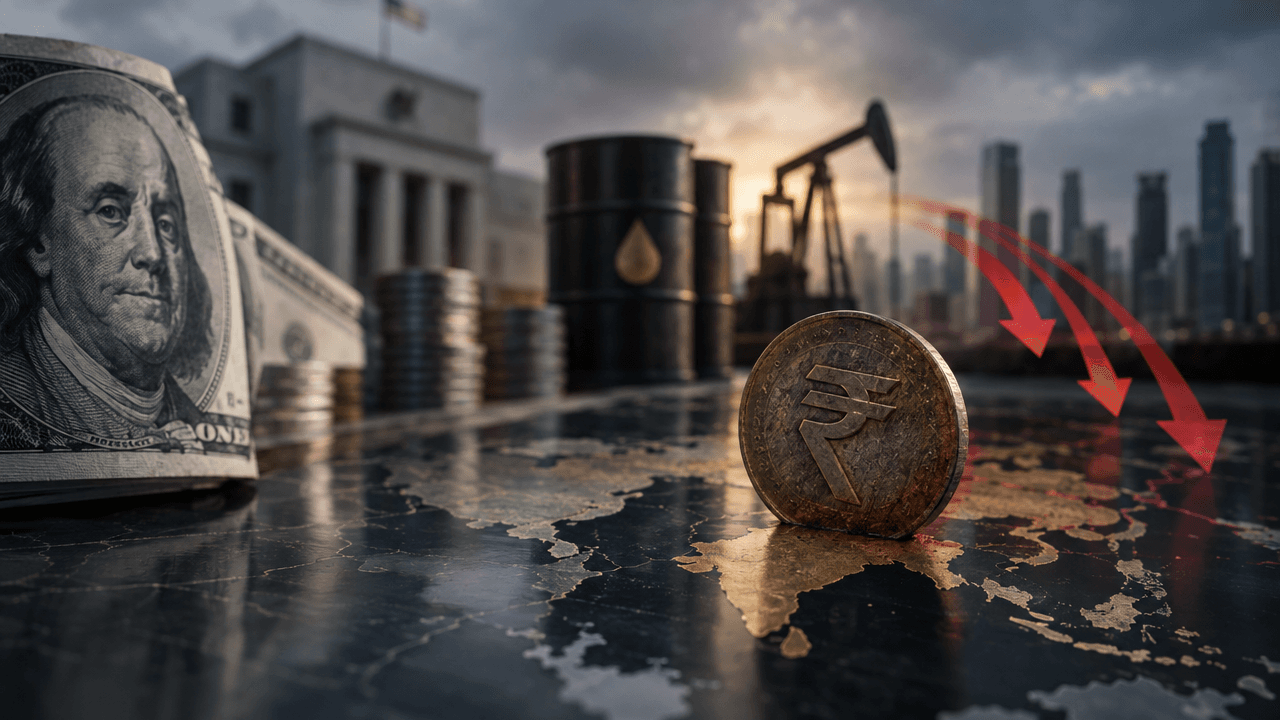
Asian foreign-exchange markets remain under pressure as a firm U.S. dollar, elevated Treasury yields, high oil prices, and persistent capital outflows continue to challenge emerging-market currencies. The Indian rupee has been among the region’s weakest performers, losing 1.2% over the latest quarter and 0.7% over the latest month. The decline highlights how quickly global macroeconomic forces can overwhelm domestic policy support.
The rupee recently traded close to 97 per U.S. dollar, near its weakest levels on record. It is also down roughly 8% this year, making it one of Asia’s worst-performing currencies. A stronger dollar and rising U.S. yields have created a difficult backdrop for India and other emerging economies, particularly those that rely heavily on imported energy. [6]
The Global Pressure On Asian Fx
The main force behind the latest currency weakness is the renewed appeal of U.S. dollar assets. When Treasury yields rise, investors can earn more from relatively low-risk dollar-denominated securities. That often reduces demand for emerging-market bonds, equities, and currencies, especially when investors expect U.S. interest rates to remain high.
The U.S. Dollar Index has recently reached its highest level since April 2025 after recording several consecutive weekly gains. At the same time, the 10-year Treasury yield rose to around 5.34%, its highest level since 2002. Such moves tighten global financial conditions and increase the cost of funding for companies and governments with dollar-linked liabilities. [13]
This dynamic affects Asian currencies unevenly. Economies with strong external balances, large foreign-exchange reserves, or significant export income may be better positioned to absorb the shock. By contrast, countries that import energy or depend on foreign portfolio investment can face sharper depreciation when global investors turn defensive.
Why The Rupee Is Underperforming
India’s exposure to crude oil is a central vulnerability. When oil prices rise, Indian importers need more dollars to pay for energy, increasing demand for the U.S. currency. Higher oil prices can also widen India’s trade deficit and place additional pressure on the country’s current-account balance.
The rupee is also contending with foreign fund outflows from local equities. When overseas investors sell Indian stocks and repatriate the proceeds, they typically convert rupees into dollars, adding further downward pressure on the exchange rate. Rising U.S. yields make this decision easier because investors can obtain more attractive returns in dollar markets without taking as much emerging-market risk.
Market positioning reflects these concerns. Recent surveys showed that bearish views on the Indian rupee remained firm, with rising oil prices and global bond yields identified as key risks. The rupee, Philippine peso, and Thai baht were viewed as particularly vulnerable among regional currencies. [3]
Policy Support Can Slow, But Not Eliminate, The Decline
The Reserve Bank of India has intervened in the foreign-exchange market to limit excessive volatility. State-owned banks have also been reported to sell dollars during periods of sharp rupee weakness. These measures can smooth price action, discourage speculative attacks, and give businesses more time to adjust.
However, intervention does not permanently reverse a broad global trend. The central bank must balance currency support against the need to preserve foreign-exchange reserves and maintain orderly domestic liquidity. If the dollar continues strengthening and foreign investors continue reducing exposure to Indian assets, official intervention may only slow the rupee’s decline rather than change its direction.
The RBI recently raised its policy rate by 25 basis points to 5.50% and shifted toward a calibrated tightening stance. Even so, higher domestic rates have not fully offset the impact of rising U.S. yields, expensive crude oil, and global risk aversion. [5]
What Traders Should Watch Next
For currency traders, the most important indicators are likely to come from the United States. Treasury yields, Federal Reserve guidance, inflation data, employment figures, and expectations for future rate decisions will influence the dollar’s direction. A sustained decline in U.S. yields could provide relief to Asian FX, while another rise would likely keep pressure on regional currencies.
Oil prices are equally important for the rupee. A continued move above elevated levels would increase India’s import bill and potentially worsen inflation expectations. Traders should also monitor foreign portfolio flows, India’s trade data, and the RBI’s presence in the spot and forward markets.
From a technical perspective, USD/INR approaching the 97 area makes that level psychologically important. A decisive move above it could encourage further buying of the dollar, while a sustained rejection could signal temporary relief. Traders should avoid treating a single intervention-driven reversal as proof that the broader trend has changed.
Risk management is especially important in this environment. Position sizes should reflect elevated volatility, and stop-loss levels should account for sudden gaps caused by policy announcements, geopolitical developments, or changes in U.S. rate expectations.
The Bigger Market Lesson
The rupee’s weakness is not an isolated domestic story. It is part of a broader repricing of emerging-market risk caused by a stronger dollar, high global yields, expensive energy, and shifting capital flows. Asian currencies may recover if U.S. yields retreat and investor confidence improves, but the near-term outlook remains fragile.
For SimFi traders and market observers, the key lesson is to connect currency movements with the wider macroeconomic system. A currency chart may show the immediate price action, but the underlying drivers often come from interest-rate differentials, commodity markets, capital flows, and central-bank credibility.
The most disciplined approach is to build scenarios rather than rely on a single forecast. If the dollar strengthens further, downside pressure on the rupee may intensify. If U.S. yields fall and oil prices ease, the currency could stabilize. Until those conditions change decisively, Asian FX—including the Indian rupee—is likely to remain sensitive to every major shift in global risk sentiment.