
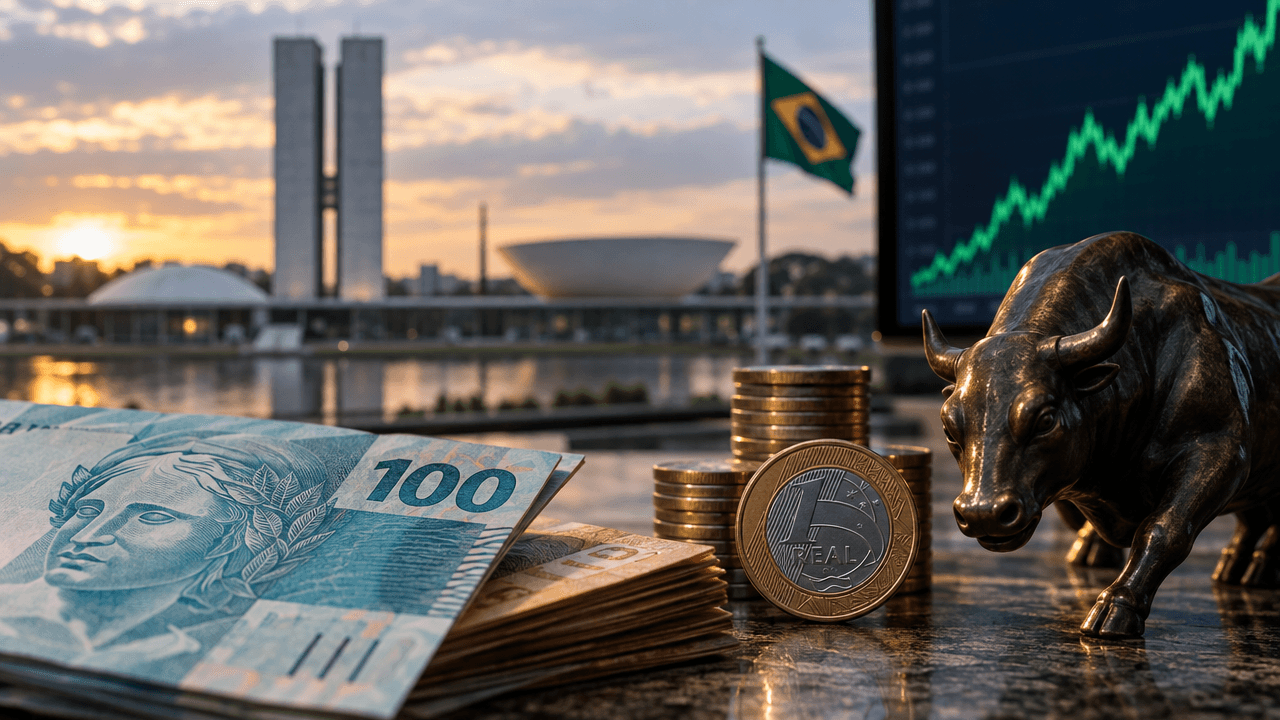
Brazilian financial markets delivered a powerful verdict after an unexpected first-round election result reshaped the country’s political outlook. The Brazilian real strengthened by approximately 4.1% against the U.S. dollar, while the Bovespa stock index jumped 7.7% to a record closing level of 206,911.89 points. The rally followed Flávio Bolsonaro’s narrow lead over incumbent Luiz Inácio Lula da Silva ahead of the October 25 runoff. [8]
Why The Election Result Mattered
Flávio Bolsonaro received roughly 47% of the first-round vote, compared with about 45% for Lula. Because neither candidate secured the majority required to win outright, the election now moves to a decisive runoff. [2]
The result surprised investors because pre-election expectations had generally pointed to a closer contest or a stronger showing by Lula. A better-than-expected performance by Bolsonaro changed the probability assigned to different economic policy outcomes, prompting traders to reassess Brazilian assets almost immediately.
Markets often react to political developments before the underlying economic consequences become clear. In this case, investors appeared to interpret Bolsonaro’s lead as increasing the possibility of policies viewed as more supportive of private enterprise, financial markets, and business investment. That interpretation helped drive buying across Brazilian equities and increased demand for the real.
Still, a first-round lead is not the same as an election victory. The runoff creates another period of uncertainty, and market expectations may shift again as candidates release policy proposals, seek support from eliminated candidates, and appeal to undecided voters.
Why The Real And Stocks Rallied
Currency markets respond quickly to changes in perceived political and economic risk. When investors believe a country may adopt policies that improve fiscal credibility, attract foreign capital, or reduce regulatory uncertainty, demand for its currency can increase.
The real’s gain of more than 4% represented one of its strongest single-day moves in years. The currency rose to around five reais per dollar, reversing part of the risk premium that had been priced into Brazilian assets ahead of the vote. [8]
Equities responded even more dramatically. The Bovespa rose nearly 9% during the session before closing 7.7% higher, its biggest daily gain since March 2020. [11] Financial companies were among the notable beneficiaries because banks are especially sensitive to interest-rate expectations, consumer credit conditions, and economic growth.
Petrobras also advanced, reflecting the importance of political leadership for state-controlled companies. Investors monitor possible changes to capital allocation, fuel pricing, dividend policy, and government influence. Other businesses exposed to domestic consumption, infrastructure, and financial services also gained as traders priced in the possibility of a more market-friendly economic direction. [9]
What Investors Are Really Pricing
The rally does not necessarily mean investors have reached a firm conclusion about Brazil’s long-term outlook. Instead, prices are likely reflecting a rapid adjustment in expectations.
One possibility is that a Bolsonaro victory could lead to lower perceived government intervention in some sectors, improved sentiment toward privatization or investment, and a more favorable environment for companies exposed to domestic growth. These expectations can lift share prices and compress risk premiums.
Another important channel is interest rates. If investors anticipate stronger confidence in fiscal management, longer-term bond yields could fall. Lower expected borrowing costs can support equity valuations, particularly for companies whose future profits are highly sensitive to discount rates.
However, the opposite risks remain. Election campaigns can produce aggressive spending promises, tax proposals, or policy reversals. Even a government seen as business-friendly may face resistance from Congress, courts, state governments, or coalition partners. Brazil’s large public debt burden and complex political system mean that campaign rhetoric must eventually be translated into workable legislation.
For traders, the central question is not simply who leads the polls. It is whether the eventual administration can build a governing coalition and deliver policies that markets consider credible.
Key Risks Before The October 25 Runoff
The first risk is political volatility. A narrow first-round margin means the race remains highly competitive. New alliances, debates, scandals, and shifts in voter turnout could produce large changes in expectations during the final campaign period.
The second risk is profit-taking. A 7.7% one-day gain in the Bovespa and a 4% currency move create conditions in which short-term traders may lock in gains. Even if the broader bullish thesis remains intact, sharp pullbacks are possible.
The third risk is that markets have moved too far too quickly. When prices rally on expectations rather than confirmed policy, disappointing announcements can trigger a reversal. Traders should distinguish between a change in political probability and an actual improvement in economic fundamentals.
The fourth risk is external. Brazil remains exposed to global interest rates, commodity prices, China’s economic performance, and movements in the U.S. dollar. A stronger dollar globally or a decline in major commodity prices could limit gains in Brazilian assets regardless of the election outcome.
Practical Takeaways For Simfi Traders
The Brazilian election offers several useful lessons for simulated finance traders.
First, political events can create large cross-asset moves. A single headline affected the currency, equities, interest-rate expectations, banks, energy companies, and consumer stocks. Monitoring only one market can miss the broader risk transmission.
Second, surprise matters more than the headline alone. Markets had already incorporated some election risk, but Bolsonaro’s stronger-than-expected result forced investors to reprice the outcome. Comparing actual results with expectations is often more informative than analyzing the result in isolation.
Third, momentum and risk management must work together. A strong opening rally can reward traders who identify the catalyst early, but chasing an extended move can expose them to sudden reversals. Position sizing, stop-loss discipline, and scenario planning remain essential.
Finally, traders should prepare for multiple outcomes. Before the runoff, it is useful to define what could happen if Bolsonaro’s lead expands, if Lula regains momentum, or if the result is contested. This approach is more robust than relying on a single prediction.
Conclusion
Brazil’s election has become one of the most important near-term drivers for Latin American markets. Flávio Bolsonaro’s first-round lead produced a sharp rally in the real and Brazilian stocks because investors interpreted the result as increasing the possibility of a more market-supportive economic agenda. [3]
That optimism is significant, but it is not final. The October 25 runoff will determine whether the initial market reaction develops into a sustained trend or becomes another example of how quickly political expectations can reverse. For SimFi traders, the episode reinforces a core principle: major opportunities often emerge when new information changes probabilities, but disciplined risk management determines whether those opportunities can be traded effectively.