
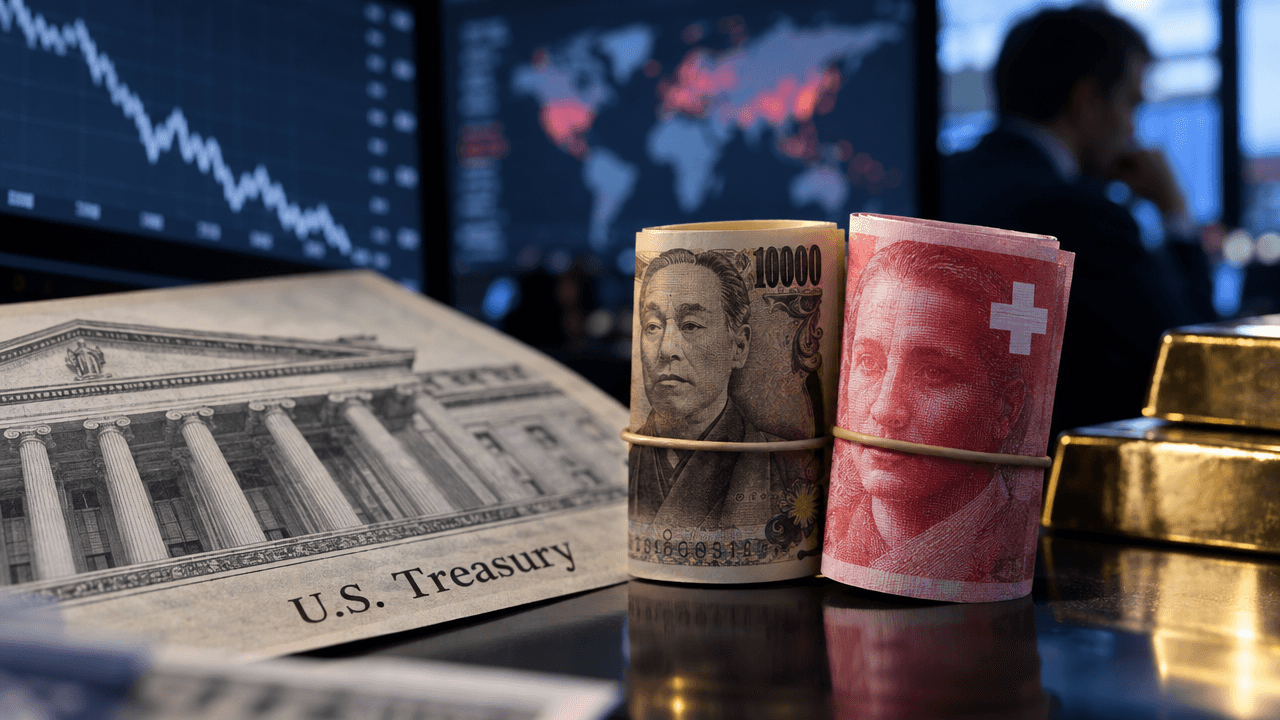
When investors lose confidence in risky assets, capital often moves quickly toward markets perceived as safer and more liquid. That pattern was visible in Asian trading on Friday, as concerns about the sustainability of heavy artificial-intelligence investment triggered a broad technology selloff. The resulting risk-off move lifted U.S. government bonds and supported two traditional defensive currencies: the Japanese yen and Swiss franc. [4]
The benchmark 10-year U.S. Treasury yield fell more than 7 basis points toward 4.91%, while the yen strengthened to approximately 157.20 per dollar. The Swiss franc traded near a one-month high at around 0.8213 per dollar. [6] These moves illustrate how markets can reprice several asset classes at once when investors reduce exposure to growth-sensitive trades.
Why Bonds Benefit From Risk Aversion
Bond prices and yields move in opposite directions. When demand for U.S. Treasuries increases, prices rise and yields decline. A fall of more than 7 basis points in the 10-year yield is meaningful because it reflects a substantial shift in expectations and positioning, particularly during a single Asian trading session.
Treasuries are widely used as a defensive asset because they are backed by the U.S. government and trade in a deep, liquid market. During periods of uncertainty, investors may sell equities, corporate debt, or emerging-market assets and redirect funds toward government bonds. This does not necessarily mean investors expect an immediate recession. It can simply indicate that preserving capital has become more important than pursuing additional returns.
The Treasury rally was also supported by the Federal Reserve’s recent decision to leave interest rates unchanged, with no firm signal about when it might raise rates again. When investors reassess future economic growth and interest-rate expectations, longer-term bond yields can adjust rapidly. [4]
The October decline in the 10-year yield had reached roughly 37 basis points, putting the month on track for its largest drop since December 2023. [6] For traders, that broader trend matters more than a single session because it may influence mortgage rates, borrowing costs, equity valuations, and currency flows.
Why The Yen And Franc Act As Havens
The Japanese yen has long been associated with defensive market behavior. Japan is a major creditor nation, and Japanese investors hold substantial overseas assets. During turbulent periods, some investors unwind international positions and bring funds back into yen. This process can strengthen the currency, especially when leveraged carry trades are being reduced.
A carry trade typically involves borrowing in a currency with relatively low interest rates and investing in assets denominated in a higher-yielding currency. When market volatility rises, traders may close those positions to limit losses. That creates demand for the funding currency, often including the yen.
The yen’s move was also notable because the Bank of Japan kept its policy settings unchanged, as economists had expected. [1] The currency therefore benefited less from a surprise policy decision than from a combination of haven demand, falling U.S. yields, and reduced appetite for risk.
The Swiss franc benefits from a different form of defensive appeal. Switzerland’s political stability, strong institutions, and history of financial credibility make the franc a preferred refuge when investors are worried about global markets. It gained broadly against major currencies, rising about 0.5% against the dollar and 0.3% against the euro in the reported session. [2]
What The Ai Selloff Signals
The immediate catalyst was concern that enormous spending on artificial intelligence infrastructure may not generate sufficient profits and cash flow. Technology valuations had risen sharply, leaving investors more sensitive to disappointing earnings, weaker guidance, or evidence that capital expenditure is outpacing returns.
When highly valued technology shares decline, the effect can spread beyond the sector. Equity index weightings may amplify the move, while hedge funds and other leveraged investors can reduce positions across multiple markets. Investors may also rotate toward defensive sectors such as consumer staples, utilities, and healthcare, while increasing allocations to bonds and safe-haven currencies.
This does not prove that the AI investment cycle is ending. It does show that markets are demanding clearer evidence that spending will translate into durable earnings. A shift from enthusiasm to scrutiny can increase volatility even when the long-term technology outlook remains constructive.
Practical Takeaways For Traders
First, watch the relationship between bond yields and the dollar. Falling Treasury yields can reduce the dollar’s interest-rate advantage and create additional support for the yen and franc. However, currency moves can reverse if economic data, central-bank communication, or geopolitical developments change the market narrative.
Second, avoid treating every haven rally as a one-way trend. The yen and Swiss franc can strengthen during the initial phase of a selloff, but crowded defensive positioning may later produce sharp pullbacks. Traders should consider position size, stop-loss placement, and the possibility of rapid reversals.
Third, monitor cross-asset confirmation. A genuine risk-off move is more credible when falling equity prices coincide with lower bond yields, stronger defensive currencies, and weaker credit-sensitive assets. If only one market is moving, the signal may be less reliable.
Finally, remember that volatility creates both opportunity and risk. Simulated trading environments allow traders to test how portfolios respond to changing correlations without placing real capital at immediate risk. The objective should be to develop a repeatable process rather than chase the latest haven move.
Conclusion
The latest market action highlights the powerful connection between equities, bonds, and currencies. Concerns over elevated technology valuations pushed investors toward U.S. Treasuries, sending the 10-year yield toward 4.91%, while the yen and Swiss franc gained as demand for traditional havens increased. [6]
For traders, the central lesson is that risk sentiment can reshape several markets simultaneously. Tracking yield movements, currency behavior, central-bank policy, and equity leadership provides a clearer view of whether a selloff is temporary turbulence or the beginning of a broader change in market positioning.