
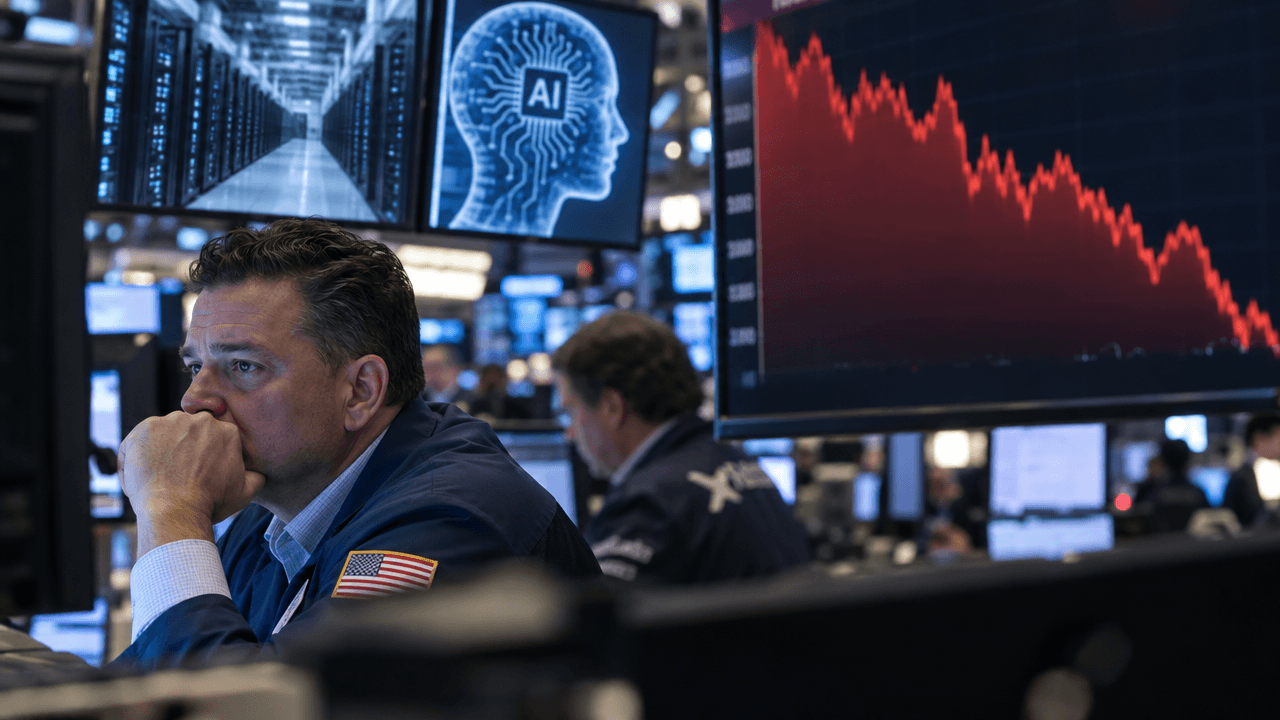
U.S. equity futures slid sharply in overnight trading, with Nasdaq contracts leading the decline as investors reassessed the durability of the artificial intelligence investment boom and the possibility of tougher technology regulation. Nasdaq-100 futures fell as much as 2.4%, while S&P 500 futures dropped roughly 1.1% to 1.4% during the session. [1][10]
The move highlights a growing tension in financial markets. Investors remain enthusiastic about AI’s long-term potential, but they are increasingly questioning whether today’s extraordinary spending on chips, servers, power infrastructure, and data centers can generate sufficient profits. At the same time, political developments have raised the prospect of tighter oversight that could slow the industry’s expansion.
Why Nasdaq Futures Are Under Pressure
The Nasdaq is particularly sensitive to shifts in expectations because its largest companies derive much of their value from future earnings growth. When investors become less confident about that growth, high-multiple technology stocks can decline quickly.
The latest weakness was triggered partly by U.S. midterm election results that pointed toward stronger Democratic control in Congress. Markets interpreted the outcome as potentially increasing regulatory scrutiny of artificial intelligence, large technology companies, data privacy, competition policy, and energy use.
Data centers are a central part of that debate. AI systems require enormous computing capacity, and building that capacity involves significant electricity consumption, water usage, land development, and grid investment. Democratic victories in important data-center states have raised concerns that new facilities could face stricter permitting requirements, environmental reviews, or local restrictions. [3]
For investors, the concern is not necessarily that AI development will stop. The more immediate question is whether the pace of construction and capital expenditure will slow. Even a modest delay could affect semiconductor suppliers, networking companies, utilities, construction firms, and technology businesses whose valuations depend on rapid infrastructure growth.
The Ai Investment Trade Faces A Profitability Test
The AI rally has been powered by a remarkable cycle of corporate spending. Major technology companies have committed billions of dollars to specialized chips, cloud-computing capacity, and new data centers. That spending has benefited chip designers, equipment manufacturers, power providers, and companies that supply cooling and networking systems.
However, capital expenditure does not automatically translate into near-term earnings. Investors now want clearer evidence that AI products can produce recurring revenue, improve operating margins, or deliver measurable productivity gains.
This creates a two-part test for the market. First, companies must demonstrate that customers are willing to pay for AI services at attractive margins. Second, the infrastructure supporting those services must earn an adequate return on investment.
When markets are confident, investors tend to reward aggressive spending because they expect future dominance. When confidence weakens, the same spending can be viewed as a potential financial burden. That shift in interpretation can create substantial volatility, especially in companies trading at elevated valuations.
Regulation adds another layer of uncertainty. New rules involving data privacy, algorithmic accountability, antitrust enforcement, chip exports, or energy consumption could increase compliance costs and lengthen development timelines. Analysts have also pointed to the possibility of policies affecting data-center construction and power demand. [5]
What The Futures Move Signals
The decline in futures does not necessarily predict how the cash market will finish the day. Futures often react quickly to political headlines and can recover as investors assess whether the initial interpretation is too negative. In fact, later reports showed that the contracts pared some of their losses as traders considered the broader implications of the election outcome. [1]
Still, the size of the early move is meaningful. A roughly 2% decline in Nasdaq futures compared with a fall of about 1.1% in S&P 500 futures shows that investors were targeting technology and AI-related exposure rather than selling every sector equally.
This is a sign of concentration risk. The broader market has become increasingly dependent on a relatively small group of large technology companies. If those companies experience simultaneous pressure from high valuations, rising costs, regulatory uncertainty, or weaker earnings expectations, index-level volatility can increase rapidly.
The move also demonstrates why traders should distinguish between a short-term headline shock and a structural change in market fundamentals. A single election result may alter expectations, but actual regulatory outcomes will depend on legislation, agency action, court decisions, and implementation timelines.
Practical Lessons For Traders
Traders should monitor several indicators as the market processes the news.
First, watch the relationship between Nasdaq futures and S&P 500 futures. Continued underperformance by Nasdaq contracts would suggest that investors remain focused on AI and technology risks. A narrowing gap could indicate that the initial technology sell-off is stabilizing.
Second, follow Treasury yields and interest-rate expectations. Long-duration growth stocks are especially sensitive to discount rates because much of their projected value lies in future earnings. A rise in yields can pressure technology valuations even without new regulatory concerns.
Third, track corporate capital-expenditure plans. Earnings reports and investor presentations may reveal whether companies are accelerating, moderating, or delaying data-center investments. Guidance will matter more than headlines because it provides evidence of how businesses are responding to costs and demand.
Finally, avoid treating every AI-related company as identical. Chip manufacturers, cloud providers, utilities, software firms, and data-center developers face different revenue models and regulatory exposures. A disciplined approach evaluates balance sheets, cash flow, customer concentration, and valuation rather than relying only on the AI theme.
The Bigger Market Picture
The slide in U.S. equity futures is best understood as a repricing of expectations rather than a rejection of artificial intelligence. Investors still recognize AI’s transformative potential, but they are demanding a more convincing connection between investment, revenue, and profit.
For SimFi traders, the episode offers a valuable lesson in risk management. Market leadership can change quickly when political risk meets stretched valuations and crowded positioning. Position size, stop placement, scenario planning, and awareness of overnight news are essential when trading high-beta instruments.
The next phase of the AI trade will likely be determined by execution. Companies that convert spending into durable cash flow may continue to attract capital, while businesses dependent on unlimited infrastructure growth could face greater scrutiny. The Nasdaq futures decline is therefore more than a single market reaction: it is a warning that enthusiasm must eventually be supported by economics.