
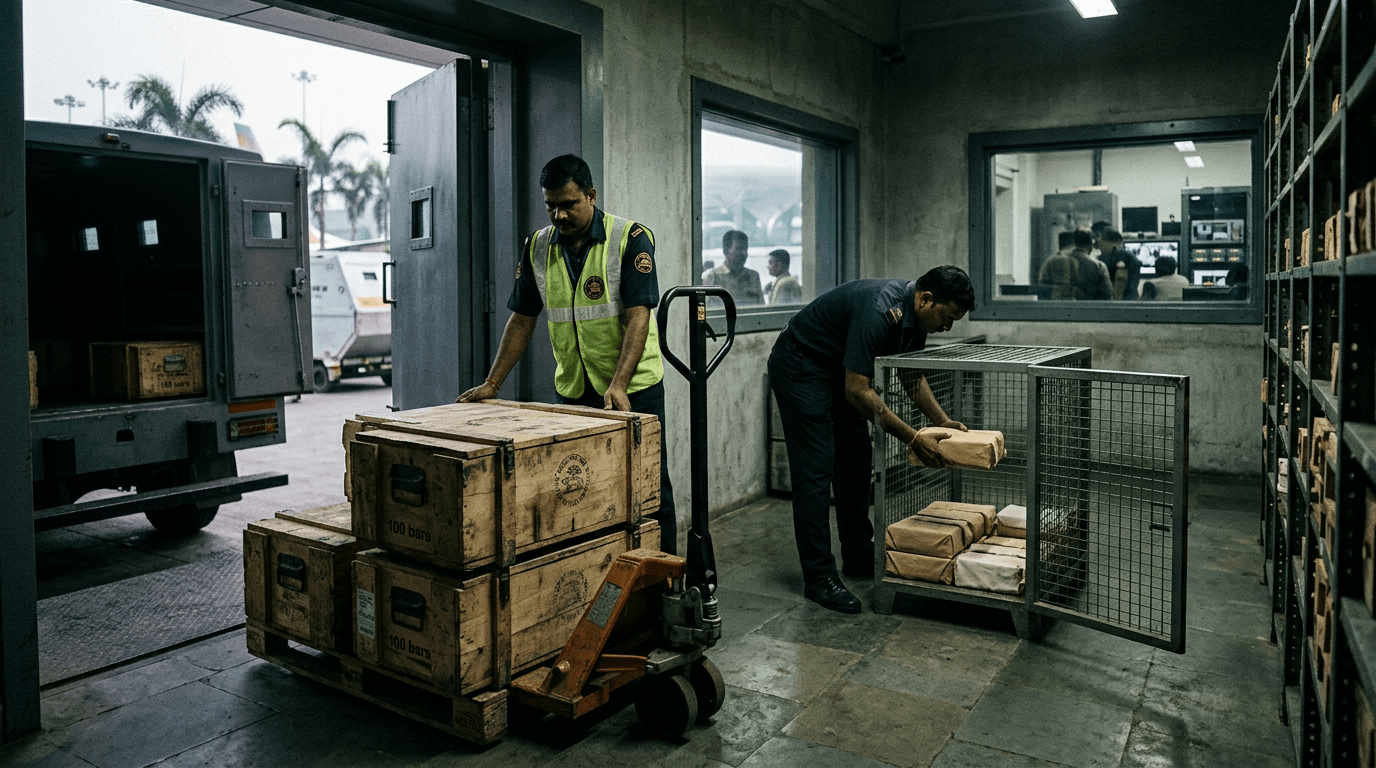
For decades, much of India’s official gold sat quietly in vaults in London and at the Bank for International Settlements (BIS). Now, the Reserve Bank of India (RBI) is accelerating a strategic shift: bringing that bullion back home, changing not the size of India’s reserves, but how and where they are held.[1][4][9] This has subtle but important implications for FX reserves management, intervention capacity, and how markets read the rupee’s safety net.
Global Context: Why Central Banks Care About Where Gold Sits
Gold has long been a core component of central bank reserves because it is a tangible, non‑liability asset that historically holds value in times of stress.[7][8] Traditionally, a significant share of this gold is stored in major financial centers like London to facilitate quick lending, swaps, and other market operations.[8]
Over the past decade, however, repeated geopolitical shocks — from sanctions to asset freezes — have made many countries more sensitive to where their sovereign assets physically reside.[1][4][9] India joins a broader group of central banks that are repatriating gold to reduce exposure to foreign jurisdictions and potential financial weaponization risks.[4][9]
For the RBI, the question is no longer just “how much gold do we hold?” but increasingly “where do we hold it, and under whose legal and operational control?”[1][2][4]
HOW MUCH GOLD HAS MOVED, AND WHAT HAS CHANGED?
The scale of India’s gold repatriation is significant. As of end‑March 2026, the RBI held about 880.52 metric tonnes of gold, of which roughly 680.05 tonnes — nearly 77% — were stored in domestic vaults, primarily in Mumbai and Nagpur.[1][4][9] Only about 197.6 tonnes remained with the Bank of England and BIS.[1]
This represents an accelerated trend. Between March 2023 and September 2025, India repatriated roughly 274–280 tonnes of gold from foreign custodians.[2][9][11][12] In the second half of FY26 alone, around 104 tonnes were flown back from the UK in high‑security operations, continuing what has now become an annual pattern of “gold lifts.”[1][4][6]
It is crucial to note what has not changed. The RBI’s total gold asset remains the same; only the storage location has shifted.[7][8] There are no customs duties, GST, or GDP effects from this move because the gold was already India’s property.[7] On the balance sheet, this is a logistical and strategic reallocation, not a financial revaluation.
Reserve Management: Gold Vs Fx Liquidity
From an FX reserves management perspective, the RBI’s move is mostly about risk and logistics, not about shrinking its intervention firepower.
First, gold’s share of India’s overall foreign exchange reserves — although rising — remains modest compared with foreign currency assets like US Treasuries and deposits.[10] As of one recent RBI report, domestic gold holdings increased from about 8.1% to 9.3% of FX reserves, suggesting that gold is a meaningful but not dominant component.[10] FX intervention capacity is still primarily driven by liquid foreign currency assets, not gold.
Second, repatriating gold does not prevent the RBI from using it in global markets. Gold stored abroad in London is easier to mobilize instantly through swaps and loans, but gold held domestically can still be used in international operations, albeit with slightly more complex logistics.[8] The underlying asset is the same; the difference is in operational pipelines and counterparty structures.
Third, the RBI clearly frames this as a risk‑management and cost decision. Storing gold at home lowers overseas storage and insurance costs and improves control over security and logistics.[2][4] At the same time, the central bank maintains a diversified approach, keeping some gold abroad to retain operational flexibility with global financial centers.[1][8]
The takeaway for traders: India’s ability to defend the rupee via FX reserves is not materially reduced by gold repatriation. If anything, the move marginally strengthens sovereign control while leaving overall FX “firepower” intact.
Market Perceptions: Signals About Rupee And Reserve Adequacy
Where this story becomes more interesting for markets is the signal it sends.
By repatriating the bulk of its gold, the RBI is saying that it values sovereign control and resilience to external shocks.[1][4][9] In a world where sanctions can immobilize foreign assets overnight, having most of your bullion under domestic jurisdiction can be read as a prudent, protective step.
At the same time, the RBI has emphasized that “nothing more should be read into it” in terms of immediate policy shifts; the move was possible because domestic storage capacity is now adequate.[8] This messaging seeks to reassure markets that the repatriation is not a sign of imminent external stress or loss of trust in foreign partners, but rather a long‑term strategic adjustment.
Still, investors and FX traders often look through official narratives to infer broader themes:
- Confidence in domestic stability: Bringing gold home can signal that institutions are strong enough to manage and secure large bullion holdings domestically.[7][9]
- Reduced jurisdiction risk: Lower reliance on foreign custodians is seen as reducing the probability that India’s reserves could be disrupted by external political decisions.[1][4]
- Quiet rebalancing of reserve composition: A gradual rise in gold’s share of reserves, coupled with domestic storage, may be interpreted as a modest hedge against fiat currency risk and global financial volatility.[9][10][12]
For rupee markets, this can strengthen perceptions of reserve adequacy from a sovereign‑risk perspective, even if the headline FX numbers do not change dramatically.
What Traders And Simulated Investors Should Watch
For active traders and SimFi participants, the direct impact of gold repatriation on short‑term rupee moves may be limited. However, it offers several useful lenses for analysis:
- Reserve quality, not just quantity: Look beyond headline FX reserve levels to the composition (gold vs currencies) and jurisdiction (domestic vs foreign). Shifts in these dimensions can affect how resilient reserves are under different shock scenarios.[9][10][12]
- Policy response capacity in crises: While gold repatriation doesn’t reduce FX intervention capacity, it hints that the RBI is thinking in multi‑scenario terms, balancing liquidity with sovereignty. That mindset can influence how it reacts to future episodes of rupee volatility.
- Long‑term hedging themes: A central bank slowly increasing its gold share and moving bullion onshore aligns with broader global trends of “financial de‑risking.” For macro‑oriented traders, this can support themes around gold as a hedge, non‑USD diversification, and potential shifts in how emerging markets think about reserve safety.[1][4][9][10]
- Narrative risk: Headlines about “bringing gold home” can be misread as a sign of crisis or distrust. In reality, the data show a multi‑year, deliberate strategy rather than an emergency scramble.[1][2][9][11][12] Understanding this helps avoid overreacting to news flow.
For simulated trading environments, RBI’s gold strategy is a rich theme to model: how changes in reserve composition and storage might interact with global risk sentiment, gold prices, and emerging‑market FX dynamics over time.
Conclusion
India’s accelerated repatriation of gold is a structural story, not a short‑term shock. The RBI is reshaping where its reserves sit to reduce jurisdictional and operational risks, while leaving the overall size of its FX buffers broadly unchanged.[1][4][7][8][9]
For the rupee and FX markets, the implication is more about resilience and signaling than about raw intervention capacity. Traders who focus on the quality, composition, and control of reserves — not just the headline numbers — will be better positioned to interpret moves like this and to understand what they reveal about a central bank’s long‑term strategy.