
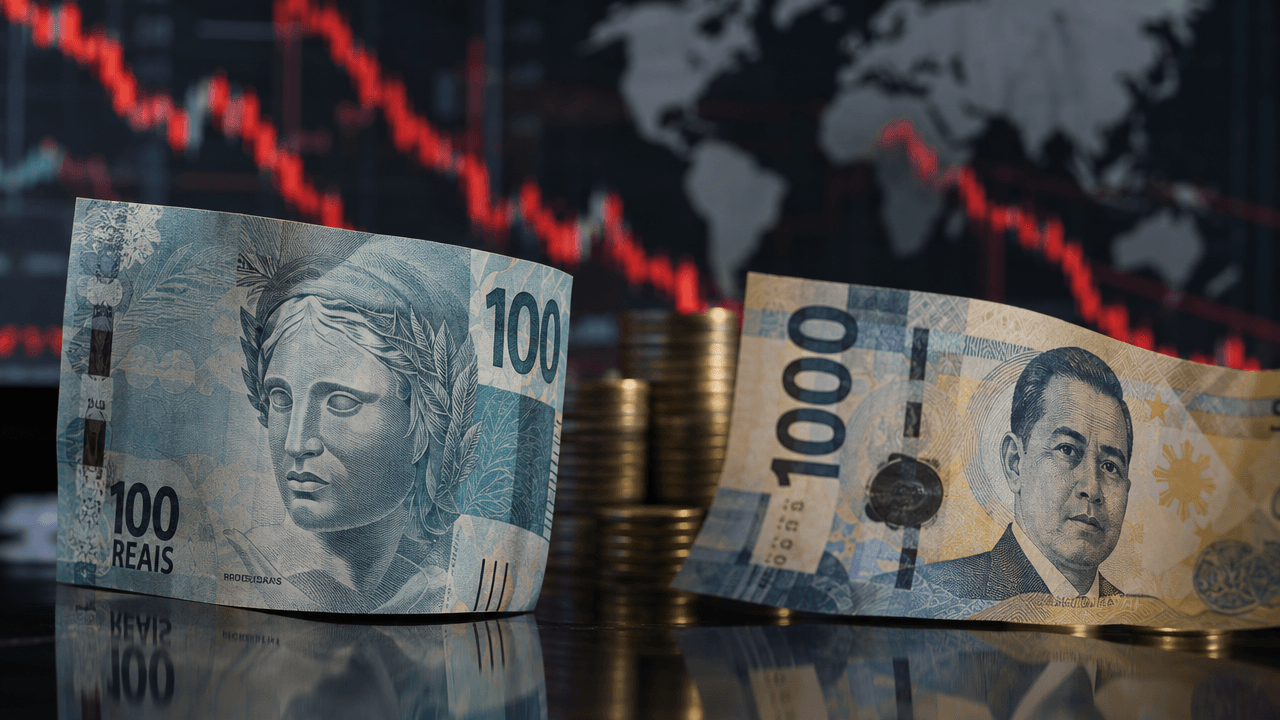
The Brazilian real and Mexican peso led a broad group of currency decliners, highlighting how quickly foreign-exchange markets can separate winners from losers when political risk, commodity prices and global sentiment collide. The real fell 1.25%, while the peso declined 0.47%. The Chinese yuan and Japanese yen also weakened, whereas the Norwegian krone, British pound and euro posted gains. [15]
For traders, the move is more than a daily performance table. It is a useful reminder that currencies respond to a combination of domestic developments and international capital flows. A currency can weaken even when its economy is growing, while a traditionally volatile currency can outperform when investors favor its supporting fundamentals.
Why The Real Faced The Heaviest Pressure
Brazil’s real has been particularly sensitive to political and fiscal uncertainty. Recent market commentary has pointed to concerns about the direction of fiscal policy, cabinet appointments and the government’s ability to reassure investors about public finances. The currency recently traded near 5.50 per U.S. dollar, its weakest level since an earlier post-election decline. [4]
Currency traders often demand a higher risk premium when they believe government spending could increase debt or inflation pressures. That premium can appear through a weaker exchange rate, higher bond yields or both. Even if Brazil’s central bank maintains a relatively restrictive interest-rate policy, investors may still reduce exposure if they expect fiscal uncertainty to persist.
The upcoming central-bank decision is therefore important, but it is not the only variable. Markets will also examine inflation expectations, economic growth forecasts and signals about the government’s policy priorities. Brazil’s manufacturing sector has remained in contraction territory, adding another layer of concern for investors assessing the balance between slowing activity and persistent fiscal risks. [4]
MEXICO’S PESO RESPONDS TO A DIFFERENT MIX
The Mexican peso’s 0.47% decline was smaller than the real’s loss, but it reflects a separate set of considerations. Mexico’s currency has benefited in recent years from relatively high interest rates, strong links to the U.S. economy and enthusiasm around nearshoring. However, those supports can weaken when traders anticipate interest-rate cuts or become more cautious about emerging-market assets.
Recent market analysis has identified the possibility of lower Mexican interest rates as a potential source of pressure on the peso. If domestic rates fall, the return available to investors holding peso-denominated assets may become less attractive, particularly when U.S. yields remain elevated or global markets turn defensive. [6]
The peso is also highly liquid and widely used in emerging-market trading strategies. That makes it easier for investors to buy and sell, but it also means the currency can become a source of funding or risk reduction during periods of uncertainty. A modest domestic concern can therefore be amplified by international portfolio decisions.
Oil, Safe Havens And Currency Divergence
The contrasting performance of the Norwegian krone, pound and euro demonstrates why foreign exchange is a relative market. Currencies do not move only because of their own economic data; they move against other currencies whose outlook may be improving or deteriorating at the same time.
Oil prices are especially relevant to the Norwegian krone because Norway is a major energy exporter. Higher oil prices can improve the country’s trade and income outlook, supporting demand for the currency. At the same time, oil-related volatility can hurt energy-importing economies and intensify inflation concerns elsewhere.
The weaker yuan and yen show that pressure was not limited to Latin America. The yuan can be influenced by China’s growth outlook, trade conditions and policy guidance, while the yen remains sensitive to interest-rate differentials and global risk appetite. When investors favor higher-yielding or commodity-linked assets, the yen may struggle. When fear dominates, however, its traditional safe-haven characteristics can return.
What Simfi Traders Should Watch
For SimFi traders, this episode offers several practical lessons.
First, avoid treating a percentage move as a complete explanation. The real’s 1.25% decline was larger than the peso’s 0.47% loss, but the underlying drivers were not identical. Build a market thesis around specific catalysts: election developments, fiscal announcements, central-bank decisions, inflation data and oil-price changes.
Second, distinguish trend from event risk. A currency may weaken because of a developing macroeconomic trend, or it may fall sharply because of one unexpected headline. Event-driven moves can reverse quickly, so position size and stop placement matter more than usual.
Third, compare currencies in pairs. A trader holding the U.S. dollar against the real is expressing a different view from one trading the peso against the euro or the yen against the pound. Relative strength analysis can reveal opportunities that are less obvious in a single currency chart.
Finally, monitor correlations without relying on them blindly. Oil, interest rates and risk sentiment can provide useful context, but relationships change. A higher oil price may support the krone while simultaneously increasing inflation concerns that influence central-bank expectations.
The Broader Market Message
The latest currency performance is best understood as a warning about uneven risk pricing rather than a universal collapse in emerging markets. The real and peso faced meaningful pressure, but the gains in the krone, pound and euro show that capital was being redistributed across markets rather than simply exiting every currency.
That distinction matters. Successful trading requires identifying where risk is concentrated, what catalyst could change the narrative and whether the current price already reflects the news. For beginners, the key takeaway is to connect exchange-rate movements with policy and macroeconomic drivers. For experienced traders, the opportunity lies in testing whether those drivers are strong enough to sustain the move.
The real and peso may remain sensitive to political developments, interest-rate expectations and global risk appetite. SimFi traders can use the episode to practice scenario planning: define a base case, outline an adverse outcome, size the position conservatively and review the thesis when new information arrives.