
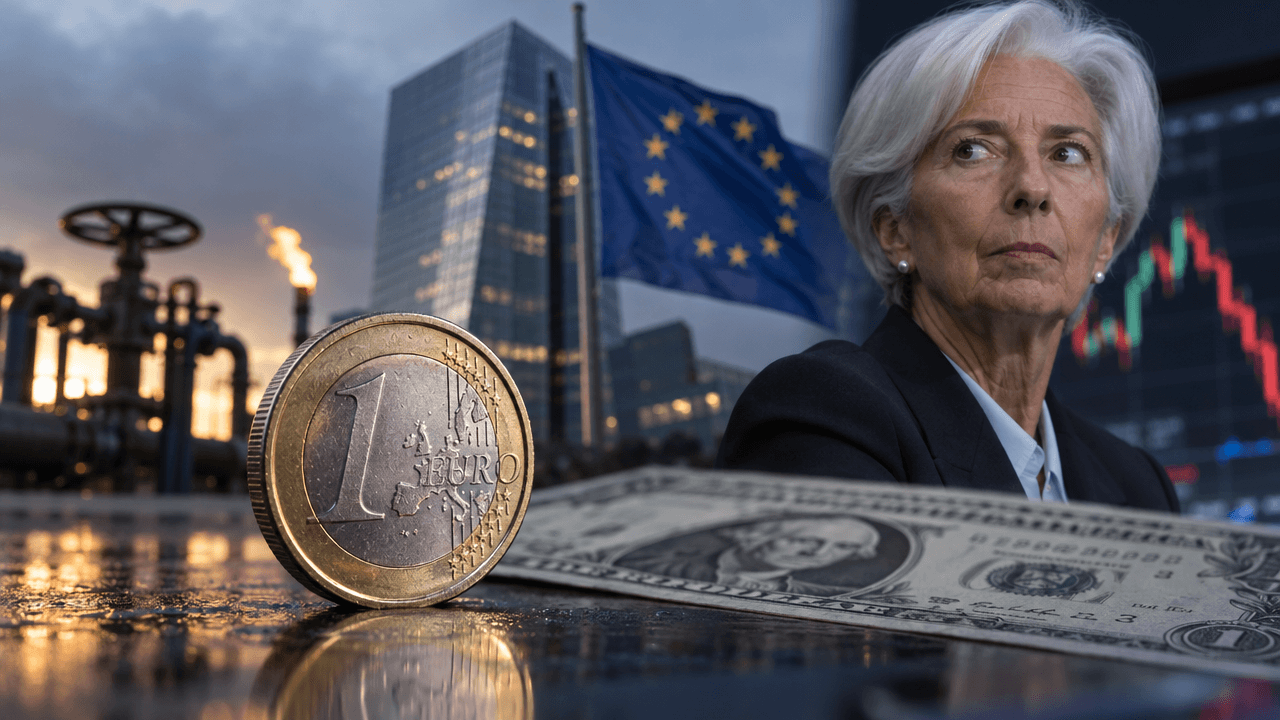
The euro remains under pressure near $1.119, with traders looking beyond the European Central Bank’s decision to leave interest rates unchanged. Although the ECB maintained its deposit rate at 2.50%, the currency is still heading toward a monthly decline as investors weigh higher energy costs, weaker growth risks and uncertainty surrounding the central bank’s leadership. [1][7]
The market’s reaction highlights an important principle for currency traders: a rate decision is rarely judged in isolation. The level of interest rates matters, but so do the outlook for inflation, the direction of future policy and the credibility of the institution setting that policy.
Ecb Holds Rates As Inflation Risks Rise
On October 29, the ECB kept its deposit facility rate at 2.50%. The main refinancing rate remained at 2.65%, while the marginal lending facility stayed at 2.90%. The decision followed two rate increases earlier in the year, including the most recent move in September. [11][13]
Holding rates steady was widely expected, so the decision itself did not provide a strong bullish catalyst for the euro. Instead, traders focused on the ECB’s warning that rising energy prices create upside risks for inflation while also threatening economic growth. The central bank is therefore facing a difficult combination: inflation is accelerating, but the economy may be vulnerable to tighter financial conditions and more expensive energy.
This is commonly referred to as a stagflationary risk. If energy costs remain elevated, headline inflation could stay above the ECB’s 2% target even as households and businesses reduce spending. A central bank may then feel pressure to raise rates to contain inflation, while simultaneously worrying that higher borrowing costs could deepen an economic slowdown.
For the euro, that tension creates an uncertain policy signal. A rate hike could support the currency by improving its yield advantage, but it could also hurt confidence if markets interpret the move as a response to deteriorating economic conditions.
Energy Prices Complicate The Outlook
Energy has become the most immediate driver of the euro-area inflation outlook. The ECB said higher energy prices are likely to push headline inflation higher in the near term and keep it above target over the coming quarters. [7]
The challenge is that energy-price inflation does not behave like demand-driven inflation. If prices rise because of supply disruptions or geopolitical tensions, higher interest rates cannot directly create more oil or gas. Monetary tightening can, however, reduce the risk that temporary energy costs become embedded in wages, services and broader pricing decisions.
Recent data underline the scale of the problem. Euro-area headline inflation reached 3.8% in September, while energy inflation rose sharply, according to market coverage of the ECB decision. [6] Traders must now assess whether the energy shock remains temporary or begins spreading into core inflation.
That distinction will be central to future euro valuations. A temporary spike could eventually fade, allowing the ECB to remain patient. Persistent price pressures could force policymakers toward another increase, particularly if inflation expectations begin moving higher.
LAGARDE’S EARLY DEPARTURE ADDS UNCERTAINTY
The policy meeting was overshadowed by Christine Lagarde’s announcement that she will step down as ECB president on February 7, 2027, ahead of the scheduled end of her term. Her successor will be appointed by the European Council. [1]
Leadership changes do not automatically imply a change in monetary policy. The ECB’s Governing Council, rather than its president alone, makes interest-rate decisions. Nevertheless, the president plays an important role in communicating policy, building consensus and shaping how markets understand the bank’s reaction function.
The timing of Lagarde’s departure gives investors another variable to price. Markets will examine the eventual candidate’s views on inflation tolerance, financial stability and the balance between supporting growth and maintaining price stability. Until the appointment process becomes clearer, traders may demand a higher risk premium for euro-denominated assets.
Political uncertainty can also influence the currency indirectly. If investors become concerned that future policy could be less independent or less predictable, the euro may weaken even if short-term interest rates remain relatively high.
Why The Euro Is Still Vulnerable
The euro’s decline reflects more than one factor. Uncertainty over ECB policy and leadership is occurring alongside elevated energy prices, concerns about regional growth and competition from other major currencies.
A currency’s value depends partly on relative expectations. Even if the ECB is considering further tightening, the euro may struggle if investors expect stronger growth or more attractive returns elsewhere. The dollar, in particular, can benefit when global investors seek liquidity and safety during periods of geopolitical or economic uncertainty.
The euro’s move around $1.119 therefore signals caution rather than a definitive forecast of an imminent collapse. Traders are balancing the possibility of additional ECB tightening against the risk that higher energy costs damage economic activity. This helps explain why a central bank can sound concerned about inflation without generating sustained currency strength.
Practical Takeaways For Traders
First, monitor the energy market alongside EUR/USD. Oil and gas prices may influence inflation expectations, bond yields and ECB rate projections at the same time.
Second, watch European bond yields and short-term interest-rate futures. A rising expectation of an ECB hike can support the euro, but a sharp rise in longer-term yields caused by fiscal or political stress may have the opposite effect.
Third, treat central-bank communication as a series rather than a single headline. Upcoming inflation, wage and growth data will help determine whether policymakers see the energy shock as temporary or persistent.
Finally, manage risk around leadership headlines. The selection of Lagarde’s successor could create abrupt volatility, especially if markets interpret the candidate as more dovish or hawkish than expected.
The euro’s near-term direction will depend on whether inflation pressure or growth anxiety dominates investor thinking. The ECB has kept rates at 2.50%, but that does not resolve the policy debate. With energy prices rising and a leadership transition approaching, traders should expect the euro to remain sensitive to every inflation reading, policy comment and political development. For now, the currency’s weakness reflects uncertainty about what the ECB will do next—and who will ultimately lead it.