
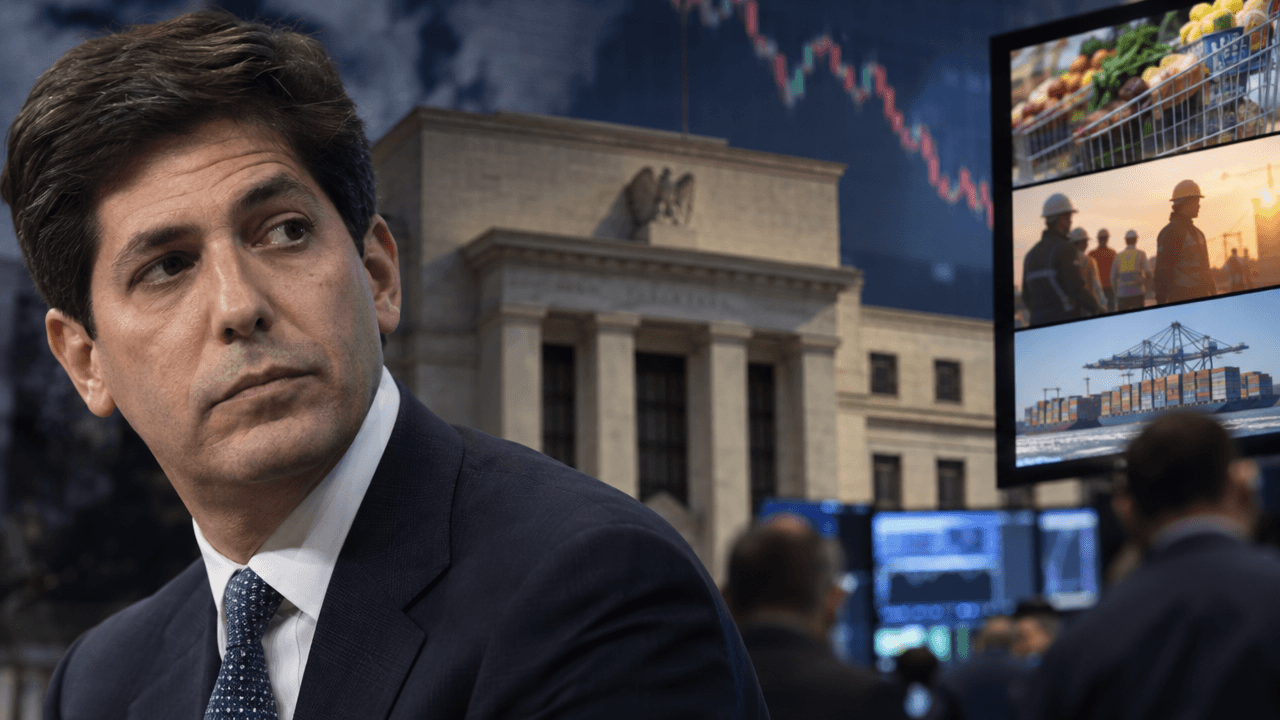
The Federal Reserve outlook has become unusually uncertain, not because policymakers lack economic data, but because the data are sending mixed signals. Inflation remains too high, employment growth has slowed, and economic output continues to show resilience. Against that backdrop, Fed Chair Kevin Warsh has declined to preview the central bank’s next move, leaving traders to reassess the likelihood and timing of future rate increases.
Warsh said policymakers would evaluate output, employment, and inflation at the Federal Open Market Committee’s October and December meetings. His message offered no firm guidance on whether rates will rise again this year. Markets interpreted the cautious tone as a sign that the Fed may be willing to wait for additional evidence before tightening policy further. [2][4]
THE MARKET’S SHIFTING RATE EXPECTATIONS
Interest-rate futures placed the probability of an October rate increase at about 15%, down from approximately 27% before Warsh spoke. That change is significant because it shows how quickly markets can reprice policy expectations when central bank communication fails to provide a clear directional signal. [1][5]
The next FOMC meeting is scheduled for October 27–28. Although traders now expect the Fed to hold rates steady, a pause should not be confused with the end of the tightening cycle. The market may simply be assigning greater value to waiting for more economic information before taking another step.
That distinction matters for traders. A rate hold can be interpreted as temporary patience rather than a dovish policy reversal. If inflation remains elevated or accelerates, the possibility of a December hike could quickly become more prominent. Conversely, a deterioration in employment or output could make additional tightening less likely.
Inflation Remains The Central Tension
The Fed’s challenge is that inflation is still above its stated objective. Consumer prices rose 3.7% over the year through September, while producer prices increased 6.3%. Market estimates suggested that core personal consumption expenditures inflation, the Fed’s preferred measure, could reach approximately 3.1% year over year. [5]
These readings complicate the case for leaving rates unchanged for an extended period. Higher producer prices can eventually pass through to consumer prices, particularly when businesses have enough demand to preserve their margins. If inflation expectations become entrenched, the Fed may need to maintain restrictive policy for longer or raise rates again.
At the same time, monetary policy works with a delay. Rate increases affect borrowing costs, business investment, housing activity, and consumer spending over time. Moving too aggressively could weaken economic growth and employment before the full impact of previous hikes becomes visible.
This is why the Fed is focused on the balance among inflation, jobs, and output rather than reacting to a single monthly report.
Employment And Output Could Decide The Next Move
The labor market appears to be cooling, but not collapsing. Hiring has slowed, while unemployment remains relatively low and within a narrow range. That combination gives the Fed room to wait, but it does not eliminate the risk that inflation could remain persistent. [9]
Economic output has also broadly developed in line with the Fed’s expectations since the September meeting. The central bank raised its benchmark interest rate by 25 basis points in September, bringing the target range to approximately 3.75%–4.00%. [1]
For policymakers, the question is whether the economy is strong enough to withstand another rate increase without creating unnecessary damage. If demand remains robust, inflation may not cool quickly enough. If growth loses momentum, another hike could increase recession risks.
Traders should therefore monitor changes in payroll growth, unemployment claims, wage trends, retail sales, inflation expectations, and business activity. The direction of these indicators may matter more than any individual headline.
What The Uncertainty Means For Traders
Uncertainty tends to increase volatility across multiple asset classes. Interest-rate-sensitive sectors such as technology, housing, financials, and consumer discretionary stocks may react sharply to changes in rate expectations. Bond yields can move quickly when traders adjust their assumptions about the timing of the next hike.
The U.S. dollar may also respond to shifts in the expected interest-rate differential between the United States and other major economies. A more hawkish Fed outlook could support the dollar, while expectations of prolonged patience could weigh on it. Gold and other non-yielding assets may benefit when markets believe the Fed is less likely to raise rates, although inflation and currency movements also influence precious metals.
For SimFi traders, the priority should be risk management rather than predicting the exact decision. Reduce unnecessary exposure ahead of major data releases, define stop-loss levels before entering a trade, and avoid increasing position size simply because a market move appears obvious. A trade thesis should include both the expected outcome and the conditions that would invalidate it.
It is also useful to separate event risk from trend analysis. A short-term market reaction to the October meeting may not determine the broader direction of stocks, bonds, currencies, or commodities. Traders should consider whether a move reflects a lasting change in economic expectations or merely a temporary repricing.
Key Takeaways
The Fed’s outlook is uncertain because inflation remains elevated while employment growth is slowing. Warsh’s refusal to prejudge the October and December meetings has reduced expectations for an immediate October hike, but it has not removed the possibility of further tightening later in the year.
Markets are now assigning only about a 15% probability to an October rate increase, down from above 25%. [1][10] That pricing can change quickly if upcoming data show renewed inflation pressure or stronger-than-expected growth.
The most disciplined approach is to remain flexible. Track the data, respect volatility, and build scenarios for a hold, a December hike, and a more dovish shift. In an environment where the Fed is deliberately withholding forward guidance, preparation is more valuable than certainty.