
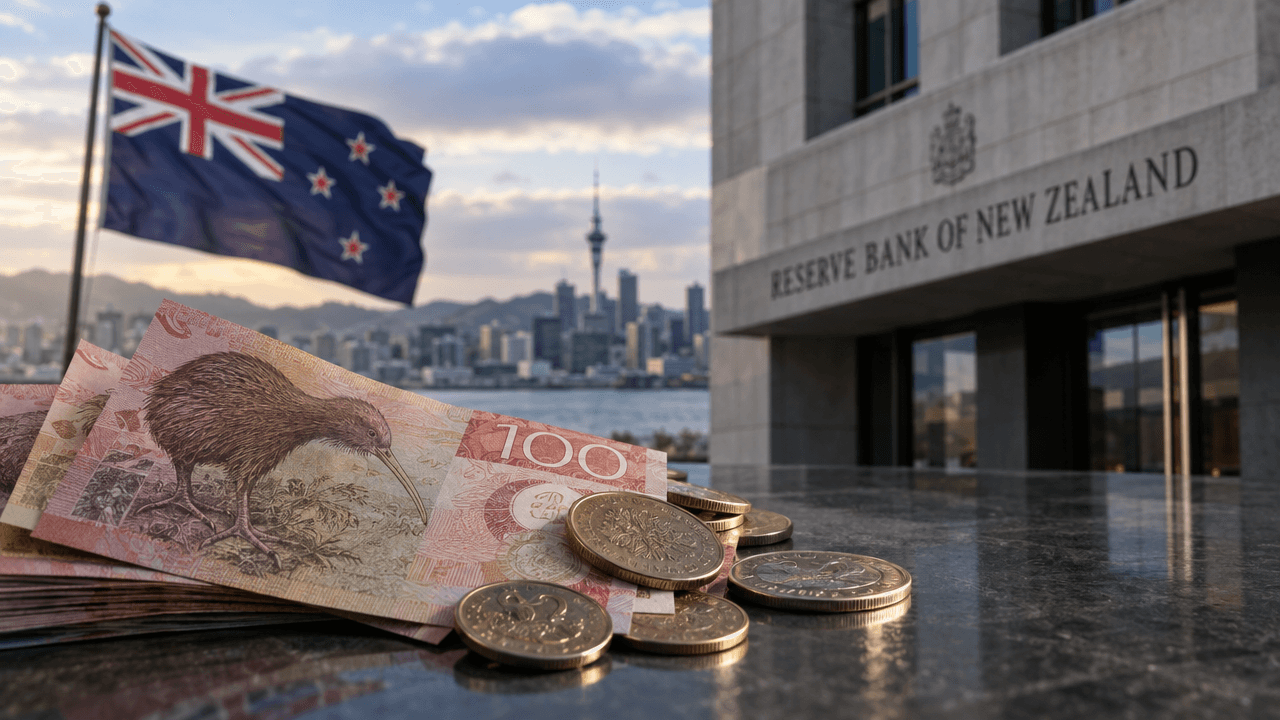
The New Zealand dollar weakened sharply on Wednesday after the Reserve Bank of New Zealand delivered a surprise pause instead of the interest-rate increase financial markets had largely expected. The RBNZ held its Official Cash Rate at 2.75%, with policymakers voting 4–3 to keep rates unchanged. Three members supported a 25-basis-point increase to 3%. [1]
The decision pushed the New Zealand dollar lower as traders rapidly adjusted their expectations for the country’s monetary-policy path. The kiwi fell as much as 1.7% against the U.S. dollar to approximately US$0.5583, while it also declined against the Japanese yen, euro, pound and Australian dollar. [11] The reaction illustrates how strongly currency markets can respond when a central bank fails to deliver an outcome that has already been priced in.
Why The Rbnz Decision Surprised Markets
Before the announcement, a rate increase to 3% was widely anticipated. A Reuters poll showed that 22 of 27 economists expected the RBNZ to raise rates by 25 basis points. [11] Markets had been focused on inflation risks, higher energy costs and the possibility that a weaker currency could increase the price of imported goods.
Instead, the Monetary Policy Committee chose to wait. The decision was not unanimous, however, and the narrow vote revealed a significant divide within the central bank. Governor Anna Breman and three external committee members voted to hold the OCR, while three senior RBNZ officials supported an immediate hike. [3]
That split matters because it suggests the pause does not necessarily represent a fundamental shift toward easier policy. Rather, policymakers appear to be balancing persistent inflation risks against weaker economic activity, subdued wage growth and concerns about raising borrowing costs too quickly.
What The Rate Hold Means For The Kiwi
Currency values are heavily influenced by interest-rate expectations. When traders believe a central bank will raise rates, the country’s assets can become more attractive because investors may receive higher yields. This can increase demand for the currency.
The reverse occurred after the RBNZ announcement. Investors who had positioned for a hike were forced to reduce those trades, creating immediate selling pressure in the New Zealand dollar. The move was amplified by strength in the U.S. dollar and Japanese yen, which benefited from broader demand for major currencies. [5]
The kiwi’s decline also creates a complicated policy challenge for the RBNZ. A weaker New Zealand dollar can make imported fuel, machinery, food and other goods more expensive. That may add to inflation at a time when policymakers are trying to return inflation sustainably to the 2% midpoint of the target range. [1]
However, a lower currency can also support exporters by making New Zealand goods and services more competitive overseas. The economic impact therefore depends on how long the depreciation lasts, how much it raises consumer prices and whether global demand remains strong.
A Pause, Not Necessarily The End Of Hikes
The RBNZ’s communication indicated that further increases remain possible. Governor Breman said policymakers expect additional OCR increases in coming meetings and suggested they could be higher than indicated at the September meeting. [11]
That guidance helped the New Zealand dollar recover part of its initial decline, but it did not fully reverse the shock. Traders generally interpreted the decision as a delay to tightening rather than a cancellation of the expected rate cycle. Market participants are now likely to focus heavily on the RBNZ’s December meeting and incoming inflation, employment and economic-growth data. [3]
For traders, the key lesson is that a split vote can be just as important as the headline decision. A rate hold by a unanimous committee would have conveyed a clearer signal. A 4–3 vote, combined with guidance pointing toward future hikes, leaves the policy outlook uncertain and increases the importance of every major economic release.
What Traders Should Watch Next
The first indicator to monitor is inflation. If price pressures remain elevated, the RBNZ may face increasing pressure to follow through with a rate increase. The central bank has also warned that a weaker currency could intensify imported inflation, making the exchange rate itself part of the policy debate. [12]
Economic activity will be equally important. Higher interest rates can help restrain demand, but they also raise mortgage payments and business-financing costs. If growth and employment weaken materially, policymakers may prefer a slower tightening path even if inflation remains above target.
New Zealand dollar traders should also track the U.S. Federal Reserve, developments in the Japanese yen and broader risk sentiment. The kiwi is often sensitive to global growth expectations and investor appetite for higher-yielding, more cyclical currencies. A stronger U.S. dollar can put additional pressure on NZD/USD even when New Zealand-specific conditions are unchanged.
Risk management is particularly important after a surprise central-bank decision. Traders should avoid assuming that the first currency move will continue indefinitely. Position sizing, stop-loss discipline and attention to follow-up comments can be more valuable than reacting emotionally to the initial price spike.
The Bigger Market Lesson
The RBNZ’s surprise hold demonstrates the difference between an expected policy outcome and the actual policy decision. Even when most economists anticipate a hike, a central bank can choose caution because of weaker growth, softer wages or uncertainty about how previous increases are affecting the economy.
For the New Zealand dollar, the immediate outlook is under pressure, but the longer-term direction will depend on whether future data justify the RBNZ’s warning that more hikes are likely. The narrow vote keeps the possibility of a December increase alive, while the currency’s weakness may add another reason for policymakers to remain vigilant.
For investors and traders, the most useful takeaway is to study both the decision and the debate behind it. The 2.75% rate itself was important, but the divided vote, inflation concerns and forward guidance may ultimately determine where the kiwi trades next.