
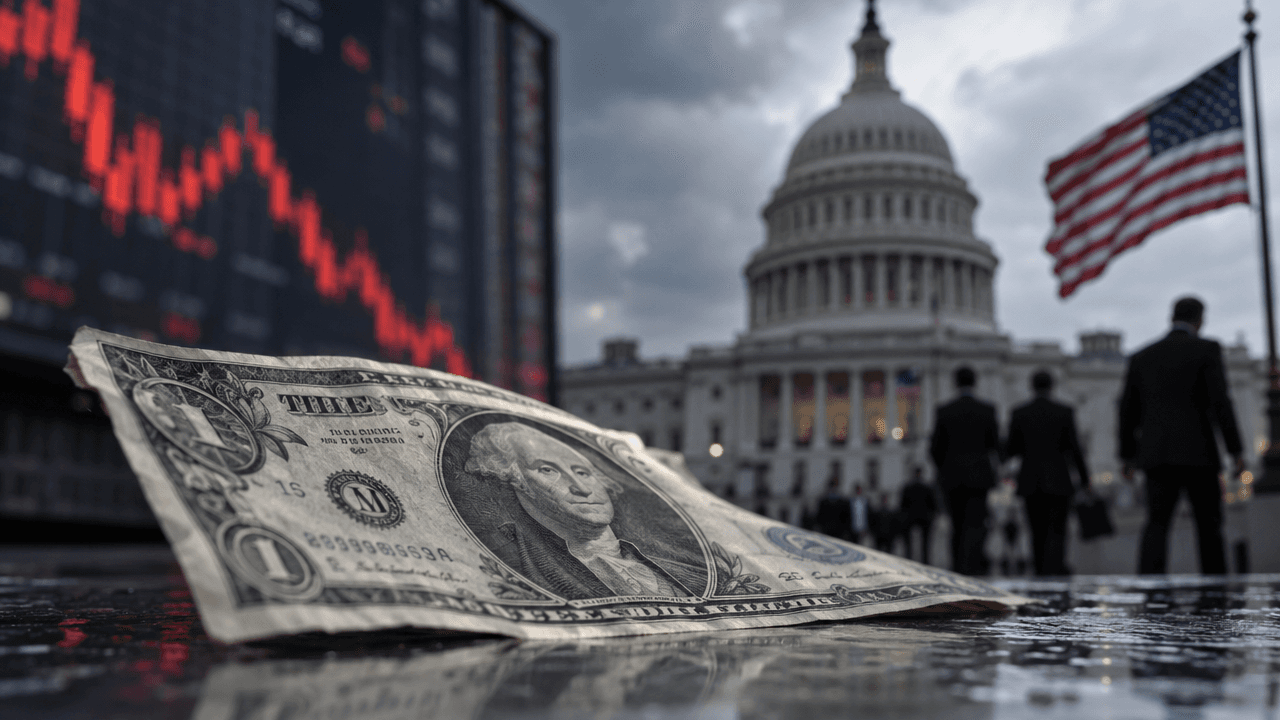
The U.S. dollar fell broadly on Wednesday after Democrats secured control of both chambers of Congress in the midterm elections, prompting investors to reassess the outlook for American growth, technology regulation, fiscal policy and interest rates. The dollar index, which tracks the greenback against six major currencies, dropped to approximately 101.25–101.27, its lowest level in about a month. [2][4]
The move was not simply a reaction to the election result itself. Currency markets were pricing in the possible economic consequences of a divided political landscape, including greater regulatory scrutiny of artificial intelligence, limits on technology investment and potential gridlock on major fiscal initiatives. As expectations for U.S. growth weakened, traders reduced exposure to the dollar and moved into the euro, pound, yen and Swiss franc.
Why The Dollar Sold Off
Currencies respond to changing expectations rather than political headlines alone. Investors were already focused on whether the United States could maintain the rapid growth associated with technology investment, data-center construction and artificial intelligence infrastructure. A Democratic-controlled Congress raised concerns that new rules could slow those industries or increase the cost of expansion.
That matters because AI-related investment has become an important source of optimism for the U.S. economy. If lawmakers impose tighter oversight on AI companies, data centers or advanced computing infrastructure, businesses may delay projects while they assess the regulatory environment. The result could be slower capital spending, softer productivity expectations and reduced demand for U.S. assets.
Market analysts also linked the dollar’s decline to falling Treasury yields. When bond yields move lower, the return available from dollar-denominated assets becomes less attractive relative to assets elsewhere. Investors therefore reassessed both the growth outlook and the possibility that future interest-rate expectations could become less supportive of the greenback. [7][10]
Currency Markets Move Together
The selloff was broad rather than isolated to one dollar pair. The euro rose roughly 0.5% to around $1.125, while sterling advanced toward $1.347. The Japanese yen strengthened by approximately 0.7% to around 157.63 per dollar, and the Swiss franc also gained. [3][6]
Each currency benefited for a slightly different reason. The euro and pound were supported by broad dollar weakness, while the yen and Swiss franc received additional support from their traditional safe-haven status. When investors reduce exposure to U.S. political or economic uncertainty, they often diversify into other major currencies rather than abandoning developed-market assets altogether.
The Swiss franc was among the strongest performers, with the dollar falling approximately 0.6% against it in one round of trading. That performance reflected demand for a currency widely viewed as a defensive holding during periods of uncertainty. [6]
However, a stronger euro or yen does not automatically mean that the economic outlook for Europe or Japan has suddenly improved. In this case, much of the movement was driven by a weaker U.S. dollar rather than a dramatic change in the fundamentals of every competing economy.
Policy Gridlock And Growth Expectations
A change in congressional control can affect markets even when it does not immediately change existing laws. Investors attempt to estimate how easily the administration will be able to advance spending plans, tax measures, trade policies and regulatory priorities.
With Democrats controlling both chambers, markets began to anticipate greater constraints on the administration’s economic agenda. Some investors interpreted that outcome as reducing the likelihood of aggressive government spending, while others focused on the prospect of tougher technology regulation. Both interpretations could weigh on the dollar if they reduce expectations for U.S. growth.
Policy gridlock can have mixed consequences. In some situations, it reassures markets by limiting the possibility of large and unpredictable policy changes. In others, it creates uncertainty because businesses cannot determine which proposals will advance. The initial reaction suggests that traders were more concerned about slower growth and regulatory pressure than reassured by political checks and balances.
For SimFi traders, this distinction is important. Political headlines can trigger immediate price movement, but the longer-term trend depends on whether economic data confirms or challenges the market’s first interpretation.
What Traders Should Watch Next
The election result is only the first stage of the market reaction. Traders should monitor Treasury yields, U.S. technology stocks, Federal Reserve expectations and economic indicators tied to business investment. A continued decline in yields alongside weakness in technology shares could reinforce pressure on the dollar.
Currency traders should also track price action around key technical levels rather than entering solely because of a headline. The dollar index’s move toward the 101 area may attract both momentum sellers and bargain hunters. If the index stabilizes while yields recover, the initial selloff could fade. If the index breaks lower and economic data deteriorates, the move may develop into a broader trend.
Risk management is especially important during election-driven volatility. Wider spreads, rapid reversals and headline-driven gaps can make normal position sizing too aggressive. Traders can consider reducing leverage, defining invalidation levels before entering and avoiding simultaneous exposure to several highly correlated dollar pairs.
The euro, pound, yen and Swiss franc may all rise against the dollar, but they will not necessarily move at the same speed. Comparing relative strength can help traders identify which currency pairs are responding most decisively to the shift in expectations.
The Broader Market Lesson
The dollar’s reaction to the midterm results demonstrates how foreign-exchange markets connect politics, interest rates and economic growth. A political outcome can affect currency values without changing monetary policy immediately because traders are constantly pricing future investment, regulation and demand for government bonds.
For now, the market’s message is clear: investors are questioning whether the United States can sustain its recent growth momentum if technology investment faces greater political and regulatory resistance. That view may prove temporary, but it has already produced a broad dollar selloff and lifted major currencies across the board.
The next phase will depend on evidence. If regulation remains moderate and U.S. economic data stays strong, the dollar could recover. If policy uncertainty weighs on investment and Treasury yields continue falling, the greenback may remain under pressure. SimFi traders should treat the election as a catalyst, not a complete trading thesis, and let price action, economic data and risk controls guide the next decision.