
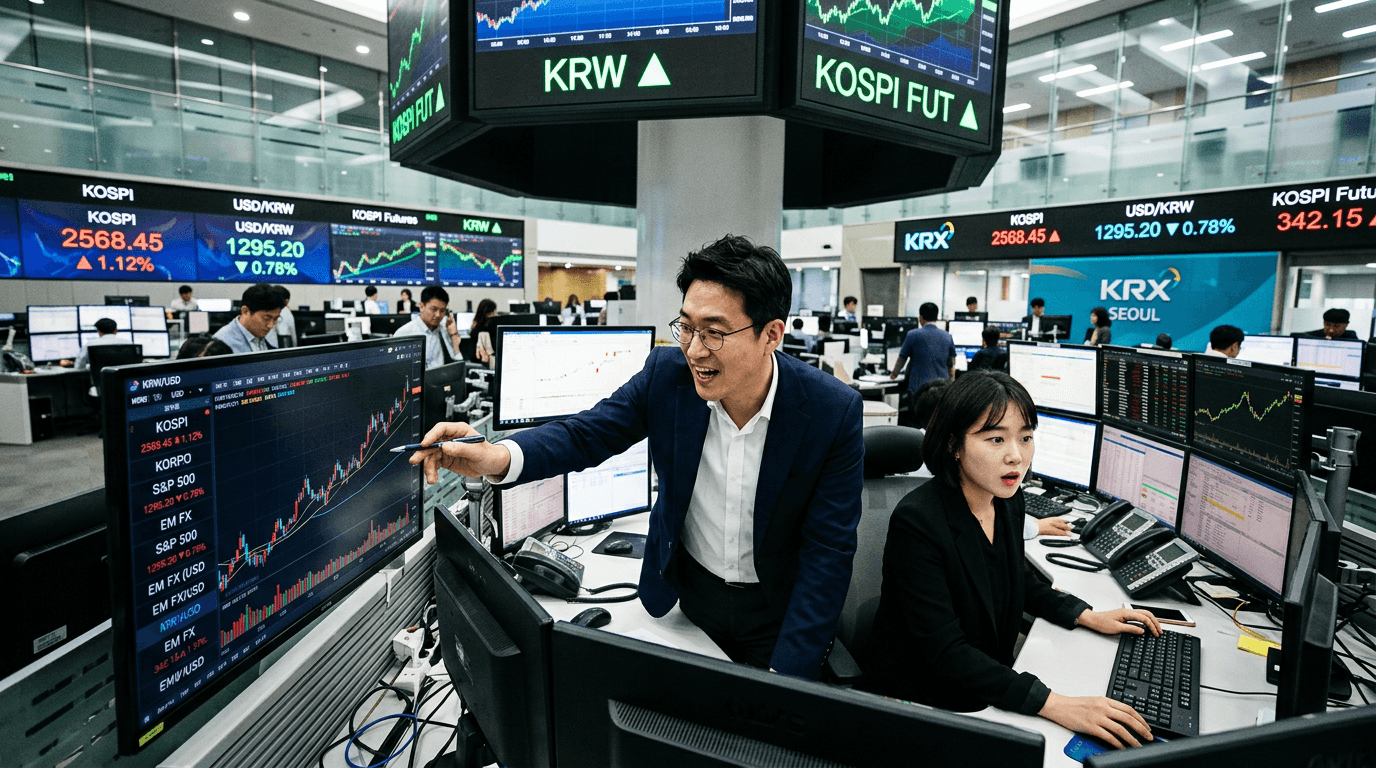
The South Korean won has strengthened on fresh signals that a long-negotiated trade deal with the United States is moving closer to full implementation, boosting expectations for Korea’s export sector and easing a key source of uncertainty that has weighed on regional markets.[8][11] The move is reverberating through Asia-focused equity and currency futures, as traders recalibrate positioning in EM-Asia currency baskets toward currencies seen as direct beneficiaries of reduced trade frictions.[4]
Markets React To Trade Deal Signals
In recent sessions, the won has appreciated against the US dollar, extending a rebound from levels that had marked a more cautious phase of trade negotiations.[8][3] At one point, the currency strengthened to around 1,425 per dollar amid a stronger outlook for Korean export industries following signals of a new trade deal with the US.[8] Earlier, the won had hovered near 1,430 per dollar as markets remained wary due to limited signs of progress in talks over a sizable investment-linked trade framework.[3]
The FX reaction is not driven solely by trade headlines. Periods of won strength have coincided with phases of dollar softness and shifts in global risk appetite, particularly as investors reassess US–China tensions and broader Asia trade dynamics.[11] However, domestic sentiment has clearly improved as both governments have indicated they are closer to resolving key disagreements around South Korea’s pledged investment in the US and associated tariff reductions on Korean goods.[11][7]
For traders, the key point is that currency markets are treating these signals as credible steps toward implementation of a deal that has already been agreed in principle, rather than as vague political promises.[6][15] That distinction matters: concrete progress tends to be priced more aggressively than mere rhetoric.
Why Trade Deal News Moves The Won
The trade framework underpinning the market reaction is significant in scale and structure. South Korea has committed to a substantial investment pledge—around $350 billion—to the United States, in exchange for Washington lowering tariffs on South Korean exports, including autos and auto parts, from 25% to 15%.[7][15][19] Autos are Korea’s largest export to the US, so a 10 percentage point tariff reduction materially improves margin profiles and volume potential for key manufacturers.[15][19]
Beyond autos, the deal envisages more favorable tariff treatment for sectors such as pharmaceuticals, timber and lumber products, and exemptions for certain aircraft components and generic drugs.[13][14] The combination of reduced trade barriers and a clearer, rules-based framework for Korean investment abroad reduces policy uncertainty for Korean corporates and investors.
Currency markets translate this into several channels:
- Improved export prospects: Lower tariffs increase expected future foreign-currency revenues for Korean firms, supporting demand for the won as profits are repatriated.[15][19]
- Reduced trade risk premium: A credible deal diminishes the probability of sudden tariff shocks or escalatory trade measures, which had previously pressured the won.[3][15]
- Signaling on FX policy: Parallel discussions between Seoul and Washington have acknowledged that excessive won volatility is undesirable, reinforcing perceptions of policy coordination and stability.[9][4]
Taken together, these factors support an appreciation bias for the won when markets receive new indications that the deal is on track. The latest signals include US comments about an “upfront payment” component of Korea’s investment pledge and statements that both sides aim to finalize outstanding details at a forthcoming summit.[11][7] While not the first time the agreement has been touted, incremental clarity on timing and implementation is what the FX market is reacting to now.
Implications For Asia-focused Equities And Currency Futures
Because South Korea is a core constituent in many Asia and EM-Asia equity indices, any meaningful shift in its trade outlook quickly spills over into regional equity and derivatives markets.[10] A stronger won, driven by improved trade prospects rather than defensive capital inflows, is typically interpreted as a constructive signal for Korean export-oriented stocks—especially autos, shipbuilding, technology hardware, and pharmaceuticals that stand to benefit from tariff reductions and clearer access to the US market.[13][15][19]
Asia-focused equity futures that carry significant Korea exposure can therefore see a bid as investors anticipate better earnings visibility and reduced headline risk for Korean corporates. At the same time, currency futures referencing the won and EM-Asia baskets are repricing the probability that Korea shifts from being a trade-uncertainty laggard to a relative beneficiary of easing frictions.[4]
However, the impact is nuanced:
- For exporters, a stronger currency can compress margins if not offset by tariff cuts and volume growth. The current move is being interpreted as net positive because tariff relief and reduced uncertainty are expected to more than compensate.[15][19]
- For investors, the key is that the won’s appreciation is being driven by fundamentals (trade and investment clarity) rather than short-term speculative flows alone.[8][11]
On simulated and live trading platforms alike, this creates opportunities in relative-value strategies—such as going long Korean exporters versus regional peers that do not benefit from similar trade tailwinds.
Em-asia Currency Baskets And Positioning Rotations
Many institutional investors and macro traders express regional views through EM-Asia currency baskets, where the won is weighted alongside currencies such as the Taiwanese dollar, Thai baht, Indonesian rupiah, and others. When a single component experiences a fundamental re-rating due to a major trade development, basket positioning tends to adjust.
Signals that the US–Korea deal is progressing have prompted traders to rotate toward currencies perceived as direct beneficiaries of trade de-escalation, with the won near the top of that list.[4][8] This can involve:
- Increasing long exposure to the won within baskets.
- Reducing hedges against Korea-specific trade risk that had been built up when tariff outcomes were uncertain.[3][15]
- Rebalancing away from currencies whose trade outlook has not improved or remains clouded by separate tensions.
For sophisticated traders, the move in the won is not only a directional FX story but also a relative-performance narrative within Asia. The question becomes: which currencies and equity markets are underpricing potential spillovers from a more stable US–Korea trade relationship, and which are already fully valued?
Practical Takeaways For Traders
For individuals and institutions analyzing this development, several practical points stand out:
- Separate headline risk from implementation risk. The US–Korea deal has been “announced” and “reaffirmed” multiple times, but markets react most strongly when there are concrete signals on ratification, investment timing, and tariff schedules.[6][11][15]
- Watch the levels. Moves from 1,440 toward the 1,420–1,430 range against the dollar have been associated with periods of optimism about the deal and broader trade momentum.[8][3][11] Those levels can serve as reference points for assessing whether the market is pricing incremental progress or simply reacting to global dollar trends.
- Link FX to sector themes. Traders should connect won dynamics to sector exposures—autos, shipbuilding, and pharmaceuticals in particular—rather than viewing the currency in isolation.[13][15][19]
- Manage volatility expectations. Officials on both sides have signaled that excessive won volatility is undesirable, which may temper extreme swings but does not eliminate the potential for sharp re-pricing around key negotiation milestones.[9][4]
On simulated finance platforms, this environment is ideal for practicing cross-asset thinking: combining views on trade policy, FX, and sector fundamentals into coherent strategies without bearing real-world capital risk.
Looking Ahead
The latest strengthening of the South Korean won underscores how sensitive modern markets remain to trade policy developments, especially when they involve large, rule-changing agreements between major economies.[8][11][15] If the US–Korea trade and investment framework is fully implemented as signaled, it could anchor a more stable environment for Korean exporters and reduce one of the key sources of uncertainty that has weighed on EM-Asia currencies.[7][15][19]
For now, traders will continue to scrutinize official statements, parliamentary ratification processes, and any adjustments to the investment and tariff timeline. Each new detail has the potential to either reinforce the won’s appreciation narrative or inject fresh volatility. Staying focused on fundamentals—exports, tariffs, and investment flows—rather than reacting to every headline in isolation will be critical to navigating the next phase of this story across FX, equities, and futures markets.