
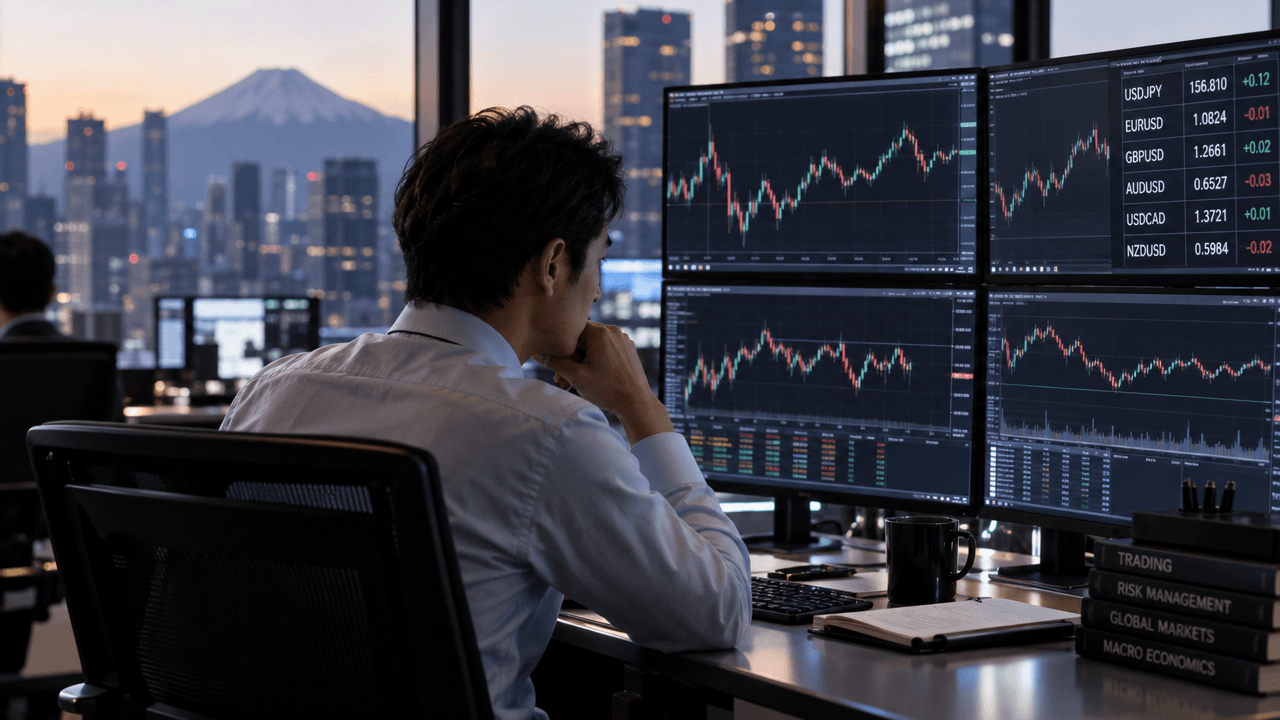
FX markets opened the week in a muted mood, with major pairs holding tight ranges and volatility subdued as traders sat on their hands ahead of key policy and data events.[3][8][12] Indicative Monday pricing showed EUR/USD near 1.1487, USD/JPY around 156.8, and GBP/USD close to 1.3384, levels broadly unchanged from late Friday, underscoring just how reluctant participants are to take fresh positions.[4][12][14] In this kind of environment, understanding how to trade range-bound markets becomes just as important as knowing how to ride strong trends.[5][13]
Current Fx Snapshot
The standout currency story is the Japanese yen hovering near 156.8 per dollar, a level that has been repeatedly tested in recent sessions without a decisive break higher or lower.[2][4][14] The day’s range has been relatively narrow, with USD/JPY oscillating roughly between 156.6 and 157.1, highlighting the lack of conviction on either side of the market.[4][14] This stability is partly due to the absence of Japanese market participation during certain sessions, which reduces liquidity and tends to compress intraday moves.[3][10]
The U.S. dollar itself is broadly steady, with the Dollar Index trading near the 100 mark and remaining within the range that has prevailed for months.[11][15] Recent commentary from institutional strategists suggests the dollar has returned to a neutral outlook, with offsetting forces—slower global growth, shifting interest-rate expectations, and geopolitical risk—keeping it confined within familiar boundaries.[1][15] Across G10 FX, that translates into modest deviations rather than big directional breaks, reinforcing the range-bound feel in pairs like EUR/USD and GBP/USD.[1][12]
WHY ARE FX MARKETS RANGEBOUND?
Range-bound conditions often emerge when markets lack a clear macro catalyst, and that is precisely the backdrop facing traders right now.[3][12] With major central bank meetings and important U.S. inflation data on the horizon, participants are hesitant to commit to new themes until they see how policymakers respond to recent economic developments.[3][7][8] The result is a wait-and-see attitude, where short-term flows revolve around repositioning and hedging rather than strong directional bets.[3][9]
In addition, recent commentary points to “offsetting fundamental forces” across currencies: pockets of stronger growth are balanced by concerns about energy prices, tariffs, and global demand, while changing rate expectations are largely priced in.[1][15] When bullish and bearish narratives cancel each other out, prices tend to gravitate toward equilibrium levels and bounce between support and resistance rather than trend decisively.[5][13] Empirically, FX markets spend much of their time in this sideways regime, making mean-reversion tactics as important as trend-following ones for active traders.[5][13]
What Range-bound Really Means For Traders
Technically, a range-bound market is one where prices oscillate between a horizontal support floor and a resistance ceiling without making higher highs or lower lows over a sustained period.[6][13] Traders can mark these boundaries by identifying the recent swing lows where price repeatedly holds and the swing highs where rallies consistently stall.[6][13] Once those levels are drawn, price action often resembles a corridor or “channel” with multiple bounces off each side before any eventual breakout.[6][13]
For traders, this regime changes the playbook. Trend-following strategies that rely on sustained momentum can underperform, as entries are frequently whipsawed when price reverses near the edges of the range.[5][13] In contrast, mean-reversion approaches—buying near support and selling near resistance—tend to perform better, provided risk is managed carefully with defined stops beyond the range boundaries.[5][6] This shift in tactics is particularly relevant when FX volatility compresses, as it has in the current environment, and price swings are modest rather than explosive.[3][12]
How To Approach Range-bound Fx In Practice
In a SimFi environment like E8 Markets, range-bound FX conditions offer a controlled setting for traders to refine their technical discipline and risk management before deploying strategies in live markets. Simulated trading allows participants to test ideas on pairs like USD/JPY or EUR/USD without capital at risk, making it easier to learn how prices behave within channels and how quickly conditions can change when a breakout finally occurs.
Several practical steps can help traders navigate the current, subdued backdrop:
1. Define the range explicitly Map recent highs and lows on pairs you trade most, such as USD/JPY around the 156–157 zone, and EUR/USD within its current band near 1.15.[4][11][12] Use these levels as reference points for potential entries and exits, rather than chasing moves in the middle of the range.[6][13]
2. Use oscillators to gauge extremes Indicators like RSI or stochastic oscillators can help identify overbought conditions near resistance and oversold conditions near support in sideways markets.[5][6] While no tool is perfect, combining price levels with momentum readings can improve the timing of mean-reversion trades.[5][13]
3. Keep position sizes modest With catalysts looming and liquidity occasionally thinner—especially during sessions lacking participation from key regions such as Japan—smaller positions and tighter stop-losses can reduce the impact of surprise breakouts.[3][10] A common guideline is to set stops at a fraction of the total range width, accepting small losses if price pushes beyond the established channel.[5][6]
4. Stay alert to upcoming events Even in quiet markets, ranges can break abruptly when data surprises or central banks shift guidance.[3][7][8] Monitoring the calendar for inflation releases, rate decisions, and major speeches ensures that traders are not caught off guard by volatility spikes that can invalidate a previously stable range.[3][9]
Conclusion: Turn Quiet Markets Into A Training Ground
The current FX landscape—yen hovering around 156.8, the dollar steady, and major pairs like EUR/USD and GBP/USD barely budging from late-Friday levels—points to a classic range-bound environment shaped by caution and a lack of immediate catalysts.[4][11][12] While such conditions may feel uninspiring for those hunting big trends, they are rich with opportunities for traders willing to focus on precision, discipline, and mean-reversion tactics.[5][13]
For learners and experienced market participants alike, this is an ideal moment to treat FX not just as a market to trade, but as a laboratory to refine process. By clearly defining ranges, aligning strategy with the prevailing regime, and using simulated environments to iterate safely, traders can turn quiet days into meaningful skill-building sessions. When the next major central bank decision or data surprise finally jolts currencies out of their corridors, those who have mastered range-bound trading will be better positioned to adapt—and potentially to capture the transition from sideways drift to fresh trend.[1][3][8]