
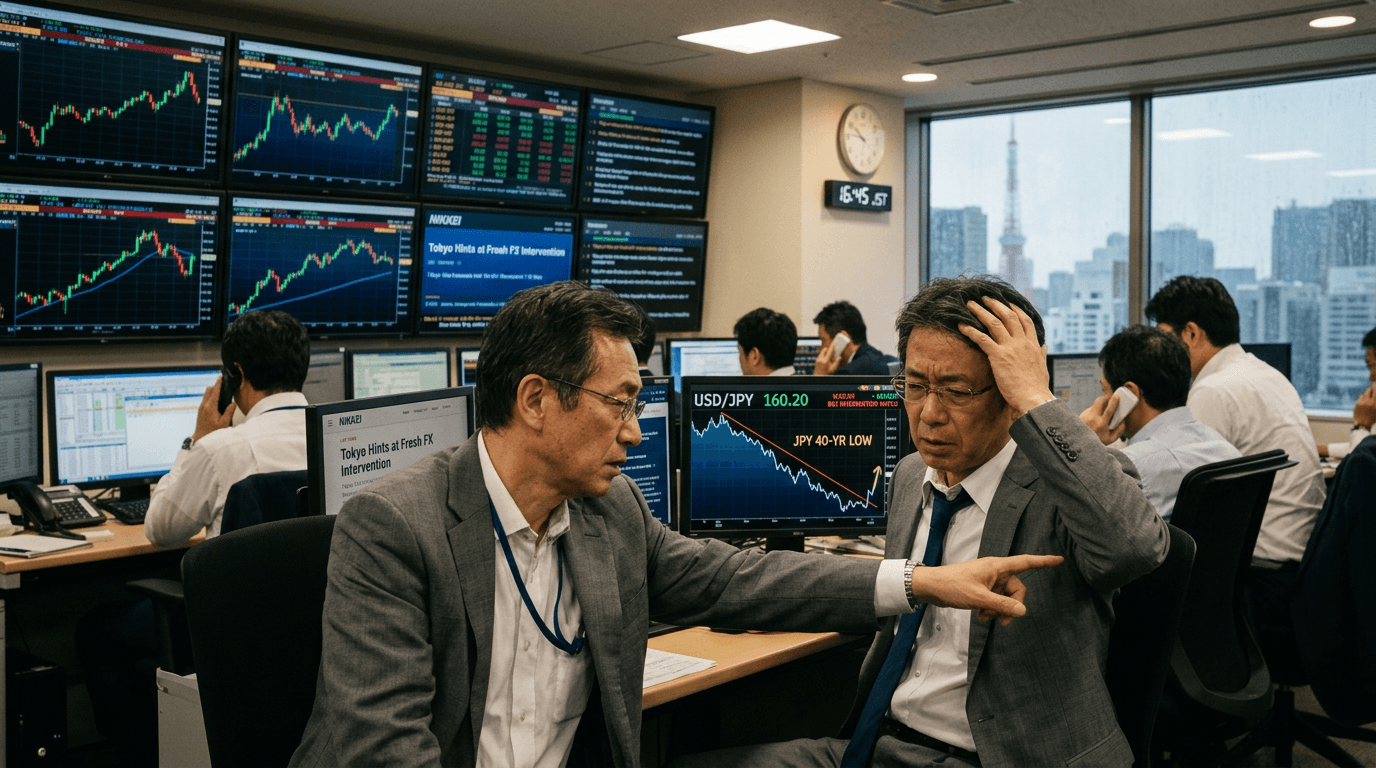
The Japanese yen’s latest slide toward a 40‑year low has jolted FX markets, reigniting speculation that Tokyo may soon step in to defend its currency once again.[1][7][10][11] With USD/JPY trading around the mid‑160s and approaching levels last seen in the mid‑1980s, traders are recalibrating their views on intervention risk, interest‑rate differentials, and how far this move can run before policymakers act.[1][7][10]
YEN’S SLIDE TO A 40‑YEAR LOW
The yen has been trading near ¥161.5 per dollar, hovering around its weakest levels since 1986 and flirting with the highs reached in July 2024 near ¥162.[1][7][10] Authorities have responded with increasingly forceful verbal warnings, signalling that they are prepared to take “decisive action” if market moves are judged to be speculative or disorderly.[2][11]
Japan has already intervened multiple times in the last two years, including a recent episode where authorities are estimated to have spent roughly $34–35 billion in a single day to support the yen.[8][11] Between late April and early May alone, Tokyo deployed around ¥11.7 trillion in FX operations, underscoring how seriously it views the current depreciation.[11]
The 160 level in USD/JPY has emerged as a psychological and political line in the sand, with several recent interventions or sharp intraday reversals occurring once the pair traded above that zone.[5][7] As spot once again pushes through this threshold, the probability of further action climbs in the minds of market participants.[5][7]
Why The Yen Is So Weak
Several forces are pulling in the same direction for USD/JPY, creating a powerful backdrop for yen weakness. The first is the interest‑rate gap between Japan and the United States: even after the Bank of Japan began inching away from negative rates, policy remains far looser than that of the Federal Reserve.[7][10] Higher U.S. yields make it more attractive to borrow in yen and invest in higher‑yielding dollar assets, reinforcing the classic carry trade dynamic.[7][10]
Japan’s domestic inflation story also complicates the picture. Although imported inflation has risen due to the weaker currency, policymakers remain cautious about tightening policy aggressively for fear of choking off a still‑fragile recovery and undermining wage momentum.[7][10][11] This reluctance to move quickly on rates, even as other central banks remain relatively restrictive, fuels the perception that the yen will stay under pressure.
On top of this, global risk appetite has been reasonably resilient, which tends to reduce demand for traditional safe‑haven currencies like the yen. When equity markets, including Japanese indices such as the Nikkei, are buoyant, investors are generally more comfortable funding risk positions with low‑yielding currencies.[1][7][10] That can leave the yen vulnerable when speculative positions become crowded.
What Fx Intervention Could Look Like
When Japanese authorities talk about “decisive action,” they are referring primarily to direct intervention: selling foreign currency reserves (usually U.S. dollars) to buy yen in the spot market.[2][11] Recent data suggest that Japan has already sold a significant amount of U.S. Treasuries to help finance these operations, highlighting their willingness to deploy reserves when necessary.[2][8][11]
Direct intervention can trigger sharp, sudden reversals in USD/JPY, especially when leveraged positions are heavily skewed to one side. In past episodes, the pair has moved several yen lower within minutes as stop‑losses cascade and momentum traders rush to cover shorts in the yen.[8][11][14] However, the durability of these moves ultimately depends on whether the intervention is aligned with, or fights against, underlying monetary policy and rate differentials.
If the Bank of Japan maintains a very gradual tightening path while the Fed keeps rates relatively high, each round of intervention may only buy time rather than engineer a lasting trend reversal. Markets may test authorities again once the immediate impact fades, particularly if USD/JPY trades back toward levels that policymakers have implicitly signalled as uncomfortable, like 160–165.[5][7][10]
By contrast, an intervention that coincides with a meaningful shift in BOJ guidance—such as clearer communication about future hikes or balance‑sheet adjustments—would likely have a more persistent impact on yen crosses. For now, traders are pricing mainly the risk of a liquidity‑driven jolt rather than a structural change in the yen’s trajectory.
Implications For Traders And Investors
For FX traders, a currency approaching a multi‑decade low with the specter of official intervention is both an opportunity and a risk. Volatility around key levels like 160 can create attractive intraday setups, but it also raises the probability of sudden, gap‑like moves that can overwhelm tight stop‑losses and overleveraged positions.[5][7][11]
Short yen carry trades—long USD/JPY or long higher‑yielding crosses like AUD/JPY or GBP/JPY—have been popular as rate differentials widened, but they are particularly exposed to intervention shocks. A coordinated or large‑scale move by Tokyo can turn a profitable carry position into a rapid drawdown if traders are not hedged or diversified.
Equity and index traders should also pay attention. A weaker yen often supports Japan’s export‑heavy stock market by boosting the competitiveness and overseas earnings of major corporates, which can be positive for indices such as the Nikkei.[1][7][10] However, if intervention triggers a sharp yen rebound, it can pressure exporters’ share prices and add cross‑asset volatility, particularly in Asia‑Pacific sessions.
Practical takeaways for traders include
1) Map key intervention zones: Monitor historical reaction areas around 160–165 in USD/JPY and be cautious about adding fresh leverage into these zones.[5][7]
2) Respect event risk: Treat verbal warnings from the Ministry of Finance and BOJ policy meetings as catalysts on par with major data releases, not background noise.[2][7][11]
3) Manage tail risk: Use position sizing, options hedges, or defined‑risk structures to guard against abrupt, multi‑yen reversals that can occur with little warning.
How Simulated Trading Can Help You Navigate Yen Volatility
Simulated Finance (SimFi) environments are particularly valuable in a regime where intervention risk and cross‑asset linkages dominate price action. Traders can stress‑test strategies against hypothetical scenarios such as a sudden 5–10 yen drop in USD/JPY following a surprise announcement from Tokyo, or a delayed intervention that allows the pair to overshoot well beyond prior highs.
By replaying historic intervention episodes and layering in current market conditions, simulated trading lets you see how different approaches—trend‑following, mean‑reversion, options‑based hedging—would have performed without putting real capital at risk. This is especially relevant in a market like the yen, where liquidity is deep but price moves around policy events can be brutally fast.
For developing traders, SimFi offers a way to practice risk management in a realistic environment: setting maximum loss limits, adjusting leverage as volatility rises, and building rules for when to step aside rather than chase extended moves. For experienced traders, it becomes a laboratory for refining execution tactics around key levels and testing how portfolios behave when correlations between FX, equity indices, and rates shift suddenly.
Conclusion: Prepare For The Next Move In The Yen
The yen’s slide toward a 40‑year low is more than a historical milestone; it is a live stress test of how markets respond when enormous rate differentials collide with the credible threat of government intervention.[1][7][10][11] As USD/JPY trades near politically sensitive levels and Tokyo reiterates its readiness to act, the probability of sharp, policy‑driven moves is rising, not falling.[2][5][11]
Whether the next chapter features another short‑lived squeeze or the start of a more durable yen recovery will depend on how intervention, BOJ policy, and global rate expectations intersect. Traders cannot control that outcome—but they can control preparation. Using structured processes, disciplined risk management, and realistic simulated environments to rehearse “what‑if” scenarios is the most robust way to turn today’s yen volatility from a threat into an opportunity.