
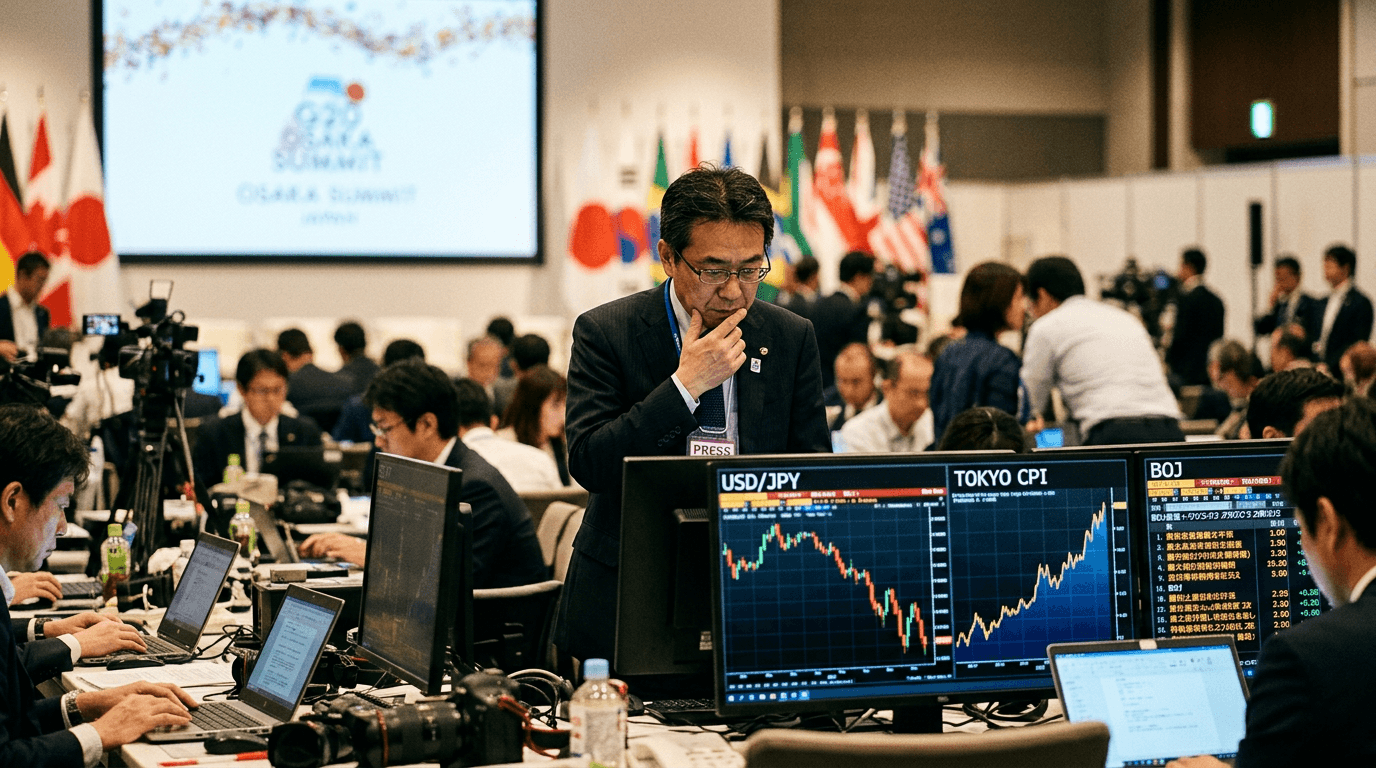
Japan’s finance minister heads into the next G20 meeting with more than just talking points in her briefcase: markets see this gathering as a potential inflection point for Japan’s stance on the weak yen just as Tokyo inflation edges closer to the Bank of Japan’s target.[1][8][9] For traders, the combination of FX fragility, recent joint intervention, and shifting price dynamics is creating a fertile environment for volatility—and opportunity.
Why This G20 Meeting Matters For The Yen
Finance Minister Satsuki Katayama will attend the upcoming G20 finance leaders’ meeting in Asheville, North Carolina, with investors laser‑focused on whether the yen’s weakness makes it onto the formal or informal agenda.[1] Markets are also watching closely for any side‑line meetings with U.S. Treasury Secretary Scott Bessent, given their recent coordination in supporting the yen.[1][8]
The yen recently touched a 40‑year low near 164 per dollar before a rare joint intervention propelled it stronger, underscoring just how stretched positioning had become.[1][5][7][13] Even after the intervention-driven rebound to around 155.20, the currency has drifted back toward the 160 area, highlighting persistent downward pressure and investor skepticism that one round of action will be enough.[1][5][7] As of the latest trading session, the yen hovered around 155.4 per dollar, a level that leaves authorities uncomfortable and speculators alert for the next move.[1][5]
For macro‑oriented traders—real and simulated—the G20 matters because it provides the forum where Japan can either reinforce its commitment to defending the currency or signal a higher tolerance for a weak yen, both of which have direct implications for FX volatility, risk premia, and cross‑asset correlations.[1][14][15]
Recent Joint Intervention: A Warning Shot To Speculators
In early August, Japan’s Ministry of Finance confirmed it had conducted a coordinated yen‑buying operation with the U.S. Treasury, a rare step that sent a powerful signal to FX markets.[3][7][11][13] This joint action, reportedly involving nearly $59 billion in dollar sales to purchase yen, marked one of the largest interventions in years and aimed to counter what authorities described as excessive and disorderly currency moves.[3][10][13]
The intervention pushed the yen more than 1% stronger to around 155.20 per dollar, its firmest level since early May and a sharp recovery from the multi‑decade lows seen only days earlier.[5][7] It was also the first time in decades that Japan and the U.S. moved together to support the yen, underscoring how serious policymakers view the risk of a runaway depreciation spilling over into broader financial instability.[6][10][13]
Katayama has since emphasized that the joint statement with Bessent on intervention “still lives,” a phrase markets interpret as a standing threat that authorities are ready to act again if speculative pressure intensifies.[1][3][12] At the same time, officials have suggested that the bar for repeated intervention is higher, reflecting the cost, political sensitivities, and limited effectiveness of unilateral or even coordinated actions if underlying monetary policy remains highly divergent.[14][15]
For traders, the key takeaway is that yen shorts now face a conditional ceiling: authorities may tolerate gradual weakening, but abrupt or disorderly moves risk triggering further joint action that can rapidly squeeze leveraged positions.[3][5][10]
Tokyo Cpi Nears The Boj Target: A Policy Crossroads
While FX headlines dominate, domestic inflation dynamics are quietly reshaping the policy calculus at the Bank of Japan. Tokyo core CPI—often viewed as a leading indicator for nationwide inflation—has oscillated around but increasingly moved closer to the BOJ’s 2% target, narrowing the gap that once justified ultra‑easy policy.[9] Earlier this year, core inflation in Tokyo slowed and dipped below target, but the broader trend of higher prices compared with the pre‑pandemic era remains clear.[9]
The upcoming G20 meeting precedes the BOJ’s next policy gathering in mid‑September, where Governor Kazuo Ueda will again face the delicate balancing act of managing inflation expectations, yen stability, and financial conditions.[8][9] A weak yen amplifies imported inflation through higher prices for energy, food, and manufactured inputs, complicating the distinction between “good” demand‑driven inflation and “bad” cost‑push inflation.[9][14]
For policymakers, the danger is that a persistently weak yen, if left unchecked, undermines confidence in price stability and forces more abrupt tightening later, rather than a gradual normalization path.[9][14][15] For markets, this raises the odds that BOJ communication around the G20 and into the September meeting could become incrementally more hawkish, even if formal changes to policy or yield curve control remain measured.
What Traders Should Watch At The G20
Against this backdrop, traders should pay close attention to three aspects of the G20 narrative:
1) Language on currencies: Any explicit or implicit reference to “disorderly moves” in the yen, “excess volatility,” or “appropriate action” will be parsed for clues about the threshold for renewed intervention.[1][3][14]
2) U.S.–Japan coordination: Signals that the U.S. remains aligned with Japan on FX stability, especially after the recent joint operation, would reinforce the credibility of future interventions and may deter aggressive speculative shorts.[3][7][10][13]
3) Link to BOJ policy: Indications that FX instability is feeding into BOJ deliberations—through imported inflation or financial stability concerns—could foreshadow a shift in forward guidance or the pace of policy normalization.[8][9][14]
In a SimFi environment, this is a rich scenario set for designing practice strategies:
- Test hedging approaches for Japanese equity or bond portfolios against sharp, intervention‑driven yen rallies.
- Simulate macro trades that pair expectations for BOJ normalization with potential G20‑driven repricing in USD/JPY.
- Explore options structures that balance the risk of further yen weakening against sudden policy‑backed reversals.
Implications For Simulated Traders And Risk Management
For traders using simulated finance platforms, the current juncture is ideal for stress‑testing assumptions about central bank reaction functions. The recent yen intervention shows that policymakers can move swiftly and at scale when FX levels cross political or economic pain thresholds.[3][5][10] However, it also highlights that intervention alone rarely reverses a trend unless it is backed by coherent macro policy and credible communication.[14][15]
Key practical takeaways for SimFi participants include:
- Treat intervention risk as a structural factor: When volatility is low and trend following feels “safe,” remember that a single coordinated action can erase weeks of gains in one session.
- Anchor scenarios in data: Incorporate paths where Tokyo CPI either consolidates around the 2% target or overshoots, and map how each scenario might alter BOJ rhetoric, yields, and the yen.[8][9]
- Diversify strategies: Combine directional FX trades with relative‑value or options‑based strategies that can benefit from volatility spikes around events like G20 meetings or BOJ decisions.
By experimenting with these dynamics in a risk‑free simulated environment, traders can build intuition about how fast policy expectations can reprice and how crucial risk controls are when markets collide with politics.
Conclusion: A Delicate Triangle Of Fx, Inflation, And Policy
Japan heads to the G20 at a moment when the yen, inflation, and monetary policy are tightly intertwined, and small shifts in messaging could have outsized market consequences.[1][3][8][9] A currency that recently hit 40‑year lows, a central bank edging closer to its inflation target, and a finance ministry that has shown willingness to act jointly with the U.S. form a potent mix for volatility.[1][3][5][7][13]
For traders and investors, the core challenge is to distinguish noise from signal: not every remark at G20 will herald a lasting policy shift, but the combination of repeated references to FX stability, inflation near target, and upcoming BOJ meetings could mark the early stages of a more decisive normalization path.[8][9][14] For SimFi participants, this environment is an opportunity to refine playbooks, practice disciplined risk management, and prepare for a world where the BOJ’s ultra‑easy stance is no longer taken for granted.