
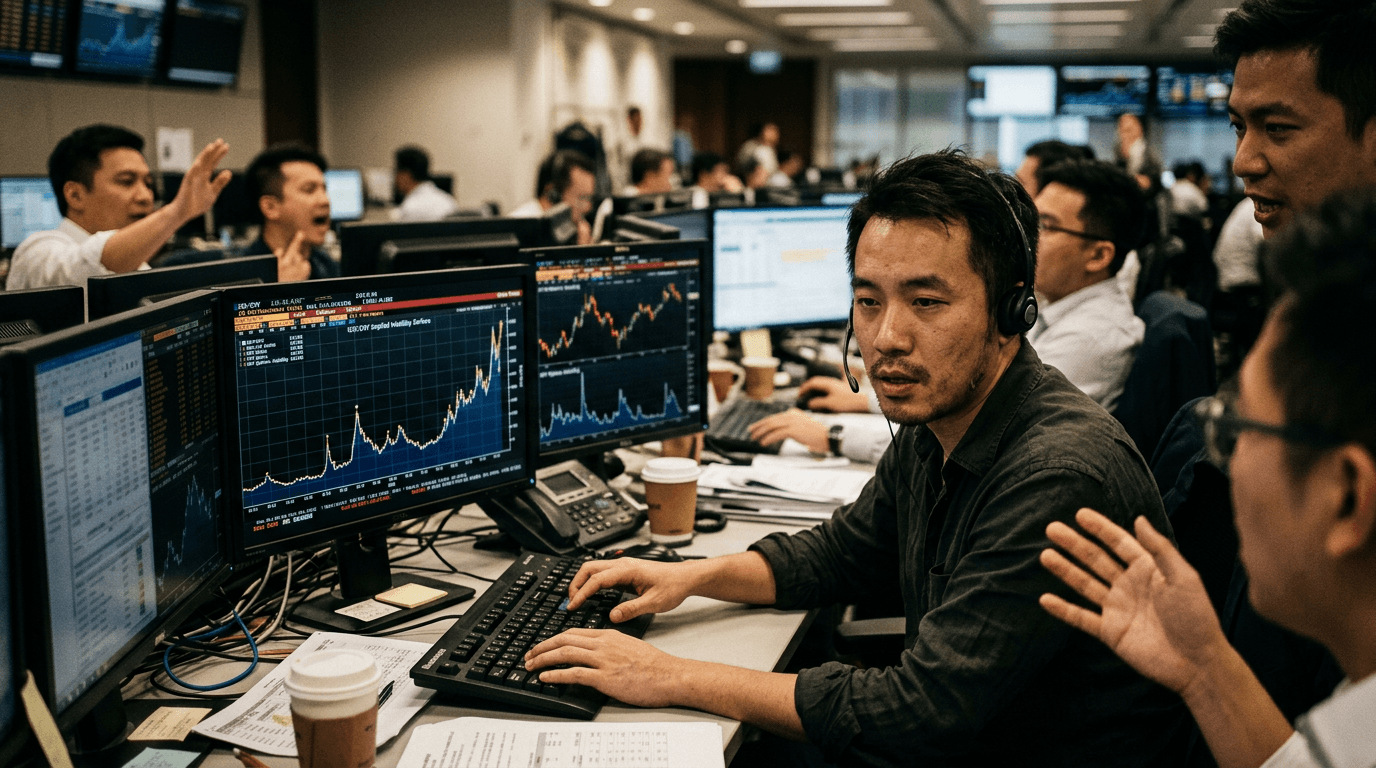
Options markets are sending a clear signal: the cost of hedging against yuan weakness has climbed to its highest level in about 15 years, and that is reshaping how traders think about Asian FX risk and global macro positioning[2]. For anyone exposed to China-linked assets – or trading them in a simulated environment – this is a moment to pay attention, not a footnote in the options market.
What The Options Market Is Telling Us
The key metric in focus is the yuan options “skew,” which compares the price of downside protection (options that pay off if the yuan falls) to upside protection (options that profit if the yuan strengthens)[2]. When this skew jumps to a 15‑year high, it means traders are paying a historically large premium for protection against depreciation, relative to bets on appreciation[2].
In practice, this premium reflects a surge in demand for puts on the yuan versus calls, especially in the offshore CNH market, which reacts more quickly to shifts in global sentiment because it is less tightly managed than the onshore CNY market[2][14]. Even if spot moves in the yuan look orderly day to day, option prices tell us investors are bracing for larger, more frequent swings and are willing to pay up to avoid being caught on the wrong side[2].
This is not just about headline volatility. Options embed expectations about the distribution of future outcomes. A 15‑year high in downside hedging costs suggests markets now assign a higher probability, or at least higher perceived risk, to scenarios where the yuan weakens meaningfully, whether due to growth concerns, policy surprises, or external shocks[2][9].
Why Yuan Risk Is Back In Focus
The yuan sits at the intersection of several macro fault lines: China’s growth trajectory, policy easing or tightening, capital flows, and the broader path of the US dollar. When uncertainty around any of these increases, the currency tends to become more volatile and more policy‑sensitive, drawing in hedgers across FX, rates, and credit markets[2][14].
Corporate behavior reinforces this story. Chinese companies have been ramping up their use of FX derivatives to hedge currency risk, pushing outstanding forward contracts to record levels as they try to protect margins from swings in the exchange rate[11][14]. Exporters, in particular, have become more active hedgers as volatility rises, often encouraged by regulators and banks to lock in future cash flows[14][18]. When more real‑economy players are buying protection, pricing in both forwards and options naturally moves higher.
It is important to recognize that the yuan has gone through phases of optimism as well as stress. At various points, hedging costs for some exposures have fallen to multi‑year lows as confidence built and traders positioned for appreciation[4][8]. The current spike in downside protection costs does not contradict those episodes; it simply highlights that sentiment has swung back toward caution. For traders, the lesson is that yuan risk is cyclical – and that the options market is often the earliest visible barometer of turning points.
How Elevated Hedging Costs Feed Into Global Markets
When the price of hedging yuan weakness spikes, the impact rarely stays confined to CNY/CNH pairs. It often ripples out across:
- Asian FX: Investors tend to reassess positions in other regional currencies that are sensitive to China’s growth, such as the Korean won or Singapore dollar, increasing implied volatility and changing correlation structures[2].
- Emerging‑market risk broadly: The yuan is a key reference point for EM FX and local‑currency bond investors. Rising hedging costs can trigger de‑risking in EM carry trades and China‑linked credit, especially if volatility is perceived as policy‑driven rather than purely data‑driven[2][17].
- Offshore yuan liquidity: As demand for options and forwards jumps, pricing in CNH funding and swaps can move sharply, raising the cost of leveraged positions and making short‑term funding more fragile[10][2]. This can squeeze speculative positions and force position adjustments that show up in spot markets.
The upshot is that an options‑driven stress test in the yuan can quickly become a broader stress test for global risk sentiment. Even traders without direct CNY exposure may find that their EM FX, rates, or equity strategies start behaving differently as volatility and correlations adjust to the new regime[2][12].
What This Means For Active Traders
For discretionary and systematic traders alike, a 15‑year high in yuan downside hedging costs is a practical signal, not just a statistic. Several implications stand out:
- Option pricing as a sentiment gauge: Watching risk reversals, implied volatility, and skew in CNH and CNY can provide early warning of shifts that may not yet be obvious in spot moves or news headlines[2][9]. Traders should treat these metrics as core inputs, not optional extras.
- Re‑pricing of carry and funding trades: Elevated hedging costs eat into the economics of carry trades and hedged yield strategies. Positions that looked attractive when volatility was cheap may no longer compensate adequately for the risk of abrupt moves in the yuan or correlated assets[12][17].
- Relative‑value opportunities: When downside protection is unusually expensive, traders can look for dislocations between currencies or tenors – for example, comparing yuan skew to other Asian FX skews, or short‑dated versus long‑dated options – to identify mispricings and spread trades, always with strict risk controls.
In this environment, strong risk management becomes non‑negotiable. Position sizing, scenario analysis, and clear rules for cutting risk around policy events or data releases are essential as options markets flag a wider range of potential outcomes.
How Simulated Traders Can Use This Episode As A Playbook
For traders using simulated finance platforms, this spike in yuan hedging costs is an ideal case study for developing robust FX and macro trading frameworks. Because the capital is virtual, you can focus entirely on process quality and decision‑making under uncertainty.
Practical ways to leverage the current backdrop include:
- Building strategies that explicitly incorporate option‑derived metrics like skew and implied volatility into trade selection and risk limits, rather than relying only on spot charts.
- Designing scenario tests around different yuan paths – gradual depreciation, sharp policy‑driven moves, or renewed strength – and mapping how positions in Asian FX, EM bonds, and equity indices behave under each scenario.
- Practicing dynamic hedging: simulating how and when you would add or reduce protection (via options, forwards, or proxy hedges) as pricing changes, and tracking the impact on portfolio drawdowns and risk‑adjusted returns.
By treating the 15‑year high in yuan downside hedging costs as a live laboratory rather than a passing headline, traders can refine the skills that matter most in real markets: reading cross‑asset signals, adapting to regime shifts, and aligning hedging decisions with their true risk tolerance and objectives.